
Bauxite and iron-ore mine restoration: species and methods

Bauxite and iron-ore mines are restored best with mixed native species on prepared ground. That means saved topsoil, terraced and drained dumps, ground cover first, then layered planting with three years of care. At one Odisha iron-ore mine, a study found Miyawaki-style planting raised survival of local species from 72% to 87%.
Bauxite and iron ore are mined mostly in opencast pits on hills and plateaus. Both leave hard, nutrient-poor ground that resists ordinary planting.
This guide covers the rules that shape restoration, the site conditions, and methods and species that work. For the legal detail, see mine reclamation under MCDR.
What do the rules require on the ground?
- Topsoil (MCDR Rule 36): strip it separately, use it to restore land or stabilise dumps, or store it for later.
- Dumps (Rule 37): backfill waste where possible; otherwise terrace dumps and stabilise them through vegetation or otherwise.
- Tailings (Rule 37): fines and tailings go into a prepared disposal area so they do not wash onto fields or into water.
- Closure (Rules 22 to 27): progressive and final closure plans, backed by a financial assurance that falls as you reclaim.
How do bauxite and iron-ore sites differ?
| Site | Typical challenge | Restoration focus |
|---|---|---|
| Bauxite plateau | Thin or no soil; ore can lie at the surface. An IBM inspection of one Kolhapur bauxite lease noted no overburden on the entire plateau. | Import and build soil in pits; hold water; plant hardy natives in layers |
| Iron-ore waste dump | Loose rock and fines on steep slopes; erosion in heavy rain | Terracing, drains, ground cover, then shrubs and trees on benches |
| Iron-ore fines and tailings area | Fine, compact material that seals the surface | Specialist soil work; treat as a separate project after survey |
| Backfilled pit | Mixed spoil, often compacted | Rip, add topsoil, then plant the final land use |
Which methods work?
1. Use a reference forest
Look at the nearest undisturbed forest on the same rock and rainfall. Its species and structure are the target.
A 2021 review of bauxite restoration in northern Chhattisgarh found that mixed native species support succession. It also named diversity as the key to restoration (Yadav et al.).
2. Save and reuse topsoil
Topsoil carries seeds, roots and soil life. Rule 36 already requires it to be stripped and stored; the restoration team should know where every heap is.
3. Stabilise before you plant
Terraces, garland drains and check dams come first. On high-rainfall hills, one heavy storm can strip an unprotected bench.
4. Cover the ground, then plant in layers
Grasses and legumes protect the surface in the first season. Shrubs and trees follow, so the canopy closes faster.
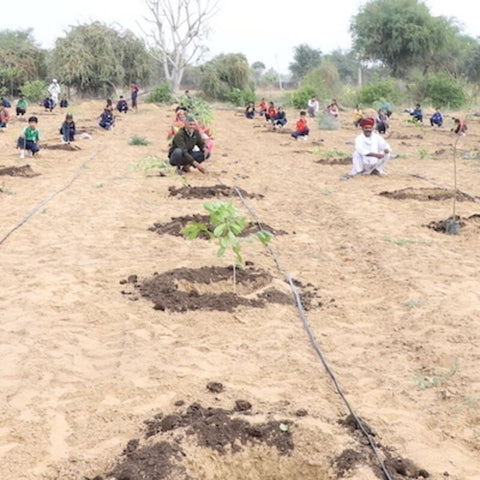
On flat benches and backfill, dense Miyawaki-style blocks work well. At Thakurani iron-ore mines in Odisha, this approach raised survival of local species from 72% to 87% compared with traditional planting (Ranjan et al., 2016).
5. Water and protect for three years
Drip lines, mulching, fire lines, protection from grazing and replacement of failed plants decide the outcome. The Yadav review also stresses continuous monitoring after mining.
Which species should you consider?
The final list must follow a site survey. These are natives with support from Indian mine-restoration research, or that we commonly test against the local reference forest.
| Species (common name) | Why it is considered | Basis |
|---|---|---|
| Pongamia pinnata (karanj) | Hardy native legume | Used in bauxite restoration in Chhattisgarh (Yadav et al.) |
| Dalbergia sissoo (shisham) | Nitrogen-fixer, good early growth | Strong results on coal mine spoil (Chaulya et al.; Banerjee et al.) |
| Albizia procera (safed siris) | Native legume, fast canopy | Among the best after eight years on mine spoil (Banerjee et al.) |
| Azadirachta indica (neem) | Drought-hardy | Best performer on some coal dumps (Chaulya et al.) |
| Local forest trees and shrubs | Long-term canopy and biodiversity | Chosen from the reference forest during survey |
Fast exotics such as Prosopis juliflora appear in older restoration work, including the Chhattisgarh study. We do not use aggressive exotics as the main mix, especially next to forest.
What are the common mistakes?
- Planting a single species across the lease.
- Planting on dumps before terracing and drainage.
- Losing topsoil to roads or mixing it with waste.
- No budget for watering after the first monsoon.
- Reporting saplings planted, not trees alive, in the yearly closure report.
How Grow Billion Trees helps
We survey the lease, match species to the reference forest, prepare pits, plant in layers, and care for trees for three years. Each tree is geo-tagged on GreenTrack, and we report 85% survival across our programmes. Reclamation is priced per project after a site survey. See the metal mining hub and our survival methodology.
Further reading: Overburden dump plantation that survives: methods and species · Mine reclamation under MCDR: progressive mine closure plans
Frequently Asked Questions
What is the first step in restoring a bauxite mine?
Secure soil and water. Bauxite plateaus often have thin soil or none, so pits need saved topsoil or imported material and the ground must be drained.
Does Miyawaki planting work on iron-ore mines?
A study at Thakurani iron-ore mines in Odisha found it raised survival of local species from 72% to 87% compared with traditional planting.
Which trees suit mine restoration in India?
Hardy native legumes such as karanj, shisham and safed siris, plus neem and species from the local reference forest. The list should follow a site survey.
Should we use fast-growing exotics?
We avoid aggressive exotics such as Prosopis juliflora as the main mix. They can spread into nearby forest and farmland.
Do MCDR rules require vegetation on dumps?
Rule 37 says dumps that cannot be backfilled should be terraced and stabilised through vegetation or otherwise.
How long should aftercare last?
At least three years. The first two dry seasons decide survival on mine spoil.
Sources: Indian Bureau of Mines: Mineral Conservation and Development Rules, 2017 (amended to April 2025) · Indian Bureau of Mines: inspection report, bauxite lease in Kolhapur (2022) · Yadav et al. (2021), Eco-restoration of bauxite mining, BHU repository · Ranjan et al. (2016), International Journal of Mining and Mineral Engineering · Chaulya et al. (2000), Land Contamination & Reclamation, via CSIR-CIMFR · Banerjee et al. (2004), Journal of Tropical Forest Science, via Yale ELTI. Last updated: October 2026. Rules change; check the latest notification before you rely on any detail.


Comments
Leave a comment