
Limestone Quarry and Mine Reclamation for Cement Companies

Limestone mines, including captive mines of cement plants, need progressive and final mine closure plans under the Mineral Conservation and Development Rules, 2017. Both are backed by financial assurance. The rules also require topsoil to be saved and reused and waste to be backfilled where possible. Well-planned native revegetation turns those duties into stable, green land.
Which rules apply to limestone mine reclamation?
Limestone is a major mineral. Its mines follow the Mineral Conservation and Development Rules, 2017 (MCDR). The Indian Bureau of Mines (IBM) or the State oversees them, depending on the system in place.
A cement plant's captive limestone mine usually has its own environmental clearance as well. The 2024 cement plant EC we reviewed, for example, notes a separate EC for its linked captive limestone mine.
What does MCDR 2017 require?
| Rule | What it requires | Where plantation fits |
|---|---|---|
| Rule 22-23: mine closure plans | Every mine needs a progressive mine closure plan, submitted as part of the mining plan, and a final mine closure plan. | Revegetation of dumps, benches and safety zones is a core part of both. |
| Rule 24: final plan timing | The final mine closure plan goes for approval two years before proposed closure. | Plantation started early is already established by then. |
| Rule 26: yearly report | A yearly report, before 1 July, on protective and rehabilitation work done against the plan. | Survival counts and maps feed this report. |
| Rule 27: financial assurance | A bank guarantee per hectare used for mining: five lakh rupees for Category A and three lakh rupees for Category B mines. | Money spent on progressive reclamation is counted against the assurance due. |
| Rule 35: star rating | Mines must reach at least a three-star rating within four years and keep it, with yearly self-assessment and digital images. | Visible reclamation supports the rating. |
| Rule 36: topsoil | Topsoil must be removed separately and used for restoration, or stored for future use. | Saved topsoil is the best base for planting. |
| Rule 37: dumps | Waste kept in separate, secured dumps; backfilled into pits where possible. | Stabilised dumps and backfilled areas are planted. |
| Rule 44: flora | Mining must cause the least damage to flora in and around the lease. | Native planting restores lost cover. |
Release of the financial assurance follows satisfactory compliance with the final mine closure plan, certified by the authorised officer. Weak reclamation can lead to forfeiture.
How should reclamation be staged?
Reclamation is cheaper and stronger when it runs alongside mining. Each stage needs its own planting approach.
| Stage | What to do | What to record |
|---|---|---|
| Before stripping | Survey native species; collect seed; strip and stack topsoil separately. | Topsoil volume and stack location. |
| Active waste dumps | Grade slopes, add contour trenches, sow grasses and legumes, then shrubs. | Area treated, slope, cover after each monsoon. |
| Inactive dumps and backfill | Spread topsoil, plant mixed native trees in pits with soil improvers. | Species, counts, survival, photos. |
| Safety zone and lease boundary | Plant a dense multi-row belt against dust and erosion. | Length, rows, survival. |
| Worked-out pits | Where the closure plan allows a water body, plant the banks with native trees. | Water spread and bank cover. |
What makes limestone sites hard to green?
Limestone overburden is often stony, low in organic matter and alkaline. Slopes erode in the first heavy rains if left bare.
- Start with grasses and nitrogen-fixing shrubs to bind the surface.
- Add compost, farmyard manure or biochar in pits to hold water and nutrients.
- Choose drought-tolerant natives such as neem, karanj, desi babool, khair and ber, checked against your zone.
- Plant at the start of the monsoon and protect saplings from grazing.
Avoid single-species blocks. A mix copes better with drought and pests, and it reads better in a biodiversity disclosure.
Can mine reclamation earn green credits or count as compensatory afforestation?
Reclaiming your own lease is a legal duty under your closure plan. Do not present it as an extra environmental credit.
The Green Credit Programme works on degraded forest land registered by State Forest Departments. Credits come only after five years of restoration and at least 40% canopy density. See our Green Credit Programme guide and compensatory afforestation explainer.
How should progress be monitored?
MCDR already asks for yearly reports and digital images of the lease area. Plantation data should plug straight into that cycle.
- Block-wise maps of planted dumps, benches and boundaries.
- Survival counts after each monsoon, with replacement planting.
- Fixed-point photos and satellite or drone images each year.
- Spend on reclamation, to set against the financial assurance.
What do inspectors look for on a reclaimed dump?
A reclaimed dump should look and behave like stable land, not a slope with saplings stuck into it. Inspectors and star-rating teams tend to check a few simple things.
- Stable slopes with no fresh gullies, slips or bare patches after the monsoon.
- Ground cover of grasses and shrubs between the trees.
- Living trees of several native species, not a single fast-growing exotic.
- Drains and toe walls that carry water off safely.
- Records that match what they see on the ground.
Plan for the record from day one. A map, a species count and fixed-point photos make each yearly report quicker and more convincing.
Plantation done for a closure plan can also support CSR or BRSR narratives. Keep the legal duty clear, and avoid counting the same hectare twice; see green credits vs carbon credits vs CSR vs BRSR.
How Grow Billion Trees helps
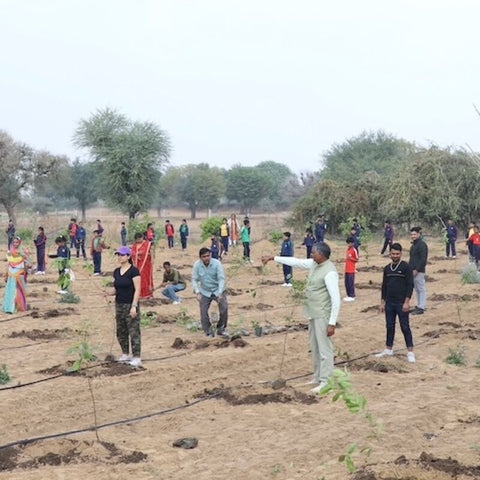
We survey the lease, read the closure plan and design staged native revegetation for dumps, benches and boundaries. We plant, care for every tree for three years, and geo-tag it, with progress on GreenTrack for your yearly reports. Reclamation is priced per project after a site survey; see our cement industry page.
Further reading: Captive Iron Ore Mine Reclamation for Steel Companies · Mine reclamation under MCDR: progressive mine closure plans
Frequently Asked Questions
Do captive limestone mines need a mine closure plan?
Yes. Under MCDR 2017 every mine needs a progressive mine closure plan within its mining plan and a final mine closure plan before closure.
When must the final mine closure plan be submitted?
Rule 24 says it goes for approval two years before the proposed closure of the mine.
Does reclamation spending reduce the financial assurance?
Yes. Rule 27 counts money spent on progressive reclamation and rehabilitation, and the assurance due falls by that amount.
What must be done with topsoil?
Rule 36 requires topsoil to be removed separately and used for restoration, or stored separately for future use.
Which trees work on limestone overburden?
Hardy, drought-tolerant natives such as neem, karanj, desi babool and khair are common choices, planted after grasses and shrubs stabilise the surface.
Can reclaimed mine land earn carbon credits?
We do not promise carbon credits from reclamation. Treat it as a closure-plan duty; any carbon figures are estimates for voluntary reporting.
Sources: Indian Bureau of Mines: Mineral Conservation and Development Rules, 2017 (updated to Jan 2026) · MoEFCC environmental clearance, integrated cement plant, Rajasthan (30 Sep 2024) · PIB: Green Credit Programme, Lok Sabha reply (16 Mar 2026). Last updated: October 2026. Rules change; check the latest notification before you rely on any detail.


Leave a comment