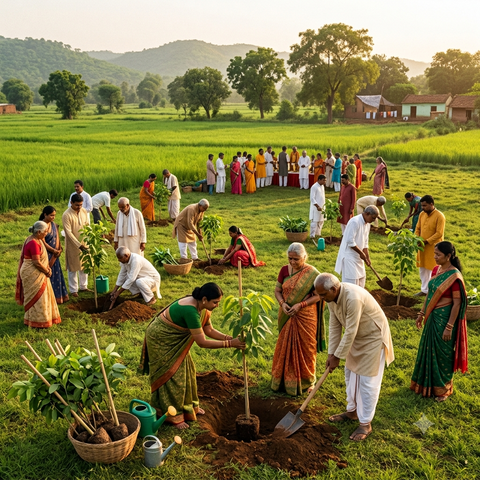
Tree Plantation in Karnataka State: Your Complete Guide to Green Karnataka
Tree plantation in Karnataka transforms landscapes while combating climate change. Strategic tree planting can restore degraded lands and improve livelihoods.
Companies spent ₹3,395 Cr on CSR projects in Karnataka in FY 2024-25 (provisional), against ₹2,329 Cr in FY 2023-24, according to the Ministry of Corporate Affairs' National CSR Portal. See CSR spending by state.
Why Tree Plantation in Karnataka State Matters Now
Karnataka has experienced forest cover loss due to urbanization and agricultural expansion. The United Nations Sustainable Development Goals recognize reforestation as supporting climate action and biodiversity conservation.
Our team has witnessed firsthand how tree plantation in Karnataka State creates multiple benefits. Farmers enjoy improved soil health and additional income streams through agroforestry programs. Urban areas experience better air quality and reduced heat island effects. Coastal regions gain protection from erosion through mangrove restoration projects.
Tree plantation helps meet environmental targets for tree cover in Karnataka.
Best Tree Species for Karnataka's Diverse Climate
Selecting appropriate species ensures successful tree plantation in Karnataka State across different ecological zones. We recommend native species that thrive in local conditions and provide maximum environmental benefits.
✅ Coastal Karnataka Species
- Mangroves: Rhizophora, Avicennia, and Bruguiera species protect coastlines
- Coconut palms: Generate income while providing coastal protection
- Casuarina: Fast-growing windbreaks that stabilize sandy soils
- Cashew trees: Combine environmental benefits with economic returns
✅ Western Ghats Region
- Teak: Premium timber species with excellent growth rates
- Sandalwood: High-value aromatic wood native to Karnataka
- Silver oak: Fast-growing shade trees for coffee plantations
- Jackfruit: Fruit-bearing trees that support local food security
✅ Deccan Plateau Areas
- Neem: Drought-resistant with medicinal properties
- Pongamia: Biofuel potential with nitrogen-fixing capabilities
- Tamarind: Long-lived trees providing food and income
- Banyan: Sacred trees offering extensive shade coverage
Successful tree plantation considers local rainfall patterns, soil types, and community needs to maximize survival rates and long-term benefits.
Government Initiatives Supporting Tree Plantation
Karnataka government actively promotes tree plantation through various schemes and incentives. The state's ambitious target involves planting 100 crore trees by 2030, aligning with national environmental goals.
The United Nations Environment Programme recognizes Karnataka's progressive forest policies as models for other Indian states. Key government programs include:
- Krishi Aranya Protsaha Yojane is a government tree plantation scheme for farmers.
- Compensatory Afforestation: Mandatory tree planting for development projects
- Joint Forest Management: Community-based conservation programs
- Urban Forest Scheme: Green belt development in cities
We collaborate with these government initiatives to ensure our tree plantation projects receive proper support and recognition. Our certified programs help participants access available subsidies and incentives while contributing to state environmental targets.
⭐ Miyawaki Method: Revolutionary Forest Creation
The Miyawaki method is a tree plantation technique that creates dense, native forests in small spaces.
This Japanese methodology involves planting native species at high density to accelerate forest growth compared to conventional methods.
💡 Pro tip: Miyawaki forests require intensive initial care but become self-sustaining within 2-3 years. We provide complete maintenance including watering, weeding, and monitoring throughout the establishment period.
Miyawaki Success Stories in Karnataka
Key benefits we've observed include:
- Rapid carbon sequestration (up to 40 tons CO2 per hectare annually)
- Enhanced groundwater recharge in urban areas
- Natural pest control through increased bird populations
- Temperature reduction of 2-5°C in surrounding areas
Agroforestry: Combining Trees with Agriculture
Agroforestry represents the most practical approach to tree plantation in Karnataka State for rural communities. This integrated system combines tree cultivation with traditional farming to boost both environmental and economic outcomes.
Agroforestry programs help farmers improve soil fertility and water retention. The approach benefits small-scale farmers.
Popular Agroforestry Models in Karnataka
- Silvi-pastoral systems: Trees + livestock grazing
- Agri-silviculture: Trees + annual crops
- Silvi-horticulture: Trees + fruit cultivation
- Homestead forestry: Mixed tree species around farmhouses
We ensure farmers receive proper training and ongoing support to maximize their agroforestry success. Our certified programs include market linkages for tree products, helping farmers access premium prices for their sustainable produce.
Corporate Tree Plantation Programs
Corporate organizations increasingly choose tree plantation in Karnataka State to achieve their Net Zero Targets and demonstrate environmental responsibility. We provide comprehensive corporate programs that deliver measurable impact while meeting sustainability reporting requirements.
The United Nations Climate Change framework emphasizes corporate reforestation in climate action.
✅ Corporate Program Benefits
- Verified carbon offset: Certified CO2 sequestration measurements
- Employee engagement: Team building through environmental activities
- Brand enhancement: Authentic sustainability credentials
- Tax benefits: Eligible for CSR compliance and deductions
Our technology integration includes GeoTag tracking for every planted tree, allowing corporate sponsors to monitor their environmental impact in real-time. Companies receive detailed reports showing tree survival rates, growth progress, and carbon sequestration data.
Urban Forest Development in Karnataka Cities
Urban tree plantation in Karnataka State addresses the growing need for green spaces in rapidly expanding cities like Bangalore, Mysore, and Hubli. Our urban forestry projects create sustainable green corridors that improve air quality and reduce urban heat islands.
Strategic urban tree plantation can improve local climate and air quality. Interconnected green networks maximize environmental benefits.
Urban Planting Strategies
Successful urban tree plantation requires careful species selection and placement. We prioritize native species that tolerate urban stress while providing maximum environmental services.
- Road medians: Fast-growing species for air purification
- Parks and gardens: Mixed native species for biodiversity
- Industrial areas: Pollution-tolerant trees for air cleaning
- Residential complexes: Fruit and shade trees for community benefit
Our urban projects include community involvement to ensure long-term tree care and protection. We provide training to local residents and maintenance staff to guarantee sustainable urban forest development.
Technology Integration in Tree Plantation
Modern tree plantation in Karnataka State benefits significantly from technology integration that improves planting success and monitoring efficiency. Our GeoTag system allows precise tracking of every planted tree throughout its growth cycle.
We use GPS coordinates, QR codes, and mobile applications to create comprehensive tree databases. This technology enables donors and corporate sponsors to monitor their specific trees and receive regular growth updates.
💡 Technology Features
- GPS mapping: Exact location tracking for every tree
- Mobile monitoring: Regular photo updates and growth measurements
- Survival tracking: Real-time data on tree health and mortality
- Impact reporting: Automated carbon sequestration calculations
Community Engagement and Education
Successful tree plantation in Karnataka State requires strong community participation and environmental education. Our programs engage local communities through workshops, school programs, and volunteer opportunities that build lasting environmental awareness.
Community training in proper tree planting and care builds local capacity for reforestation.
Educational Program Components
- School workshops: Environmental education for students
- Farmer training: Agroforestry and sustainable practices
- Corporate seminars: Sustainability awareness for employees
- Community events: Public tree planting celebrations
Our educational approach emphasizes hands-on learning and practical skills development. Participants learn to identify native species, prepare planting sites, and provide ongoing tree care that ensures long-term survival and growth.
Challenges and Solutions in Karnataka Tree Plantation
Tree plantation in Karnataka faces several challenges that require adaptive management approaches.
⚠️ Major Challenges
- Water scarcity: Limited irrigation during dry seasons
- Land availability: Competition between development and conservation
- Maintenance gaps: Insufficient follow-up care after planting
- Species selection: Using non-native species with poor survival
We address water scarcity through drip irrigation systems and rainwater harvesting structures that support tree growth during critical establishment periods. Our maintenance programs guarantee three years of professional care for every planted tree.
Land availability challenges are solved through innovative partnerships with farmers, schools, and corporate landowners who provide space for tree plantation projects. We ensure all parties benefit from these collaborative arrangements.
Seasonal Planting Calendar for Karnataka
Timing plays a crucial role in successful tree plantation in Karnataka State, with different regions requiring specific planting schedules based on monsoon patterns and local climate conditions.
Optimal Planting Seasons
- Pre-monsoon (May-June): Coastal areas with early rainfall
- Monsoon (June-September): Ideal for most Karnataka regions
- Post-monsoon (October-November): Supplementary planting with irrigation
- Winter (December-February): Container plants in controlled conditions
Our planting schedule considers local weather patterns, soil moisture levels, and species-specific requirements to maximize survival rates. We maintain nurseries across Karnataka to ensure healthy saplings are available throughout optimal planting windows.
→ Best practice: Plant immediately after the first substantial monsoon rains when soil moisture is optimal for root establishment. We monitor weather forecasts and coordinate planting activities to take advantage of favorable conditions.
Economic Impact of Tree Plantation Programs
Tree plantation in Karnataka State generates significant economic benefits beyond environmental improvements. Our programs create direct employment opportunities while supporting rural livelihoods through sustainable forest-based enterprises.
Tree plantation programs can generate income from forest products and ecosystem services. See World Wildlife Fund forest initiatives for details.
Economic Benefits We've Documented
- Direct employment: 500+ jobs created across Karnataka projects
- Agroforestry adoption increases farmer income through tree products.
- Carbon credits: Additional revenue stream for communities
- Ecotourism: New opportunities in restored forest areas
Our economic impact extends to supporting local nurseries, equipment suppliers, and transportation services involved in tree plantation activities. These multiplier effects strengthen rural economies while advancing environmental conservation goals.
Frequently Asked Questions
What is the cost of tree plantation in Karnataka State?
Tree plantation costs vary by species and location. A tree costs ₹299 (a 2–3 ft sapling, three years of care, geo-tagged).
Which trees grow fastest in Karnataka climate?
Fast-growing species for Karnataka include eucalyptus (3-4 meters annually), silver oak (2-3 meters), and casuarina (2-3 meters). However, we recommend balancing growth speed with ecological benefits by choosing native species like neem, pongamia, and local fruit trees that provide long-term environmental and economic value.
How can farmers benefit from tree plantation programs?
Agroforestry systems combine trees with existing crops. Free saplings, training, and market access support adoption. Government support is available through various schemes.
What permits are required for large-scale tree plantation?
Large-scale projects require forest clearance from Karnataka Forest Department and environmental impact assessments for areas over 5 hectares. We assist with all permit applications and ensure compliance with state regulations. Smaller community projects typically need only local gram panchayat approval.
How do you ensure planted trees survive and grow?
We guarantee tree survival through comprehensive three-year care programs including regular watering, fertilization, pest control, and replacement of failed saplings. Our GeoTag system monitors each tree's progress with monthly photo updates and growth measurements. Survival rates exceed 85% across all our Karnataka projects.
Can individuals plant trees for special occasions?
Yes, we offer personalized tree plantation services for birthdays, memorials, anniversaries, and other special occasions. Each tree comes with a digital certificate, GPS coordinates, and regular growth updates. This creates meaningful, lasting gifts that contribute to Karnataka's environmental restoration while honoring important life events.
What technology do you use for tree monitoring?
Our GeoTag system uses GPS coordinates, QR codes, and mobile applications to track every planted tree. Donors receive unique tree IDs, location coordinates, and access to a digital dashboard showing growth progress, survival status, and carbon sequestration data. Monthly photo updates document tree development over time.
How does tree plantation help achieve Net Zero Targets?
Trees sequester approximately 22-50 kg of CO2 annually depending on species and age. Our verified carbon offset programs help corporations calculate and document their emission reductions through tree plantation. We provide detailed carbon accounting reports that meet international standards for sustainability reporting and Net Zero commitments.
Which regions in Karnataka are best for tree plantation?
All Karnataka regions offer excellent tree plantation opportunities with appropriate species selection. Western Ghats areas excel for timber species, coastal regions benefit from mangrove restoration, and Deccan plateau areas suit drought-resistant species. We conduct site assessments to recommend optimal species and planting strategies for each location.
How can schools participate in tree plantation programs?
Schools can organize educational tree plantation events that combine environmental learning with hands-on conservation action. We provide age-appropriate workshops, free saplings, and ongoing monitoring support. Student groups receive certificates and can track their trees' growth throughout their academic years, creating lasting environmental connections.
Transform Karnataka Through Tree Plantation
Tree plantation in Karnataka State represents our collective opportunity to combat climate change while creating sustainable prosperity for future generations. Our proven methods, technology integration, and comprehensive care programs ensure every planted tree contributes meaningfully to environmental restoration and community development.
We welcome you to join our mission of planting 100 crore trees across India, with Karnataka playing a vital role in this ambitious goal. Whether you're an individual wanting to Plant a tree in your Name, a farmer exploring agroforestry opportunities, or a corporation pursuing Net Zero Targets, we provide the expertise and support needed for success.
Together, we can transform Karnataka's landscapes while addressing the urgent challenge of climate change through strategic tree plantation. Discover how you can contribute to Karnataka's green transformation today and become part of this wonderful environmental movement that's creating lasting positive impact across the state.