
Avenue and Corridor Plantation for Highways: Green Highways Policy

The Green Highways (Plantation, Transplantation, Beautification & Maintenance) Policy, 2015 is the main rulebook for planting along National Highways. Avenue and median plantation follows an Annual Plantation Action Plan and the IRC:SP:21-2009 guidelines, and NHAI has run it through an SOP since 2019. For contractors, the real test is survival. NHAI links plant growth to payment and tracks every plant on its Harit Path app.
What does the Green Highways Policy 2015 ask for?
The Ministry of Road Transport and Highways released the policy in New Delhi on 29 September 2015, IANS reported. Its aim is greening of highway corridors with farmers, the private sector, NGOs and government institutions taking part.
Business Today's review of the policy noted three practical points. One per cent of total project cost is set aside for plantation. For new projects, land needed for plantation becomes part of the detailed project report. Species are to be selected scientifically for each patch of roadside.
In a Rajya Sabha reply of 27 November 2024, the ministry said avenue and median plantations follow an Annual Plantation Action Plan. They conform to the IRC:SP:21-2009 guidelines. NHAI wrote a Standard Operating Procedure in 2019 and updates it regularly.
Avenue, median and corridor plantation: what is the difference?
| Plantation type | Where it sits | What to plan for |
|---|---|---|
| Avenue plantation | Rows along the edges of the right of way | Tall native shade trees, set back from the carriageway; protection from cattle and traffic |
| Median plantation | The central verge of divided highways | Low, dense shrubs that cut headlight glare; no trees that block sight lines |
| Corridor or block plantation | Spare land parcels near interchanges, bypasses and toll plazas | Dense native blocks; NHAI has used the Miyawaki method on such land |
| Slope and embankment planting | Cut and fill slopes | Grasses and deep-rooted shrubs that hold soil |
The table is a planning summary. Always check the current IRC guideline and your contract schedule for exact spacing and species lists.
How is survival checked on National Highways?
In August 2020, NHAI launched the Harit Path mobile app, according to PIB. It records the location, growth, species, maintenance and targets for each plant.
Photographs and plant data are to be uploaded every three months. Highway contractors are accountable for upkeep and liable to replace missing or dead plants.
PIB also reported that NHAI links plant performance and growth to contractor payments. It asked for avenue saplings of at least 1.5 metres in height.
For a developer, this means plantation is not a one-time handover item. It is a maintained asset with a payment tied to it.
What about the Miyawaki blocks near expressways?
In June 2024, NHAI announced Miyawaki plantations on land parcels next to National Highways. PIB reported over 53 acres identified in and around Delhi-NCR.
The sites included land along the Dwarka Expressway, near interchanges and at bypasses. NHAI said the focus is indigenous species suited to local soil and climate. It described these dense blocks as a sound and dust barrier.
Dense native blocks suit odd-shaped land that avenue rows cannot use. Our Miyawaki forest page explains the method.
Where do most corridor plantations fail?
The ministry itself named one major constraint in its 2024 reply: limited land for plantation. Other failures are practical and common on site.
- Wrong species for the strip. Exotic ornamentals or trees that need more water than the verge gets.
- No water plan. Saplings planted at the start of monsoon, then left dry in the first summer.
- No protection. Cattle, grass fires and mowing crews damage young plants.
- Weak records. No geo-tags or photos, so replacements cannot be proved.
- Short contracts. Care ends before the trees can survive on their own.
A practical checklist for EPC and concessionaire teams
- Read the plantation clauses in your concession agreement and the current NHAI SOP before mobilisation.
- Survey the right of way and mark avenue, median, slope and spare-land zones on drawings.
- Choose native species by zone and climate; keep sight lines clear at curves and junctions.
- Fix the water source and watering schedule for at least the first two summers.
- Geo-tag every plant and keep quarterly photo records that match the Harit Path format.
- Budget replacement of dead plants inside the maintenance period, not as an extra.
If trees must come down for the road, see our guide on tree transplantation vs replacement planting. Forest land diversion is a separate process; our compensatory afforestation and CAMPA guide covers it.
Choosing species by zone
Business Today noted that the policy calls for scientific selection of species for each patch of roadside. In practice, that means matching the plant to the strip, not to a catalogue.
| Zone | Look for | Avoid |
|---|---|---|
| Outer avenue rows | Long-lived native shade trees with deep roots | Brittle trees that drop branches on traffic |
| Inner avenue rows | Medium native trees and flowering species | Thorny species near footpaths |
| Median | Dense, low shrubs that tolerate dust and heat | Trees that grow into sight lines |
| Embankment slopes | Grasses and deep-rooted shrubs | Shallow-rooted ornamentals |
| Spare land blocks | Many native species in dense layers | Single-species blocks |
Ask the local forest division or a horticulture expert for the native species list for your district. NHAI itself engages horticulture experts for supervision, PIB reported in 2020.
Working with farmers and communities
The policy envisages greening with farmers, NGOs, the private sector and government institutions taking part. That matters on the ground.
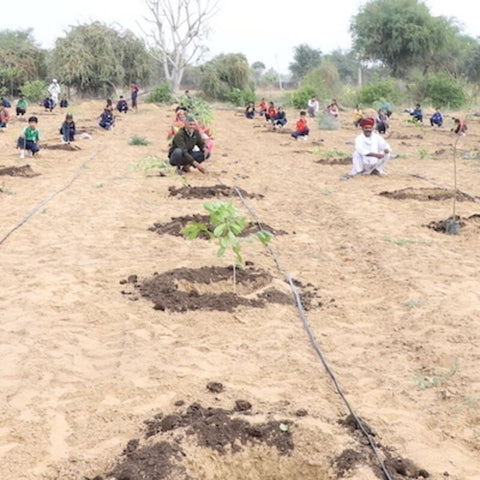
Villages next to the corridor can guard saplings from cattle and fire. Local workers can water and weed through the dry months. Agree roles and payments in writing before planting.
What to report
- Saplings planted by zone, species and chainage.
- Survival at each quarterly check, with geo-tagged photos.
- Replacements made and the reason for losses.
- Watering and maintenance logs.
These records serve the concession, the NHAI app and your company's BRSR Principle 6 disclosure.
How Grow Billion Trees helps
We plan, plant, geo-tag and care for corridor and spare-land plantations for three years, with records on GreenTrack. We report 85% survival across our programmes and follow our published survival methodology. Corridor work is priced per project after a site survey. See our infrastructure projects page or plan a programme.
Frequently Asked Questions
Is the Green Highways Policy 2015 still in force?
Yes. A Rajya Sabha reply of 27 November 2024 said avenue and median planting continues under it. NHAI follows an annual plan and a 2019 SOP.
How much of a highway project budget goes to plantation?
Reports on the 2015 policy said 1% of total project cost is set aside for plantation and maintenance. Check your own contract for the exact provision.
Which technical guideline applies to roadside planting?
The ministry says plantations conform to IRC:SP:21-2009 guidelines. Your concession schedule and the current NHAI SOP add project-specific rules.
Who pays if planted saplings die?
PIB reported that highway contractors are liable to replace missing or dead plants, and that plant growth is linked to contractor payment.
Can highway plantation earn carbon credits?
Do not plan on it. Plantation along roads is a contract and policy duty. Our CCTS guide explains why trees do not earn credits under India's compliance market.
Can we use Miyawaki blocks on highway land?
NHAI announced Miyawaki plantations on land parcels next to highways in 2024, starting around Delhi-NCR. They suit spare land near interchanges and bypasses.
Sources: Eastern Mirror/IANS: Green Highways policy release (29 Sep 2015) · Business Today: Green Highways policy (29 Sep 2015) · PIB: Green Highways, Rajya Sabha reply (27 Nov 2024) · PIB: NHAI launches Harit Path app (21 Aug 2020) · PIB: NHAI Miyawaki plantations along National Highways (18 Jun 2024). Last updated: October 2026. Rules change; check the latest notification before you rely on any detail.


Leave a comment