
Compensatory afforestation for mining leases: what is different
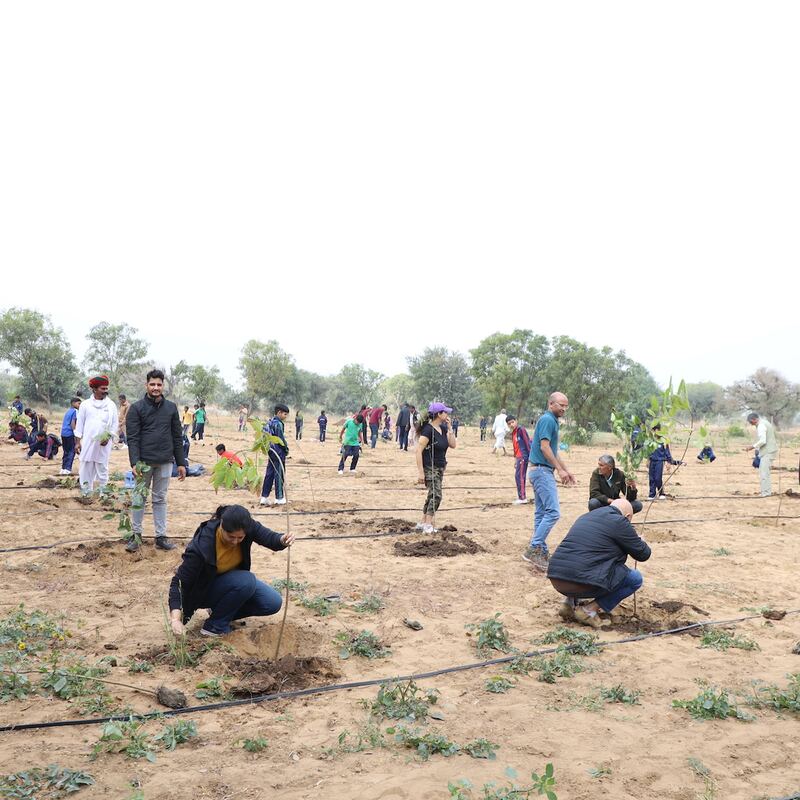
Mining leases on forest land carry the usual compensatory afforestation duties plus mining-specific ones. MoEFCC's 2014 guidelines require a 7.5 m safety zone along the lease boundary, kept as a regenerated green belt. They also require afforestation of degraded forest land elsewhere, one and a half times the safety zone area, under State Forest Department supervision.
Our CAMPA and compensatory afforestation guide explains the general rules: when CA applies, land and money, and who plants. This guide does not repeat that.
Here we cover only what changes when the project is a mine.
What is the safety zone condition?
A circular from MoEFCC's Forest Conservation Division, dated 4 July 2014, set standard conditions for mining leases approved under the Forest (Conservation) Act, 1980. They replaced earlier, looser wording.
| Condition | What it requires |
|---|---|
| Demarcation | A 7.5 m strip along the outer boundary of the mining lease, marked with 4 ft RCC pillars carrying DGPS coordinates, and watchers deployed under State Forest Department supervision |
| Fencing near people | Where the lease adjoins habitation or roads, that stretch of the safety zone is fenced at project cost |
| Green belt | The safety zone is maintained as green belt with dense canopy; the user agency carries out regeneration at project cost under Forest Department supervision |
| Off-site afforestation | Afforestation on degraded forest land elsewhere, one and a half times the safety zone area, by the user agency at project cost under Forest Department supervision |
These conditions appear in the Stage-I approvals, so check your own approval letter for the exact wording.
How do the different plantation duties fit together?
A mining company can carry several overlapping duties. Keeping them separate avoids double counting.
| Duty | Where | Rule source | Our guide |
|---|---|---|---|
| Compensatory afforestation for diverted forest land | Land identified with the Forest Department | Forest clearance | CAMPA guide |
| Safety zone regeneration | 7.5 m strip on the lease boundary | MoEFCC 2014 circular | This page |
| 1.5× safety zone afforestation | Degraded forest land elsewhere | MoEFCC 2014 circular | This page |
| Progressive reclamation | Mined-out land and dumps inside the lease | MCDR (non-coal) or Ministry of Coal guidelines | MCDR guide, coal closure guide |
| Plantation under EC | Dumps, reclaimed land, green belt | Environmental clearance | Green belt guide |
For coal, a December 2024 PIB release says EC conditions cover plantation on reclaimed degraded forest and non-forest land, and on external overburden dumps.
Can green credits be used for a mining project's CA?
Under the Green Credit Programme, credits from tree plantation are issued after five years and on reaching 40% canopy density. They can be used once, for compensatory afforestation, CSR or statutory plantation.
This gives a mining company another route. It can support plantation on degraded land early, then use the credits for a later CA duty if the rules then allow. See our Green Credit Programme guide.
What should an off-site afforestation plan include?
The 1.5× afforestation is done by the user agency under Forest Department supervision. A clear plan makes that supervision simpler.
- Land details: location, area and a check that it is at least one and a half times the safety zone area.
- Site condition: soil, slope, water source and access for watering and protection.
- Species list matched to the local forest type, with nursery sources.
- Protection: fencing, watch and ward, and fire lines.
- A care schedule for at least three years, with yearly survival counts and replacement.
- Geo-tagged maps and photos the Forest Department can verify.
What makes mining CA work on the ground?
- Start the safety zone early. It is the first thing inspectors see on the boundary, and regeneration takes years.
- Use local species. The safety zone usually adjoins forest, so planting should match it.
- Protect it. Pillars, watchers and fencing near villages are in the conditions for a reason.
- Pick off-site land with water and access in mind. Degraded land far from roads is hard to water and protect.
- Keep geo-tagged records. Forest Department supervision goes faster with clear maps, counts and photos.
How Grow Billion Trees helps
We support mining companies with safety zone regeneration, plantation on degraded land where the Forest Department permits, and Green Credit Programme plantation. We care for trees for three years and report on GreenTrack with 85% survival across our programmes. Projects are priced per project after a site survey. See government mandates or the metal mining hub.
Further reading: Compensatory Afforestation and CAMPA Explained for Project Developers · Compensatory afforestation for pipelines and linear projects
Frequently Asked Questions
What is the safety zone in a mining lease?
A 7.5 m strip along the outer boundary of a mining lease on forest land. MoEFCC's 2014 guidelines require it to be demarcated, protected and kept as green belt.
What is the 1.5 times afforestation condition?
Afforestation of degraded forest land elsewhere, one and a half times the safety zone area, at project cost under State Forest Department supervision.
Is the safety zone the same as compensatory afforestation?
No. CA compensates for diverted forest land. The safety zone and its 1.5× afforestation are separate conditions on mining leases.
Can Green Credits be used for compensatory afforestation?
Green credits from tree plantation, issued after five years and 40% canopy density, can be used once for CA, CSR or statutory plantation.
Who supervises safety zone work?
The State Forest Department, while the user agency carries out the work at project cost.
Where do the general CA rules sit?
Sources: MoEFCC: Guidelines on safety zone in mining leases (4 Jul 2014) · PIB: Green Credit Programme · PIB: Green cover around coalfields (16 Dec 2024) · Indian Bureau of Mines: Mineral Conservation and Development Rules, 2017 (amended to April 2025). Last updated: October 2026. Rules change; check the latest notification before you rely on any detail.
Keep reading
 Compensatory Afforestation and CAMPA Explained for Project Developers
 Compensatory afforestation for pipelines and linear projects
 Monitoring mine reclamation: satellite, geo-tagging and reporting
 Mine reclamation under MCDR: progressive mine closure plans
 Captive Iron Ore Mine Reclamation for Steel Companies
 Tree Transplantation vs Replacement Planting for Project Developers


Leave a comment