
Tree-Felling Permission and Replacement Planting in Indian Cities
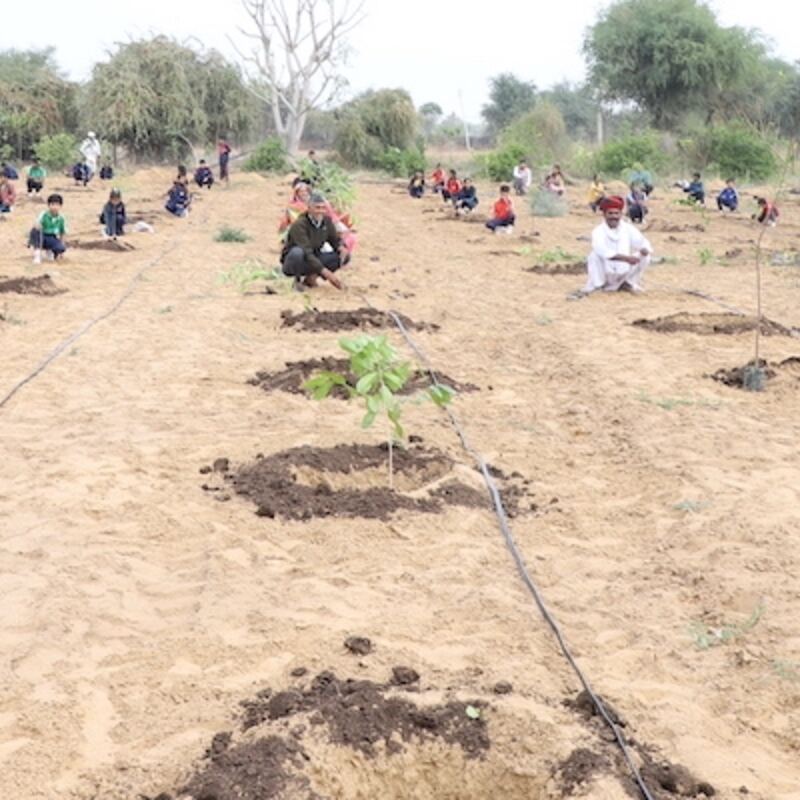
In Indian cities, felling even one tree usually needs permission from a Tree Officer or tree authority. Replacement planting is a common condition. Rules vary by state and city. Delhi asks for 10 saplings per tree felled, kept for 5-7 years; Maharashtra protects urban trees aged 50+ as heritage trees. Apply early, survey every tree, and plan the replacement land before you need it.
Why every developer should check this early
Tree permission is often on the critical path for a site. A missing permit can stop excavation, invite penalties and draw public objection.
Each state or city has its own tree law. The examples here are from sources we opened. Your local rule may differ.
Example 1: Delhi
A Delhi Forest Department circular of 2 June 2023 sets out the process under section 9 of the Delhi Preservation of Trees Act, 1994.
- Apply to the Tree Officer with proof of land ownership, the number and kind of trees, and girth at 1.85 metres from the ground.
- Give the reasons for felling and a site map with khasra numbers.
- The Tree Officer may inspect and grant, partly grant or refuse permission.
- The decision is due within sixty days; if it does not come, the Act deems permission granted.
- Permissions carry a condition of 10 saplings for each tree felled, maintained for 5-7 years.
Delhi also has a Tree Transplantation Policy, notified in December 2020. It asks agencies to transplant at least 80% of affected trees, with an 80% survival benchmark after one year.
Example 2: Maharashtra
In June 2021, the Maharashtra cabinet approved an amendment to the Maharashtra (Urban Areas) Protection and Preservation of Trees Act, 1975, The Tribune reported. Trees with an estimated age of 50 years or more are classed as heritage trees, and a Maharashtra Tree Authority was formed.
The Hitavada reported in 2022 that proposals to fell more than 200 trees go to the State Tree Authority. In one case, the Authority asked a civic body to reassess the trees' cumulative age and supply satellite images before deciding.
How the two compare
| Point | Delhi | Maharashtra (urban areas) |
|---|---|---|
| Law | Delhi Preservation of Trees Act, 1994 | Maharashtra (Urban Areas) Protection and Preservation of Trees Act, 1975, amended 2021 |
| Who decides | Tree Officer | Local tree authority; State Tree Authority for proposals above 200 trees |
| Replacement condition | 10 saplings per tree felled, maintained 5-7 years | Set under the amended Act and its rules; check the current notification |
| Special protection | Transplantation policy (2020) | Heritage trees aged 50 years or more |
Other states and cities have their own laws and ratios. Always confirm with the local tree authority.
A practical sequence for a building project
- Tree survey at land due diligence. Species, girth, height, health, age estimate and geo-tagged photos.
- Design around trees. Shift driveways, basements and services to save the best trees.
- Decide per tree. Retain, transplant or fell, with reasons.
- Apply early. File with complete documents; track deadlines.
- Secure replacement land. On site where possible, or land agreed with the authority.
- Plant and maintain. Keep geo-tagged records for the full maintenance period.
Building rules can add more
MoEFCC notification S.O. 3999(E) of 9 December 2016 integrated environmental conditions with building permissions for projects in size bands from 5,000 sq m upwards.
A 2022 draft, the Building Construction Environment Management Regulations, proposed one tree per 80 sq m. It aimed for at least 10% of plot area under tree cover, counting existing trees. Check whether your state has adopted similar norms.
Replacement planting is not CSR
Planting required by a felling permit is a legal condition. It should not be booked as CSR. Our Schedule VII checklist explains the line.
Voluntary planting beyond the condition can be reported in BRSR. See BRSR Principle 6.
Why applications stall
- Missing ownership documents or site maps.
- Girth not measured at the height the rule asks.
- No land identified for replacement planting.
- Public objections the developer did not expect.
- Large proposals sent up to a higher authority, as in Maharashtra.
Most of these can be avoided with a careful tree survey and early talks with the Tree Officer.
Records to keep
| Record | Why it matters |
|---|---|
| Tree survey with geo-tagged photos | Proves the starting count and condition |
| Permission letter and conditions | Sets the ratio, land and maintenance period |
| Replacement planting log | Shows species, location and date of each sapling |
| Survival checks | Shows the condition was met over time |
| Transplant records | Shows method, aftercare and survival for moved trees |
How Grow Billion Trees helps
We carry out replacement and compensatory planting on agreed land, with three years of care. Geo-tagged records on GreenTrack can be shared with the authority. We report 85% survival across our programmes. Work is priced per project after a site survey; see our real estate page or the mandate checker.
Further reading: Tree Transplantation vs Replacement Planting for Project Developers · Green Building Ratings (IGBC, GRIHA): Landscape and Tree Credits
Frequently Asked Questions
Do I need permission to cut a tree on my own plot?
In most Indian cities, yes. Tree laws usually cover private land too. Check with the local Tree Officer or tree authority.
How many saplings does Delhi require for each tree cut?
A June 2023 Delhi Forest Department circular says permissions carry a condition of 10 saplings per tree felled, maintained for 5-7 years.
What is a heritage tree in Maharashtra?
After the 2021 amendment, a tree with an estimated age of 50 years or more in urban areas is classed as a heritage tree.
How long does Delhi take to decide?
The Act says the Tree Officer should decide within sixty days. If no decision is communicated in time, permission is deemed granted.
Can replacement planting be done off site?
Often yes, on land agreed with the authority. Delhi links its condition to land identified for compensatory plantation.
Can we count replacement planting as CSR?
No. Planting required by a permit is a legal duty. Only voluntary planting beyond it can be considered for CSR.
Sources: Delhi Forest Department circular on DPTA 1994 tree felling (2 Jun 2023) · Outlook: Just 37% of transplanted trees survived in Delhi · The Tribune: Maharashtra heritage tag for 50-year-old urban trees (11 Jun 2021) · The Hitavada: State Tree Authority asks NMC to reassess tree age (2 Sep 2022) · India Environment Portal: S.O. 3999(E) on environmental conditions for buildings (2016) · Outlook/PTI: Draft Building Construction Environment Management Regulations, 2022. Last updated: October 2026. Rules change; check the latest notification before you rely on any detail.
Keep reading
 Tree Transplantation vs Replacement Planting for Project Developers
 Green Building Ratings (IGBC, GRIHA): Landscape and Tree Credits
 Tree Felling Rules on Farmland: What Farmers and Companies Need to Know
 Miyawaki Forests in Residential and Commercial Projects
 Compensatory afforestation for mining leases: what is different


Leave a comment