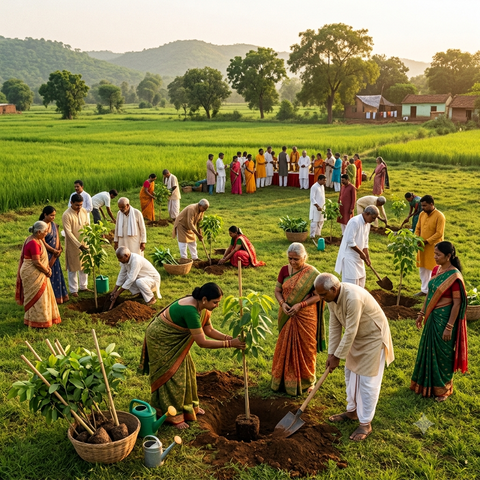
Agroforestry in Chhattisgarh combines trees with crops, creating systems that increase farmer incomes while protecting the environment. These practices build resilience in rural livelihoods.
✅ Understanding Agroforestry in Chhattisgarh
Agroforestry integrates trees, crops, and livestock on the same land. In Chhattisgarh, this practice has gained tremendous momentum among conscious farmers. The state's diverse climate zones make it perfect for various agroforestry models.
Traditional farming methods often deplete soil nutrients. However, agroforestry systems naturally restore soil health through tree roots. Trees provide organic matter, reduce erosion, and improve water retention. This sustainable approach helps farmers thrive while protecting precious natural resources.
According to the United Nations Sustainable Development Goals, sustainable agriculture practices like agroforestry are crucial for achieving global food security and environmental protection.
⭐ Benefits of Agroforestry Systems
Farmers practicing agroforestry in Chhattisgarh enjoy multiple income streams. Trees provide timber, fruits, and medicinal plants alongside traditional crops. This diversification reduces financial risks and improves family welfare.
Trees sequester carbon dioxide and create microclimates that protect crops from extreme weather.
Biodiversity flourishes in these systems. Birds, beneficial insects, and soil organisms find habitat among the trees. This natural balance reduces pest problems and eliminates the need for harmful pesticides. The World Wildlife Fund's forest conservation initiatives highlight how agroforestry supports wildlife conservation.
🌱 Popular Agroforestry Models in Chhattisgarh
Silvo-Pastoral Systems
These systems combine trees with livestock grazing. Farmers plant fodder trees like Leucaena and Gliricidia alongside grasses. Animals benefit from shade and nutritious leaves. Tree roots prevent soil erosion in grazing areas.
Tree cover reduces heat stress in livestock, which improves productivity during Chhattisgarh's hot summers.
Agri-Silviculture Systems
This model integrates trees with annual crops. Farmers plant timber species like teak or bamboo with rice, wheat, or vegetables. Trees are spaced to allow adequate sunlight for crops.
Bamboo agroforestry is popular in Chhattisgarh. Bamboo grows quickly with multiple harvests and is used for construction, handicrafts, and paper production.
Multi-Story Cropping
This intensive system maximizes land use through vertical layering. Tall trees form the canopy, medium trees create the middle layer, and crops grow at ground level. Some systems include climbing plants and root crops.
Multi-story systems are perfect for small farmers with limited land. They produce food, fuel, fodder, and income throughout the year. We ensure our agroforestry programs include training on these complex but rewarding systems.
💡 Implementation Strategies for Success
Successful agroforestry requires careful planning and species selection. Farmers must consider local climate, soil conditions, and market demands. We provide comprehensive guidance to ensure optimal results.
Tree species selection is crucial. Native trees like sal, mahua, and tendu adapt well to local conditions. They require minimal inputs and provide maximum benefits. Exotic species may grow faster but often need more care and resources.
Proper spacing prevents competition between trees and crops, ensuring adequate light for both while maximizing benefits.
Training and education are essential for adoption. We conduct workshops on pruning, harvesting, and marketing. Farmers learn to manage complex systems effectively. Government support through subsidies and technical assistance accelerates adoption.
🌿 Environmental Impact and Climate Benefits
Agroforestry in Chhattisgarh plays a vital role in climate change mitigation. Trees absorb atmospheric carbon dioxide and store it in biomass and soil. A single mature tree can sequester 48 pounds of carbon annually.
Water conservation is a benefit of agroforestry. Tree roots improve soil structure and water infiltration. Canopy cover reduces evaporation and maintains soil moisture.
The United Nations climate change initiatives recognize agroforestry as a nature-based solution for climate adaptation and mitigation. Chhattisgarh's agroforestry programs contribute to India's commitment to plant 100 crore trees and achieve Net Zero Targets.
Biodiversity conservation thrives in agroforestry systems. These green corridors connect fragmented forests and support wildlife movement. Birds, butterflies, and beneficial insects find refuge among the trees. This natural diversity improves ecosystem resilience.
📈 Economic Opportunities and Market Potential
Agroforestry creates diverse income opportunities for Chhattisgarh farmers. Timber sales provide long-term financial security. Fruit trees generate annual income through fresh and processed products. Medicinal plants offer premium prices in growing health markets.
Value addition transforms raw products into profitable enterprises. Farmers process fruits into jams, juices, and dried products. Bamboo handicrafts and furniture create employment opportunities. Our team helps farmers access these lucrative markets.
Government schemes support agroforestry development. The National Agroforestry Policy provides financial incentives and technical support. Farmers can access subsidized seedlings, training programs, and market linkages. These initiatives boost adoption rates significantly.
Corporate partnerships offer additional opportunities. Companies seeking to achieve net zero goals invest in agroforestry projects. They provide funding for tree planting and maintenance. Farmers benefit from guaranteed income while companies offset their carbon footprint.
⚠️ Challenges and Solutions
Initial establishment costs can deter farmers from adopting agroforestry. Tree seedlings, fencing, and maintenance require upfront investment. However, government subsidies and microfinance schemes help overcome financial barriers.
Long gestation periods for tree maturity test farmer patience. Returns from timber may take 10-15 years. Therefore, we recommend fast-growing species and multiple income sources. Fruit trees and fodder species provide interim benefits.
Market access remains a challenge for many farmers. Remote locations and poor infrastructure limit marketing opportunities. Cooperative societies and farmer producer organizations help aggregate produce and improve bargaining power.
Technical knowledge gaps affect system performance. Farmers need training on pruning, pest management, and harvesting techniques. Extension services and demonstration plots address these knowledge needs effectively.
🌟 Success Stories from Chhattisgarh
Ramesh Kumar from Raipur district transformed his 5-acre farm using agroforestry. He planted bamboo with rice and vegetables. Within three years, his income doubled through bamboo sales and improved crop yields. His success inspired neighboring farmers to adopt similar practices.
Sunita Devi established a multi-story system with mango, guava, and seasonal crops. She processes fruits into value-added products. Her women's self-help group markets these products in urban areas. This initiative provides employment to 15 women in her village.
Bamboo agroforestry is promoted across tribal areas of Chhattisgarh.
🚀 Future Prospects and Scaling Up
Agroforestry in Chhattisgarh has immense potential for expansion. The state government aims to cover 2 million hectares under agroforestry by 2030. This ambitious target requires coordinated efforts from all stakeholders.
Technology integration can boost adoption and productivity. Mobile apps provide weather information, pest alerts, and market prices. Drone technology helps monitor tree growth and health. These innovations make agroforestry more attractive to young farmers.
Research continues to improve agroforestry systems. Scientists develop climate-resilient varieties to help farmers adapt to changing weather.
Policy support remains crucial for widespread adoption. Simplified procedures for tree cutting permissions encourage farmer participation. Insurance schemes protect farmers from climate risks. These supportive policies create an enabling environment for growth.
Frequently Asked Questions
What is the best time to start agroforestry in Chhattisgarh?
The monsoon season (June-September) is ideal for planting trees in agroforestry systems. Adequate rainfall ensures good establishment and reduces irrigation needs. However, with proper irrigation, planting can be done throughout the year.
Which tree species are most suitable for Chhattisgarh's climate?
Native species like sal, mahua, tendu, and bamboo perform exceptionally well. Fruit trees such as mango, guava, and amla also thrive. These species are adapted to local conditions and require minimal inputs.
How much initial investment is required for agroforestry?
Agroforestry requires initial investment in seedlings and setup. Government subsidies are available to support farmers.
Can small farmers with 1-2 acres practice agroforestry?
Absolutely! Small farmers can benefit significantly from agroforestry. Multi-story systems and boundary planting are perfect for limited land. These systems maximize productivity per unit area and provide year-round income.
What government support is available for agroforestry?
The National Agroforestry Policy provides subsidies for agroforestry. State schemes offer additional support for seedlings, training, and equipment. NABARD provides low-interest loans for agroforestry development.
How does agroforestry help achieve Net Zero Targets?
Agroforestry systems sequester significant amounts of carbon dioxide from the atmosphere. Trees store carbon in their biomass and improve soil carbon content. This natural carbon capture helps offset greenhouse gas emissions and supports climate goals.
What are the main challenges in marketing agroforestry products?
Limited market access, price fluctuations, and lack of processing facilities are major challenges. Farmer producer organizations help aggregate produce and improve market linkages. Value addition through processing increases profitability significantly.
How can I get technical support for agroforestry implementation?
Agricultural extension departments provide technical guidance and training. NGOs and research institutions offer specialized support. Online resources and mobile apps provide real-time information on best practices and market updates.Agroforestry in Chhattisgarh represents the future of sustainable agriculture. This wonderful approach combines environmental protection with economic prosperity. Farmers who embrace these systems enjoy improved livelihoods while contributing to global climate goals.The World Wildlife Fund's research on deforestation emphasizes how agroforestry can reverse forest loss while maintaining agricultural productivity. Together, we can transform Chhattisgarh's agricultural landscape into a model of sustainability.Ready to join the agroforestry revolution? Plant a tree in your Name for just ₹299 with our 2-3ft Tree Planting + 3 Years Care + GeoTag service. Let's work together toward our goal of 100 crore trees and combat climate change through collective action. Discover how you can contribute to this green transformation today!
Agroforestry with Grow Billion Trees
Companies fund fruit and timber trees through CSR, and farmers plant them on their own land. The farmer keeps the fruit and timber income: up to 3× farm income compared with conventional two-crop farming. Registration for farmers is free.
- Agroforestry programme for companies
- Agroforestry for farmers: register free
- Agroforestry projects
- Top trees used in agroforestry in India
- CSR rules for tree plantation
Talk to our team about a programme for your company.