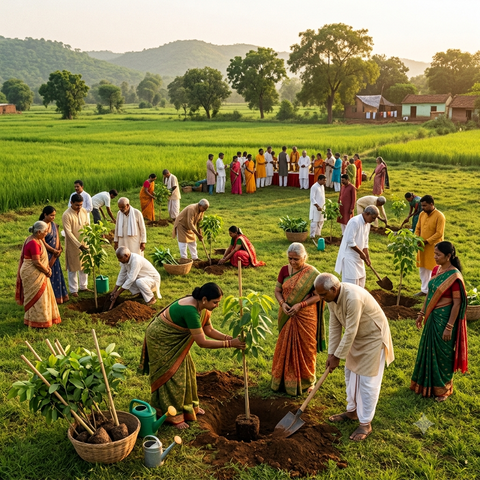
Agroforestry in Arunachal Pradesh is one of India's most inspiring examples of sustainable land use — where farming and forests grow together, side by side. This proven approach integrates trees with crops and livestock on the same land, boosting food security while nurturing the planet's green cover. In 2026, communities across Arunachal Pradesh are rediscovering the power of trees as partners in farming, not just as background scenery.
We are glad to share that agroforestry is not a new idea here. Indigenous communities in Arunachal Pradesh have practiced tree-based farming for generations. However, today's challenges — climate change, soil loss, and shrinking forest cover — make this eco-friendly approach more vital than ever.
✅ What Is Agroforestry and Why Does It Matter?
Agroforestry is the conscious integration of trees and shrubs into crop and animal farming systems. It creates a multi-layered, natural land system that improves biodiversity, sequesters carbon, and supports farmer income. For background, see United Nations Environment Programme on Forests.
This approach directly addresses the twin crises of food insecurity and climate breakdown. Trees act as natural windbreaks, reduce soil erosion, and enrich the soil with organic matter. Moreover, they provide timber, fruits, and medicinal products — adding multiple income streams for farming families.
The United Nations Sustainable Development Goals recognise agroforestry as a key tool for achieving Zero Hunger (SDG 2), Climate Action (SDG 13), and Life on Land (SDG 15). For communities in Arunachal Pradesh, this is not just policy — it is daily reality.
⭐ Arunachal Pradesh: A Natural Home for Agroforestry
Arunachal Pradesh has diverse terrain — from tropical lowlands to alpine peaks. However, shifting cultivation and deforestation are gradually eroding the state's natural wealth.
The state's rich biodiversity makes it an ideal candidate for agroforestry programs. Farmers here grow rice, maize, millet, cardamom, and ginger alongside fruit trees like orange, jackfruit, and bamboo. Therefore, blending trees with existing crops is a natural transition, not a disruptive change.
💡 Traditional Agroforestry Practices in Arunachal Pradesh
Indigenous tribes such as the Adi, Nyishi, and Apatani have long practiced forms of agroforestry. The Apatani people of Ziro Valley are globally recognised for their sustainable paddy-cum-fish farming system, which integrates trees on bunds for shade and soil protection. This traditional knowledge holds enormous value for modern sustainable farming.
Jhum cultivation — or shifting cultivation — has historically served as a form of agroforestry. However, it carries risks of deforestation when rotation periods grow too short. Structured agroforestry models can reduce forest loss while supporting farming systems.
Bamboo-based systems are especially popular across the state. Bamboo grows fast, improves soil health, and provides timber, food, and handicraft materials. It is a wonderful example of how nature rewards mindful, conscious farming choices.
✅ Environmental Benefits: Forests and Farms in Harmony
The environmental case for agroforestry in Arunachal Pradesh is strong. Trees in farming systems sequester significant carbon dioxide — a critical tool for Combating Climate Change Through Collective Action. For background, see United Nations Climate Change portal. Agroforestry directly counters this trend.
Healthy tree cover also regulates water cycles. In Arunachal Pradesh, where rivers like the Brahmaputra originate, protecting watershed forests is essential. Agroforestry helps maintain these water systems naturally, reducing flood risks downstream.
In addition, tree-integrated farming protects biodiversity. According to the World Wildlife Fund on deforestation and forest degradation, habitat loss remains the leading driver of species extinction. Agroforestry creates green corridors between forests and farmland, giving wildlife a safe path to thrive.
⭐ Economic Benefits: Transforming Farmer Livelihoods
Agroforestry does not just save forests — it also transforms farmer incomes. By growing trees alongside crops, farmers can harvest multiple products from a single plot of land. Timber, fruits, nuts, medicinal herbs, and fodder all come from a well-designed agroforestry system.
Agroforestry provides income through diversified products — timber, fruits, and herbs — while trees naturally enrich soil fertility and reduce dependence on chemical inputs.
In addition, agroforestry strengthens food security. During crop failures, tree products provide a vital food buffer. Families in Arunachal Pradesh growing fruit trees alongside paddy rice have a safety net that monoculture farmers simply do not enjoy. This resilience is a wonderful benefit of working with nature, not against it.
🌱 Grow Billion Trees: Championing Agroforestry in Arunachal Pradesh
At Grow Billion Trees, we are proud to support agroforestry programs across India, including in Arunachal Pradesh. Our mission is to plant 100 crore trees across India by June 2030 — and agroforestry is one of our most powerful tools to reach that goal. We ensure that every tree planted delivers lasting value for both people and the planet.
Our agroforestry program offers farmers a complete support package — from site assessment and species selection to 2-3ft Tree Planting + 3 Years Care + GeoTag technology. Each tree planted under our program is geo-tagged so farmers and sponsors can track its growth in real time. This transparency builds genuine trust and accountability.
We partner with local communities, forest departments, and tribal councils in Arunachal Pradesh to provide hands-on training in sustainable land management. Our workshops teach farmers how to select the right tree species, plan layouts, and manage their agroforestry systems for maximum yield and ecosystem benefit.
You can Plant a tree in your Name for just ₹299 and directly support agroforestry expansion in regions like Arunachal Pradesh. Your contribution helps us reach our Net Zero Targets and restores green cover that communities depend on. Every tree you sponsor brings us closer to a greener, more sustainable India.
Our partners include local NGOs, certified environmental bodies, and farmer cooperatives. Together, we ensure that agroforestry programs respect indigenous knowledge while introducing modern eco-friendly techniques that improve outcomes for farmers and forests alike.
💡 How to Support Agroforestry and Forest Restoration
Supporting agroforestry in Arunachal Pradesh is easy and deeply rewarding. Here are ways you can get involved:
- ✅ Plant a tree through Grow Billion Trees for just ₹299 — includes 3 years of care and GeoTag tracking
- ✅ Gift a tree to a friend or loved one for a birthday, memorial, or special occasion
- ✅ Corporate programs — partner with Grow Billion Trees to achieve verified Net Zero Targets through certified agroforestry
- ✅ Spread awareness — share this article and help grow the movement for sustainable farming across India
Explore our full range of programs at Grow Billion Trees and discover how your support can transform landscapes across India. Together, we can save what matters most.
Frequently Asked Questions
What is agroforestry in simple terms?
Agroforestry is the practice of growing trees alongside crops or livestock on the same piece of land. It improves food production, boosts farmer incomes, and restores natural ecosystems — all at the same time.
Why is Arunachal Pradesh ideal for agroforestry?
Arunachal Pradesh has rich biodiversity, high rainfall, and diverse terrain that supports a wide range of tree and crop species. Its indigenous farming traditions also make the transition to structured agroforestry natural and culturally appropriate.
How does agroforestry help combat climate change?
Trees in agroforestry systems absorb carbon dioxide, reduce soil erosion, and regulate water cycles. These functions directly offset greenhouse gas emissions and help communities adapt to climate impacts.
What trees are commonly used in Arunachal Pradesh agroforestry?
Common species include bamboo, jackfruit, orange, teak, alder, and various medicinal plants. Species choice depends on local soil conditions, climate, and the farmer's economic goals.
How does Grow Billion Trees support agroforestry in Arunachal Pradesh?
Grow Billion Trees provides end-to-end agroforestry support — from planting and 3 years of care to GeoTag tracking. We work with local communities to integrate trees into farming systems sustainably and responsibly.
Can I plant a tree as a gift through Grow Billion Trees?
Yes! You can Plant a tree in your Name or as a gift for just ₹299. Each tree comes with a personalised certificate, GeoTag tracking, and 3 years of guaranteed care.
What is the goal of Grow Billion Trees?
Our goal is to plant 100 crore trees across India by June 2030. Through agroforestry, Miyawaki forests, mangrove restoration, and urban forestry, we are building a greener, more sustainable India — together.
Is agroforestry profitable for farmers?
Agroforestry provides income through diversified products — timber, fruits, and herbs — which help when primary crops underperform.
Growing Together Towards a Greener Future
Agroforestry in Arunachal Pradesh represents a wonderful bridge between ancient wisdom and modern sustainability. It proves that farming and forests can thrive together — and that communities can grow economically while protecting their natural environment. We at Grow Billion Trees are happy to be part of this transformation and deeply committed to its future.
Join our mission today. Plant a tree in your Name for just ₹299 and become part of our drive to plant 100 crore trees across India. Together, we can secure a green, abundant, and climate-resilient future for India and the world. Explore our programs and start planting today.
Agroforestry with Grow Billion Trees
Companies fund fruit and timber trees through CSR, and farmers plant them on their own land. The farmer keeps the fruit and timber income: up to 3× farm income compared with conventional two-crop farming. Registration for farmers is free.
- Agroforestry programme for companies
- Agroforestry for farmers: register free
- Agroforestry projects
- Top trees used in agroforestry in India
- CSR rules for tree plantation
Talk to our team about a programme for your company.