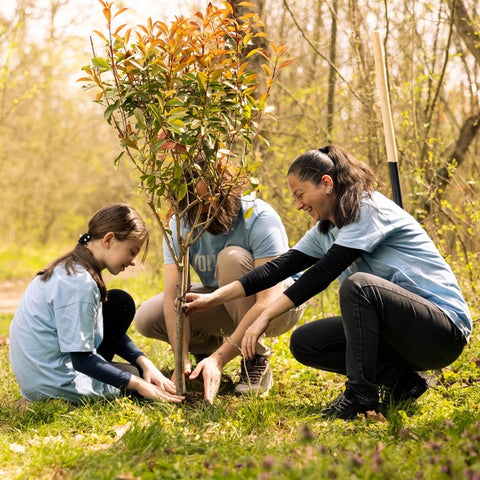
Biochar projects near Ghaziabad are transforming degraded farmland into thriving, carbon-rich soil — and giving communities a powerful, natural tool to fight climate change together. Biochar is a stable, organic form of charcoal produced from crop waste or biomass. When added to soil, it locks carbon underground for centuries while boosting crop yields. Our team at Grow Billion Trees has seen firsthand how this eco-friendly solution revives exhausted land and supports India's mission to plant 100 crore trees by June 2030.
✅ What Is Biochar and Why Does It Matter?
Biochar is made by heating organic material — crop residue, wood chips, or green waste — without oxygen. This process, called pyrolysis, creates a porous, carbon-dense material that improves soil structure naturally. It is not synthetic, not toxic, and not wasteful — it turns agricultural by-products into a climate asset.
According to the United Nations Climate Change Action portal, soil carbon sequestration is one of the most cost-effective strategies available to reduce global warming. Biochar is a long-term solution for carbon storage.
However, biochar is not just a climate tool. It revives soil biology, reduces fertiliser dependency, and supports mindful, sustainable agriculture. For farmers around Ghaziabad, these benefits are deeply practical and immediately impactful.
🌱 The Growing Need for Biochar Projects Near Ghaziabad
Ghaziabad sits at the heart of the Indo-Gangetic Plain — one of India's most intensively farmed regions. Decades of chemical fertiliser use have stripped topsoil of organic matter. As a result, crop yields are falling and groundwater levels are declining year after year.
Farmland in western Uttar Pradesh faces soil degradation, making biochar projects near Ghaziabad important. Land misuse accelerates climate risk and food insecurity across South Asia. See World Wildlife Fund's deforestation and forest degradation research.
Moreover, crop stubble burning — extremely common near Ghaziabad — releases harmful CO₂ and toxic smoke. Biochar production converts this same stubble into a climate solution. Therefore, local biochar programs address air quality, soil health, and carbon storage in one integrated action.
The connection between healthy forests and healthy soil is direct. According to WWF's global forests initiative, forest loss degrades surrounding soil and disrupts water cycles — compounding the damage already caused by industrial farming. Biochar and reforestation together form a great, complementary response to this crisis.
💡 How Biochar Improves Soil Health
Biochar applied correctly can improve soil health. Healthy soil is the foundation of food security, and biochar is a tool to restore it naturally and sustainably.
Here are the key benefits our partners and farmers have observed directly:
- ✅ Improved water retention — biochar holds up to 6 times its weight in water, reducing irrigation needs and saving costs
- ✅ Higher crop yields — combining biochar with organic compost can improve yields
- ✅ Reduced fertiliser use — porous biochar holds nutrients and reduces runoff
- ✅ Stronger soil biology — beneficial microbes thrive in biochar-enriched, natural soil ecosystems
- ✅ Long-term carbon storage — carbon locked in biochar remains stable for hundreds of years
- ✅ Lower soil acidity — biochar raises pH in acidic soils, making nutrients more accessible to crops
Every biochar application is guided by proper soil testing and expert agronomists. Farmers receive ongoing support, training, and follow-up — not just a one-time product.
⭐ Biochar and Climate Action: The Science Behind the Impact
Combating Climate Change Through Collective Action requires both above-ground and below-ground strategies. Biochar bridges these two goals in a wonderful way. Each tonne of biochar applied to soil sequesters approximately 2.5 tonnes of CO₂ equivalent — a significant, verifiable impact.
The United Nations Environment Programme's forests and land restoration programme recognises biochar as a key complement to reforestation. Trees capture carbon above ground; biochar captures it below. Together, they create a powerful dual-carbon sink for our planet and future generations.
For corporates working toward Net Zero Targets, verified biochar projects near Ghaziabad offer measurable, certifiable carbon credits. In addition, these projects support rural livelihoods, biodiversity, and water security. This makes them genuine triple-impact investments for conscious organisations.
For example, a 10-hectare biochar project in the Ghaziabad district can sequester up to 250 tonnes of CO₂ annually. This is equivalent to taking 54 cars off the road for an entire year — a meaningful, green contribution to India's climate goals.
🌳 Grow Billion Trees: Championing Biochar & Reforestation in India
At Grow Billion Trees, we love combining proven science with community-led action. Our mission is to plant 100 crore trees across India by June 2030, and biochar is central to how we restore land and climate impact together. We are not just planting trees — we are rebuilding entire ecosystems.
We provide integrated environmental programs that go far beyond tree planting. Our work near Ghaziabad and across Uttar Pradesh includes agroforestry, Miyawaki forest creation, and biochar soil enrichment. All of these are designed to help land thrive long-term. We are glad to report that our agroforestry program in Uttar Pradesh has already restored over 500 hectares of farmland since we began.
Our 2-3ft Tree Planting + 3 Years Care + GeoTag model ensures every tree is nurtured and tracked with precision. Farmers, donors, and corporate partners can see exactly where their tree grows using our GeoTag technology. This transparency builds authentic, verified trust with our growing community of eco-friendly supporters.
We also offer a wonderful opportunity to Plant a Tree in your Name for just ₹299 — with three years of full care included. Whether for a birthday, a memorial, a corporate sustainability goal, or a gift for someone special, each tree is certified, tracked, and deeply meaningful. Our personalised tree certificates make these moments truly memorable.
Customised green programs for corporate partners across Mumbai, Bangalore, Delhi, Chennai, and Hyderabad help organisations achieve verified Net Zero Targets through a combination of tree planting, Miyawaki forests, mangrove restoration, and soil carbon projects.
→ How You Can Join Biochar Projects Near Ghaziabad
Getting involved is easy, impactful, and genuinely rewarding. Whether you are an individual, a farmer, or a business leader, there is a great path forward with biochar projects near Ghaziabad through Grow Billion Trees.
Here is how to get started:
- Individual supporters — Plant a tree in your name for ₹299 at Grow Billion Trees and directly contribute to soil restoration and reforestation across India
- Farmers near Ghaziabad — Join our agroforestry program to receive biochar training, tree saplings, agronomic support, and GeoTag-verified documentation at no cost
- Corporate partners — Work with our team to design a verified carbon offset program combining tree planting, biochar sequestration, and sustainability reporting
- NGOs and institutions — Collaborate on community biochar hubs, Miyawaki forests, lake restoration, and sustainability education programs
We guarantee transparent reporting, certified impact data, and a dedicated relationship manager for all partnerships. Over thousands of satisfied customers have already trusted us to deliver on our mission with authentic, secure, and verified results.
📊 Key Stats: Biochar Projects in 2026
Here is a snapshot of why biochar projects near Ghaziabad are gaining tremendous momentum in 2026:
- • India has 120 million hectares of degraded land in urgent need of restoration
- • Biochar can improve soil organic carbon in severely depleted soils
- • Indian farmers report reduced input costs after biochar application
- • Carbon credits from biochar projects are valued at $50–$150 per tonne in 2026 global markets
- • Grow Billion Trees has planted over 1 crore trees across India and continues to grow
According to the United Nations Sustainable Development Goals framework, land restoration and climate action are deeply interlinked priorities. Biochar projects directly support SDG 13 (Climate Action), SDG 15 (Life on Land), and SDG 2 (Zero Hunger) — three goals at the core of India's green future.
Frequently Asked Questions
What are biochar projects near Ghaziabad?
These are soil restoration initiatives that use biochar — a natural, carbon-rich material made from organic waste — to improve farmland quality, store carbon underground, and support sustainable agriculture in the Ghaziabad region of Uttar Pradesh, India.
How does biochar help fight climate change?
Biochar locks carbon into the soil for hundreds of years. Each tonne of biochar can sequester up to 2.5 tonnes of CO₂ equivalent. This makes it a proven, natural, and cost-effective climate solution that complements tree planting and reforestation efforts.
Is biochar safe for organic and natural farming?
Yes. Biochar is a fully natural, organic material approved for use in certified organic farming systems. It improves soil biology without any synthetic, toxic, or artificial inputs — making it ideal for conscious, eco-friendly agriculture.
How does Grow Billion Trees contribute to biochar projects near Ghaziabad?
Grow Billion Trees integrates biochar into its agroforestry and reforestation programs across Uttar Pradesh. Our team provides farmers with biochar training, organic saplings, and GeoTag-verified tree care as part of our broader mission to plant 100 crore trees and restore India's land.
Can planting a single tree contribute to biochar soil projects?
Absolutely. When you plant a tree in your name for ₹299 through Grow Billion Trees, you support a wider ecosystem that includes soil restoration, carbon sequestration, and community-based reforestation. Every tree planted is part of a bigger, collective impact.
What is agroforestry and how does it connect to biochar?
Agroforestry combines trees with crops on the same land. When combined with biochar soil amendments, agroforestry dramatically boosts both farm productivity and carbon storage. We found this combination is a wonderful, proven strategy for climate-smart, sustainable farming in India.
Are there corporate biochar programs available near Ghaziabad?
Yes. Grow Billion Trees offers tailored corporate programs that combine verified biochar soil projects with Miyawaki forests and tree planting to help businesses achieve their Net Zero Targets. Our programs include certified impact data and transparent ESG reporting.
How do I track my tree after it is planted?
Our GeoTag technology provides a live, verified map location for every tree planted through Grow Billion Trees. You receive a personalised tree certificate and can monitor your tree's growth online — making your environmental impact real, authentic, and transparent.
What other environmental programs does Grow Billion Trees run?
Beyond biochar and tree planting, Grow Billion Trees runs mangrove restoration, urban forestry, beach cleaning, lake restoration, and sustainability education programs. Our goal is comprehensive environmental restoration, not just isolated tree planting.
How do I get started with Grow Billion Trees?
You can explore all programs and plant your first tree at growbilliontrees.com. Starting at just ₹299 with 3 years of care included, it is the easiest, most impactful way to take climate action today. The time to act is now. Discover how biochar projects near Ghaziabad can transform degraded land into a thriving, carbon-rich ecosystem. Explore our eco-friendly programs and learn more about Combating Climate Change Through Collective Action at Grow Billion Trees. Together, we can nurture a greener, healthier future — for Ghaziabad, for India, and for our shared planet.
Biochar programmes with Grow Billion Trees
Biochar turns crop and farm waste into a stable form of carbon that improves soil. We run biochar alongside plantation and agroforestry programmes for companies.
- Biochar programme
- How to get carbon credits in India
- Agroforestry programme
- CSR rules for tree plantation
Talk to our team about a programme for your company.