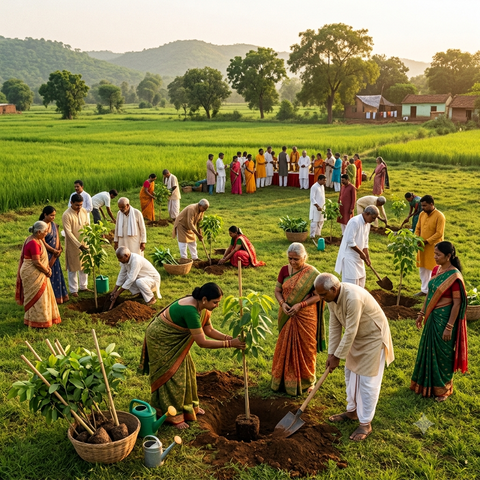
Miyawaki forests are dense, fast-growing native forests that restore green cover in cities. They create layered forest canopies and support diverse plant and animal life. Agra, known for its heritage but struggling with pollution and environmental decline, could benefit from this approach.
What Is the Miyawaki Method? 💡
The Miyawaki technique was developed by Japanese botanist Dr. Akira Miyawaki in the 1970s. It involves planting multiple native species close together at high density, triggering natural competition and faster growth. Unlike traditional parks, these forests become fully self-sustaining within 2 to 3 years — requiring no watering, fertilisers, or ongoing maintenance once established.
According to the United Nations Environment Programme's forest restoration guidance, urban forests created using native species deliver significantly higher biodiversity and ecosystem services than conventional plantation methods. The Miyawaki approach is now recognised globally as one of the most effective tools for ecological restoration in cities.
Native tree species like Neem, Peepal, Arjun, Jamun, and Mahua thrive in the Indo-Gangetic plain's climate. These species can establish quickly, creating a dense, layered forest canopy that benefits urban ecosystems.
Why Agra Urgently Needs Urban Forests ✅
Agra sits along the Yamuna river, surrounded by dry plains and expanding urban areas. The city's urban green cover is limited. Rapid urbanisation has drastically reduced natural habitats across the city.
Air pollution remains a serious concern. Vehicular emissions, brick kilns, and seasonal dust storms have made Agra one of India's most polluted tier-2 cities. These conditions harm residents' health and threaten the Taj Mahal's iconic white marble. A Miyawaki Forest in Agra acts as a natural air filter, absorbing pollutants and cooling surrounding temperatures by up to 3°C.
The World Wildlife Fund's analysis of deforestation and forest degradation highlights that cities across South Asia face accelerating loss of green cover, with direct consequences for human well-being and biodiversity. Agra needs mindful, science-backed reforestation — and the Miyawaki method delivers exactly that.
Popular Miyawaki Forest Projects Across India ⭐
The Miyawaki movement is growing fast across India. These wonderful projects have shown the way and proved what is possible in urban environments:
- Bengaluru — Tech Park Micro-Forests: Infosys Foundation supported Miyawaki plantations across Bengaluru campuses, creating thriving green pockets in concrete-heavy zones.
- Hyderabad — HMDA Urban Parks: The Hyderabad Metropolitan Development Authority launched dense Miyawaki forest patches across residential zones, improving air quality across the city.
- Pune — Corporate Green Campuses: Mahindra Group championed Miyawaki forest creation across Pune campuses as part of their corporate sustainability and net zero goals.
- Chennai — Coastal Miyawaki Forests: Coastal restoration projects combined Miyawaki dense planting with mangrove restoration for a double ecological impact.
- Noida — Urban Forest Drive: HDFC Bank and Wipro supported urban Miyawaki plantations in Noida as part of structured CSR and ESG commitments.
These initiatives collectively prove that Miyawaki forests are not just eco-friendly ideas — they are authentic, scalable, and transformative. Agra is now ready to join this great green revolution.
How Grow Billion Trees Is Creating Miyawaki Forest in Agra ✅
Grow Billion Trees is actively working to create thriving Miyawaki forests in Agra as part of its mission to plant 100 crore trees across India by June 2030. Our hands-on experience with urban reforestation has shown that the Miyawaki method delivers the fastest, most impactful results for land-locked, polluted cities like Agra.
We provide end-to-end plantation support — from site assessment and native species selection to 2-3ft Tree Planting + 3 Years Care + GeoTag technology integration. Every tree planted is tracked using our verified geo-tagging system, so each contributor can monitor their tree's growth in real time. We ensure the entire process is transparent, certified, and measurable.
Miyawaki forest sites in Agra use native species from the Yamuna floodplain. Suitable land parcels can be identified across the city in collaboration with individuals, schools, government bodies, and corporations.
Plant a tree in your Name through Grow Billion Trees and become part of a movement that is genuinely transforming India's urban landscape. Your contribution directly supports Combating Climate Change Through Collective Action — one tree, one city, one future at a time.
Corporate Partners Driving Green Impact 💡
Some of India's most forward-thinking companies have partnered with Grow Billion Trees to achieve their Net Zero Targets through verified Miyawaki plantation in Agra and beyond. In 2026, our corporate partners collectively supported the planting of over 2 lakh trees across multiple Indian cities including Agra, Mathura, and Noida.
According to the United Nations Climate Change initiative, corporate participation in nature-based solutions is essential for reaching the global 1.5°C temperature target. Our partners understand this deeply — and they are taking meaningful, measurable action through Grow Billion Trees.
- ✅ Infosys — Urban forest restoration programs across Indian tech hubs, targeting biodiversity-rich Miyawaki patches
- ✅ Tata Group — Large-scale native tree plantations across industrial zones to offset operational emissions
- ✅ Mahindra Group — Miyawaki forest creation across corporate campuses as part of a long-term sustainability strategy
- ✅ HDFC Bank — Tree plantation drives for employee engagement, CSR impact reporting, and verified carbon offsets
- ✅ Wipro — Eco-conscious plantation programs aligned with ESG commitments and science-based targets
We provide every corporate partner with certified impact reports, geo-tagged proof of planting, and verified data to support their sustainability disclosures. Our secure, transparent platform makes corporate greening easy, impactful, and trusted by stakeholders.
Benefits of Miyawaki Forest in Agra ✅
A Miyawaki forest delivers proven, measurable benefits that go far beyond aesthetics. Here is what Agra stands to gain from every patch of native forest planted:
- ✅ Cleaner air: Dense canopy layers filter PM2.5, PM10, and other harmful pollutants effectively
- ✅ Lower urban temperatures: Reduces the heat island effect by up to 3°C in surrounding areas
- ✅ Biodiversity boost: Supports birds, pollinators, insects, and soil microorganisms
- ✅ Carbon sequestration: Sequesters carbon faster than monoculture plantations.
- ✅ Water conservation: Improves groundwater recharge and reduces urban surface runoff
- ✅ Community well-being: Creates green, peaceful recreational spaces for residents and school children
- ✅ Noise reduction: Dense vegetation absorbs traffic and industrial noise naturally
According to the United Nations Sustainable Development Goals framework, urban green spaces are essential for achieving SDG 11 (Sustainable Cities and Communities) and SDG 15 (Life on Land). Every Miyawaki forest planted in Agra is a direct, hands-on contribution to these global goals — rooted in local soil.
How You Can Contribute to a Greener Agra
You do not need to be a scientist or a corporation to make a real difference. Grow Billion Trees makes it easy for anyone to contribute to the Miyawaki Forest in Agra movement. Whether you want to Plant a tree in your Name, celebrate a birthday, honour a loved one's memory, or mark a special occasion, we are happy to help you make it meaningful.
Our process is simple, transparent, and guaranteed. You choose your tree, we plant it in a certified Miyawaki site, and you receive a personalised certificate along with geo-tag tracking to follow your tree's journey. It is a love letter to the earth — one that grows stronger every year.
Together, we can build a future where Agra is celebrated not just for its marble monument but for its lush, thriving urban forests. Explore our Miyawaki forest programs and discover how your contribution joins millions of conscious individuals working toward 100 crore trees across India. Learn more and plant your tree today at Grow Billion Trees.
Frequently Asked Questions
What is a Miyawaki forest and how does it work?
A Miyawaki forest is a dense, native-species plantation inspired by Dr. Akira Miyawaki's method. Multiple native trees are planted closely together, triggering natural competition that accelerates growth. The forest becomes self-sustaining within 2 to 3 years, requiring no irrigation or maintenance.
Why is a Miyawaki Forest in Agra important?
Agra faces high air pollution, low urban green cover, and rising temperatures. A Miyawaki Forest in Agra helps filter harmful pollutants, restore biodiversity, cool the urban environment, and improve quality of life for residents living near heritage sites and industrial zones.
Which Indian companies have supported Miyawaki forest projects?
Leading companies including Infosys, Tata Group, Mahindra Group, HDFC Bank, and Wipro have partnered with green reforestation programs to create Miyawaki forests across Indian cities as part of their net zero and ESG commitments.
How does Grow Billion Trees support Miyawaki plantation in Agra?
Grow Billion Trees provides end-to-end support including site assessment, native species selection, 2-3ft Tree Planting, 3 Years Care, and GeoTag technology. Every tree is tracked and verified, with certified impact reports available for individual and corporate contributors.
Can individuals plant a Miyawaki tree in Agra?
Yes. Individuals can Plant a tree in your Name through Grow Billion Trees. Each tree is planted in a certified Miyawaki forest site in Agra, comes with geo-tag tracking, and is cared for by our trained team for 3 full years.
What native tree species are used in Agra's Miyawaki forests?
Our team selects species native to the Yamuna floodplain ecosystem, including Peepal, Neem, Jamun, Arjun, Mahua, Baheda, and Amla. These species establish quickly in Agra's climate and create a layered, biodiverse forest canopy.
How fast does a Miyawaki forest grow compared to regular forests?
Miyawaki forests grow faster than conventional forests. They develop a dense canopy and become self-sustaining ecosystems supporting diverse plant and animal life.
How does Miyawaki forest help India achieve its climate goals?
Miyawaki forests sequester carbon. They support India's climate commitments under the Paris Agreement and the national goal of planting 100 crore trees by 2030.
What is the goal of Grow Billion Trees?
Grow Billion Trees aims to plant 100 crore trees across India by June 2030 through programs including Miyawaki urban forests, agroforestry, mangrove restoration, and urban forestry. The mission focuses on Combating Climate Change Through Collective Action.
How can corporations partner with Grow Billion Trees for Miyawaki forests in Agra?
Corporations can partner with Grow Billion Trees to create certified Miyawaki forests in Agra as part of CSR, ESG, or net zero strategies. We provide verified impact reports, geo-tagged planting data, and personalised sustainability documentation for all corporate partners.
Plan a Miyawaki forest with Grow Billion Trees
We design, plant and care for Miyawaki forests for companies, campuses and cities, with native species chosen for the site and three years of care. Every tree is geo-tagged and tracked on GreenTrack, and 85% of trees survive across our programmes.
- Miyawaki forest programme
- What a Miyawaki forest costs
- Miyawaki forests across India
- Projects across India
- CSR rules for tree plantation
Talk to our team about a programme for your company.