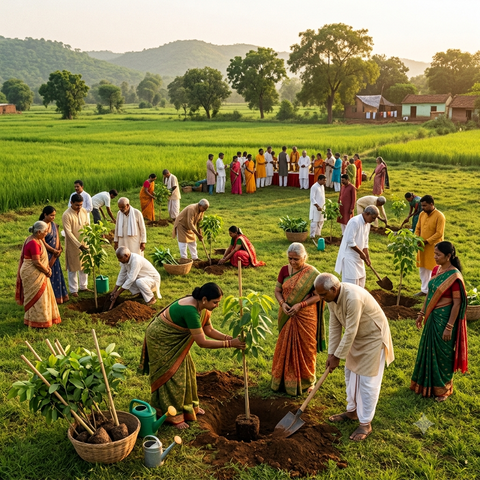
The Miyawaki Forest in Arunachal Pradesh is a nature-based approach to restoring degraded land into thriving forests. Developed by Japanese botanist Dr. Akira Miyawaki, this technique plants dense layers of native species to recreate natural forest succession.
Arunachal Pradesh is home to one of the world's most extraordinary biodiversity hotspots — the Eastern Himalayas. However, encroachment, shifting cultivation, and infrastructure pressures are degrading forest patches at an alarming rate. According to UNEP's research on forests and reforestation, tropical forests store up to 250 billion tonnes of carbon, making their protection and restoration globally critical. In 2026, bold Miyawaki initiatives are helping reverse this decline.
What Is the Miyawaki Method? 💡
The Miyawaki method is a proven reforestation technique that plants 20–40 native species in dense, multi-layered configurations within a small plot. This mimics natural forest succession and creates a self-sustainable ecosystem without long-term human intervention. The result is a vibrant, biodiverse canopy that grows naturally and thrives for centuries.
Unlike monoculture plantations, Miyawaki forests build ecological resilience through diversity. Each plant layer — shrub, sub-tree, canopy, and emergent — supports the others. Moreover, the dense planting suppresses weeds naturally, eliminating the need for pesticides or fertilizers after the first establishment phase.
The World Wildlife Fund's forest conservation programs confirm that native species plantations deliver greater ecological benefit than exotic species.
Why Arunachal Pradesh Needs Miyawaki Forests ✅
Arunachal Pradesh spans tropical rainforests, temperate zones, and alpine meadows — making it ideal for diverse, layered Miyawaki restoration. Forest loss due to development pressure is a challenge in India. Restoring degraded land through Miyawaki forests can deliver ecological benefits.
The state's unique geography supports thousands of endemic plant and animal species found nowhere else on Earth. Therefore, every Miyawaki forest planted here does more than grow trees — it rebuilds entire ecosystems, restores wildlife corridors, and strengthens local communities. This is what makes conscious reforestation in this region so wonderful and urgent.
For background, see WWF's report on deforestation and forest degradation. Restoring forests supports India's climate commitments. Healthier forests also improve water retention and reduce erosion.
Forests improve soil microbiota, regulate local climate, and recharge groundwater. For farming communities, Miyawaki forests combine ecological and livelihood benefits.
Popular Miyawaki Forests in Arunachal Pradesh ⭐
Several landmark Miyawaki forest projects have taken root across Arunachal Pradesh, setting inspiring examples of what collective action can achieve. These sites are living proof that green futures are possible — and they are growing stronger every year.
- Itanagar Urban Miyawaki Forest — Located near the state capital, this project covers over 2 acres and features 35 native species including Hollong (Dipterocarpus macrocarpus), Nahor (Mesua ferrea), and Wild Mango. It now serves as a certified green lung for the growing city.
- Pasighat Miyawaki Demonstration Forest — Established along the Siang River basin, this forest showcases riparian native species and supports biodiversity corridors.
- Naharlagun Green Patch Initiative — A community-led Miyawaki project near the industrial township, converting a degraded hillside into thriving native forest. This project now supports over 40 bird species and is a trusted biodiversity refuge.
- Ziro Valley Agroforestry-Miyawaki Integration — In this UNESCO-recognized cultural landscape, Miyawaki principles have been integrated with traditional Apatani farming practices. This combines food security with ecological restoration in a truly mindful way.
- Bomdila Forest Restoration Plot — A high-altitude Miyawaki initiative using temperate native species, demonstrating that the method is effective across Arunachal Pradesh's varied altitude zones.
Each of these sites is a wonderful example of what nature can achieve when given the right start and consistent care. They inspire communities, attract ecotourism, and improve local livelihoods.
Corporates Leading the Green Revolution ✅
India's corporate sector has embraced Miyawaki forests as a powerful, authentic tool for achieving Net Zero Targets and demonstrating genuine environmental responsibility. Several leading companies have invested in Arunachal Pradesh's green future through CSR and sustainability programs.
- Oil India Limited (OIL) — With deep operations across Northeast India, OIL has funded multiple Miyawaki plantation drives as part of its CSR mandate, covering areas bordering Arunachal Pradesh with verified native tree restoration.
- NTPC Limited — As part of its green energy commitment, NTPC's Arunachal Pradesh hydropower divisions have sponsored Miyawaki forest creation to offset project footprints and restore riparian zones near project sites.
- Tata Sustainability Group — Tata has supported reforestation across Northeast India, with Miyawaki projects contributing to their biodiversity commitments and nature-positive business goals.
- Wipro EcoEnergy — Wipro has championed urban Miyawaki forests across India. Its Northeast India programs include Arunachal Pradesh, restoring degraded patches and improving urban green cover.
- Adani Foundation — Through community development programs in the Northeast, Adani Foundation has co-funded Miyawaki initiatives in partnership with local NGOs and state forest departments.
These corporate partnerships are central to Combating Climate Change Through Collective Action. Together, companies and communities are proving that business growth and ecological restoration can move forward as one. We are glad to work alongside these forward-thinking organisations.
How Grow Billion Trees Builds Self-Sustainable Miyawaki Forests 💡
At Grow Billion Trees, we provide end-to-end Miyawaki forest creation designed to build genuinely self-sustainable ecosystems. Our hands-on approach ensures every forest we establish is rooted in ecological science, community engagement, and long-term care. We love seeing barren land transform into vibrant, living forests.
Our process begins with a thorough site assessment and soil health analysis. We identify native species best suited to the local microclimate, altitude, and ecological zone. This ensures each Miyawaki forest we create is authentically local — never a generic plantation.
Our team uses 2-3ft Tree Planting + 3 Years Care + GeoTag technology to track every sapling's growth. Each tree is geo-tagged with GPS coordinates, allowing you to monitor its progress in real time through our secure digital platform. This certified, verified approach guarantees full transparency and peace of mind.
We ensure the critical establishment phase — the first 12 months — is fully managed by our expert ecologists. This includes mulching, targeted watering, and organic weed management to give saplings the best possible start. After this phase, the forest becomes truly self-sustaining, requiring no further intervention.
Our Commitment to Arunachal Pradesh
Grow Billion Trees expands Miyawaki programs in Arunachal Pradesh, partnering with state forest departments, local panchayats, and community groups.
Our mission to plant 100 crore trees across India includes a strong focus on Northeast India's irreplaceable biodiversity hotspots. Through our Plant a Tree in your Name campaigns, individuals and corporates can directly contribute to Miyawaki forest creation in Arunachal Pradesh. You receive a personalized certificate and can follow your tree's growth journey through our GeoTag platform.
The Environmental Impact: Numbers That Matter ⭐
- Absorbs up to 20 tonnes of CO2 per year at maturity
- Supports greater biodiversity than conventional plantations
- Improves local groundwater levels
- Reduces ambient temperature by up to 3°C in surrounding areas
- Becomes fully self-sustaining within 2–3 years — zero ongoing maintenance
For background, see United Nations Climate Change Action framework.
Miyawaki forests restore forest cover in degraded areas.
Why Choose Grow Billion Trees for Miyawaki Reforestation? ✅
Our team brings together ecologists, forest scientists, and community coordinators to deliver Miyawaki forests that truly last. We are trusted by leading corporates, government bodies, and thousands of conscious individuals committed to a greener India.
- ✅ Site-specific native species selection for genuine ecological impact
- ✅ GeoTag technology for real-time, transparent tree tracking
- ✅ 3-year aftercare guarantee for every sapling planted
- ✅ Certified and verified reforestation practices
- ✅ Community integration for long-term forest sustainability
- ✅ Corporate partnership programs aligned with Net Zero Targets
We believe every individual, family, and company has the power to transform the planet. Our programs make it easy and meaningful to save the forests we love, boost biodiversity, and improve lives across India. Together, we can build a future where every patch of degraded land becomes a thriving, natural forest.
Frequently Asked Questions
What is a Miyawaki Forest in Arunachal Pradesh?
A Miyawaki Forest is a dense forest created using the Miyawaki method — planting multiple layers of indigenous species close together.
How long does a Miyawaki forest take to become self-sustaining?
Typically, a Miyawaki forest becomes fully self-sustaining within 2–3 years. After the initial establishment phase, it requires no irrigation, fertilizers, or maintenance — growing entirely on its own like a natural forest.
Which native species are used in Miyawaki forests in Arunachal Pradesh?
Common native species include Hollong (Dipterocarpus macrocarpus), Nahor (Mesua ferrea), Wild Mango (Mangifera sylvatica), Simul (Bombax ceiba), Elephant Apple (Dillenia indica), and various native bamboo and shrub species suited to local microclimates across different altitude zones.
How does Grow Billion Trees help build Miyawaki forests?
Grow Billion Trees provides complete end-to-end Miyawaki forest services — from site assessment and native species selection to 2-3ft Tree Planting + 3 Years Care + GeoTag tracking. Every forest is built for long-term ecological success and monitored through our secure digital platform.
Can corporates partner with Grow Billion Trees for Miyawaki forests?
Absolutely. We offer dedicated corporate Miyawaki programs to help companies achieve their Net Zero Targets and CSR environmental goals. Our team designs, plants, and monitors forests on behalf of corporate partners with full transparency, certified reporting, and GeoTag verification.
What makes Miyawaki forests better than regular tree plantations?
Miyawaki forests use multiple native species in dense, multi-layered configurations to create biodiverse ecosystems.
How does GeoTag technology work for Miyawaki forests?
Every tree planted through Grow Billion Trees receives a unique GeoTag ID linked to its GPS coordinates. You can track your tree's growth, view photos, and monitor its health through our secure digital platform — giving you real, hands-on connection to your forest and its progress.
Can I Plant a Tree in my Name in Arunachal Pradesh?
Yes. Grow Billion Trees allows you to Plant a Tree in your Name in Miyawaki forests across India, including Arunachal Pradesh. You receive a personalized certificate and can track your tree's entire growth journey through our verified GeoTag system.
How do Miyawaki forests support local communities?
Miyawaki forests improve soil health, boost groundwater recharge, reduce erosion, and support local biodiversity. They can be integrated with farming systems to support local livelihoods.
What is Grow Billion Trees' overall reforestation mission?
Grow Billion Trees is working to plant 100 crore trees across India by June 2030. Through Miyawaki forests, agroforestry, mangrove restoration, and urban forestry programs, we are Combating Climate Change Through Collective Action — one tree, one community, one future at a time.
A Greener Arunachal Pradesh Starts Today
The Miyawaki Forest in Arunachal Pradesh is more than a reforestation technique — it is a movement to restore, revive, and celebrate the natural world. From corporate giants to individual tree planters, everyone plays a great role in this living, growing story. Our team is passionate about making every square metre of restored land count.
Grow Billion Trees is happy to partner with anyone who shares this green vision. Whether you are a conscious individual, a forward-thinking company, or a community eager to transform degraded land, we provide the expertise, technology, and care to make it happen. Discover how easy it is to make a lasting impact.
Explore our Miyawaki forest programs today and become part of India's journey to plant 100 crore trees. Together, we can build a future where every degraded hillside in Arunachal Pradesh blooms into a self-sustainable, thriving forest. Visit Grow Billion Trees now to learn more and take your first meaningful step towards a greener planet.
Plan a Miyawaki forest with Grow Billion Trees
We design, plant and care for Miyawaki forests for companies, campuses and cities, with native species chosen for the site and three years of care. Every tree is geo-tagged and tracked on GreenTrack, and 85% of trees survive across our programmes.
- Miyawaki forest programme
- What a Miyawaki forest costs
- Miyawaki forests across India
- Projects across India
- CSR rules for tree plantation
Talk to our team about a programme for your company.