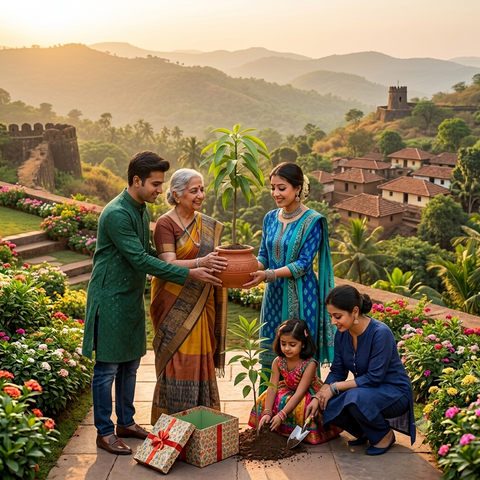
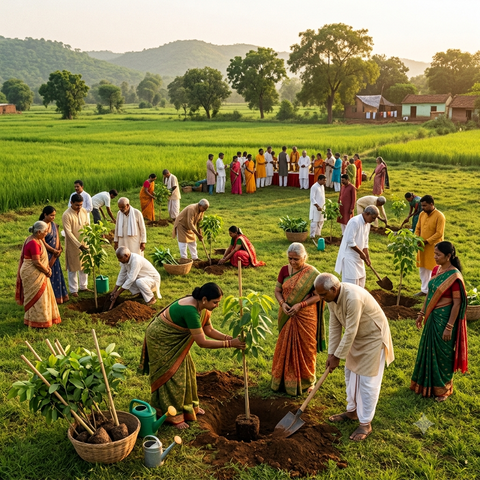
The Miyawaki method creates dense, self-sustaining forests by planting multiple native species closely together. This Japanese approach is suited to Jhansi's semi-arid landscape for forest restoration.
According to the United Nations Environment Programme, dense native plantings are among the most effective tools for biodiversity restoration. Our team has seen hands-on how these mini-forests transform barren patches into thriving ecosystems within just 2–3 years. The need for such green interventions has never been greater.
💡 What Is the Miyawaki Method?
The Miyawaki method was developed by Japanese botanist Akira Miyawaki. When it comes to miyawaki forest in jhansi,It involves planting multiple native species close together, mimicking the natural structure of a forest. Plants are set 3–4 per square metre, creating a naturally competitive environment that accelerates growth. No chemical pesticides or fertilisers are used at any stage.
Miyawaki forests become self-sustaining over time, requiring less irrigation and maintenance as they mature.
- ✅ Uses only native, locally adapted species
- ✅ Faster growth than conventional forests
- ✅ Becomes self-sustaining within 2–3 years
- ✅ Supports local birds, insects, and biodiversity
- ✅ Requires zero chemical inputs after establishment
⭐ Why Jhansi Needs Miyawaki Forests
Jhansi lies in the Bundelkhand region, one of India's most water-stressed and ecologically fragile zones. When it comes to miyawaki forest in jhansi,The area faces severe deforestation, drought, and rapid land degradation. As noted by the World Wildlife Fund on deforestation and forest degradation, forest loss threatens millions of species and accelerates climate change at a global scale.
Miyawaki forests help reduce local temperatures and support groundwater recharge. Urban forests offer environmental benefits for cities like Jhansi.
Reduced forest cover in Bundelkhand has worsened heat waves, irregular rainfall, and soil erosion. Moreover, local farming communities suffer as a direct result of these changes. Restoring native forests here delivers cascading benefits for both people and the planet.
✅ Popular Miyawaki Plantation Projects Across India
India has seen a great surge in Miyawaki plantation projects in recent years. These initiatives prove that the method works brilliantly across diverse Indian climates — and inspire what is possible in Jhansi.
Aarey Colony in Mumbai has an urban Miyawaki forest. Infosys has created Miyawaki forests across its campuses to support biodiversity and sustainability goals.
Toyota Kirloskar Motor developed Miyawaki-style green belts at their Bidadi facility in Karnataka, planting over 1 lakh native trees. Mahindra Group has championed Miyawaki forests at various sites in Maharashtra and Telangana, integrating green spaces into their sustainability roadmap.
Wipro has planted Miyawaki forests at multiple campuses as part of their comprehensive environmental sustainability programs. Larsen & Toubro (L&T) has developed dense mini-forests at their construction and corporate sites, each featuring thousands of native plant species. HDFC Bank and Bosch India have also supported Miyawaki-based greening drives as part of their CSR commitments. These projects demonstrate that Miyawaki Forest in Jhansi is achievable at scale with the right partners.
🌱 How Grow Billion Trees Is Transforming Jhansi
Grow Billion Trees is proud to bring its expertise in sustainable forest creation to Jhansi and the wider Bundelkhand region. When it comes to miyawaki forest in jhansi,Our mission — planting 100 crore trees across India by June 2030 — is directly served by establishing Miyawaki forests in ecologically stressed zones. We provide end-to-end services: site assessment, native species selection, plantation, and 2-3ft Tree Planting + 3 Years Care + GeoTag tracking for every tree.
Our hands-on experience in Miyawaki plantation across India gives us deep knowledge of native species best suited to Bundelkhand's climate. When it comes to miyawaki forest in jhansi,We ensure each project is certified and verified through our proprietary GeoTag technology. This means you can Plant a tree in your Name and track its growth in real time — knowing your contribution is making a genuine, measurable difference.
We are glad to partner with corporates, government bodies, and conscious individuals who want to invest in Jhansi's green future. When it comes to miyawaki forest in jhansi,Our corporate environmental programs help organisations achieve their Net Zero Targets with transparent, data-backed impact. Combating Climate Change Through Collective Action is at the heart of everything we do — and Jhansi is one of our most loved project locations.
💡 How Corporates Can Partner for Miyawaki Projects in Jhansi
Grow Billion Trees welcomes corporate partnerships for Miyawaki Forest in Jhansi. Our partners enjoy dedicated project sites, branded signage, and regular GeoTag-powered progress reports. We also provide carbon offset certificates for ESG reporting and customised plantation certificates for CSR communication.
- ✅ Dedicated Miyawaki forest site with branded recognition
- ✅ Regular progress reports powered by GeoTag data
- ✅ Carbon offset certificates for ESG and sustainability reporting
- ✅ Employee engagement: tree planting drives and green days
- ✅ Personalised plantation certificates for CSR communication
According to the United Nations Climate Change framework, corporations must act urgently to limit global warming to 1.5°C. When it comes to miyawaki forest in jhansi,Miyawaki forests are one of the most proven, science-backed tools to support that goal. Corporates like Tata Group, Infosys, Mahindra, and Wipro have demonstrated that investing in Miyawaki forests delivers both environmental and reputational value.
⭐ The Environmental Impact of Miyawaki Forest in Jhansi
Miyawaki forests sequester carbon, support diverse bird and insect species, and provide climate and water-management benefits.
The United Nations Sustainable Development Goals highlight biodiversity conservation and climate action as top global priorities for 2030. When it comes to miyawaki forest in jhansi,Miyawaki forests directly advance these goals by restoring native ecosystems quickly and sustainably. For Jhansi — a city battling water scarcity and rising heat — this is a wonderful, organic solution that improves lives at the community level.
In addition, Miyawaki forests improve air quality, reduce noise pollution, and create natural cooling corridors in urban areas. When it comes to miyawaki forest in jhansi,Moreover, they thrive without chemical inputs, making them a truly eco-friendly investment. Our partners consistently report that these forests boost employee wellbeing and community goodwill in equal measure.
Frequently Asked Questions
What is a Miyawaki Forest in Jhansi?
A Miyawaki Forest in Jhansi is a dense, native forest created using the Japanese Miyawaki method. Multiple species are planted close together to mimic natural forest structures. These forests mature relatively quickly and become self-sustaining.
Why is Jhansi a good location for Miyawaki forests?
Jhansi lies in the ecologically stressed Bundelkhand region, facing deforestation, drought, and rising temperatures. Miyawaki forests are ideal here because they restore biodiversity, improve groundwater, and reduce heat — all critical needs for this area and its farming communities.
How does Grow Billion Trees create Miyawaki forests in Jhansi?
Grow Billion Trees conducts thorough site assessments, selects native Bundelkhand species, plants them at high density, and provides 2-3ft Tree Planting + 3 Years Care + GeoTag tracking. Our team monitors every tree through technology for verified, transparent impact you can follow online.
Can corporations partner with Grow Billion Trees for Miyawaki projects?
Yes. Grow Billion Trees offers structured corporate partnership programs for Miyawaki Forest in Jhansi, including dedicated sites, ESG reporting support, carbon certificates, and employee engagement. Corporates like Mahindra, Infosys, and L&T have benefited from similar hands-on programs.
How long does a Miyawaki forest take to establish?
A Miyawaki forest becomes visibly dense within 6–12 months and fully self-sustaining within 2–3 years. After this period, no irrigation, pruning, or fertilising is required. The forest continues to grow and improve the local ecosystem indefinitely.
What native species are planted in a Jhansi Miyawaki forest?
Native species suited to Bundelkhand include Neem, Peepal, Arjun, Mahua, Jamun, Baheda, Amaltas, and Palash. These are climate-resilient, organic species that support local biodiversity and thrive without chemical inputs in Jhansi's semi-arid conditions.
How can I plant a tree in Jhansi through Grow Billion Trees?
You can Plant a tree in your Name through the Grow Billion Trees website. Each tree comes with GeoTag tracking so you can follow its natural growth. It is a great, mindful gift for birthdays, memorials, corporate occasions, or simply as a personal pledge to the planet.
What is the carbon sequestration impact of a Miyawaki forest?
Miyawaki forests provide ecological benefits in compact spaces. Corporates have adopted this approach for sustainability goals.
Together, We Can Green Jhansi
Miyawaki Forest in Jhansi represents a proven, powerful path to ecological restoration in one of India's most climate-vulnerable regions. Whether you are a conscious individual, a corporate seeking to meet net zero targets, or a community leader wanting to transform your neighbourhood, Grow Billion Trees is your trusted partner. We ensure every tree is planted with care, tracked with technology, and nurtured for three full years.
Together, we can transform Jhansi's barren landscapes into thriving, biodiverse green corridors — one native tree at a time. When it comes to miyawaki forest in jhansi,Discover our Miyawaki plantation programs and explore how you can contribute to planting 100 crore trees across India. Learn more at Grow Billion Trees and take your first step toward a greener, cooler, more sustainable Jhansi today.
Plan a Miyawaki forest with Grow Billion Trees
We design, plant and care for Miyawaki forests for companies, campuses and cities, with native species chosen for the site and three years of care. Every tree is geo-tagged and tracked on GreenTrack, and 85% of trees survive across our programmes.
- Miyawaki forest programme
- What a Miyawaki forest costs
- Miyawaki forests across India
- Projects across India
- CSR rules for tree plantation
Talk to our team about a programme for your company.