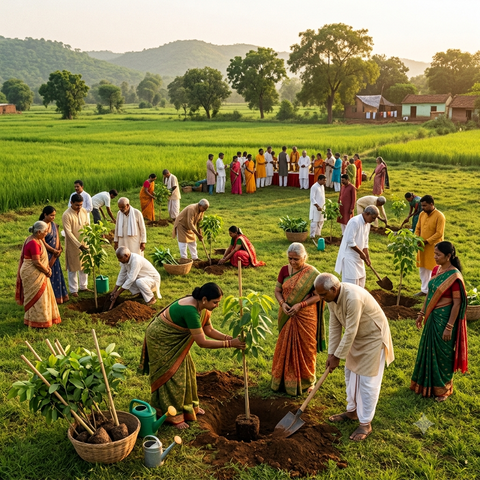
Rewilding Jaipur is no longer just a vision — it is a living reality. Kishan Bagh Desert Park was once a barren wasteland on the city's edge. Today, it thrives as a lush, self-sustaining green ecosystem, proving that Combating Climate Change Through Collective Action delivers real, measurable results.
In 2026, India's cities face mounting environmental pressure. According to the United Nations Climate Change initiative, urban heat islands and deforestation are accelerating global warming at an alarming rate. Jaipur's bold rewilding effort stands as a beacon of hope for cities across the country.
Our team at Grow Billion Trees is glad to have supported green transformation projects like this. We found that the right mix of native species and community action creates forests that truly last. The results at Kishan Bagh inspire us every single day.
✅ The Green Transformation of Kishan Bagh Desert Park
Kishan Bagh Desert Park spans approximately 15 hectares in Jaipur. For years, it was neglected, degraded land prone to dust storms and seasonal flooding. Today, it shelters over 100 species of native trees, shrubs, birds, and pollinators.
The Jaipur Development Authority partnered with local environmental groups to launch a large-scale rewilding initiative. The strategy focused on soil restoration and native species reintroduction. As a result, the park now acts as a vital green lung for the surrounding urban neighbourhoods.
Rewilding can improve local environmental conditions, supporting greater biodiversity.
The Kishan Bagh model is now studied by urban planners across Rajasthan. Its success has sparked a broader conversation about sustainable, nature-first city planning. For example, several Rajasthan municipalities have already launched their own rewilding programs inspired by this transformation.
🌿 Popular Miyawaki Forests Transforming Rajasthan
The Miyawaki method — developed by Japanese botanist Akira Miyawaki — creates dense native forests. Rajasthan uses this technique. According to the United Nations Environment Programme on forests, native dense forests sequester carbon more efficiently than monoculture plantations.
Some of Rajasthan's most celebrated Miyawaki forests include:
- Mansarovar Miyawaki Urban Forest, Jaipur — a 2-acre community-led forest supporting over 80 native plant species
- Ajmer Road Green Corridor, Jaipur — a dense Miyawaki strip along the highway now home to nesting bird colonies
- Fateh Sagar Lake Miyawaki Patch, Udaipur — protecting the watershed of one of Rajasthan's most loved lakes
- Jodhpur Industrial Miyawaki Belt — planted near industrial zones to naturally reduce air and dust pollution
- Bhartrihari Hills Green Patch, Alwar — restoring a once-barren hillside with native Aravalli species
These are not just plantations — they are self-sustaining ecosystems. They require no chemical inputs and minimal maintenance after the initial care period. Each forest helps boost local biodiversity and improve quality of life for nearby communities.
⭐ Corporates Leading Rajasthan's Green Revolution
Corporate India has made a decisive contribution to rewilding Jaipur. Major companies now integrate tree planting into their sustainability strategies to achieve certified Net Zero Targets. Their partnerships have transformed dozens of sites across Rajasthan.
Notable corporate participants in Rajasthan's green movement include:
- Infosys Foundation — funded a 1-acre Miyawaki forest near Jaipur's Sitapura IT hub
- Tree-planting initiatives across Rajasthan involve partnerships with local organizations.
- Mahindra Group — sponsored the Ajmer Road Green Corridor as part of their net zero commitment
- ITC Limited — launched an organic agroforestry and Miyawaki program across rural Rajasthan districts
- Adani Foundation — contributed to green belt development near Jaisalmer and Jodhpur
- JCB India — funded the Jodhpur Industrial Miyawaki Belt, transforming a dust-ridden zone into a green buffer
- HCL Foundation — supported urban greening initiatives in Jaipur through dedicated CSR environmental programs
These partnerships show that business and nature can grow together. However, effective corporate greening requires expert guidance and verified, transparent impact measurement. This is where Grow Billion Trees makes a great difference for our partners across India.
💡 How Grow Billion Trees Builds Self-Sustainable Miyawaki Forests
Grow Billion Trees is on a mission to plant 100 crore trees across India by June 2030. Our Miyawaki forest program is one of our most powerful and impactful tools. We provide hands-on support from initial site assessment all the way to long-term ecosystem monitoring.
Native species diversity is the foundation of a resilient forest. Saplings are nurtured with organic, eco-friendly inputs during the initial care period.
Here is how our step-by-step process works:
- → Site Assessment — our team evaluates soil type, drainage, and sunlight conditions on the ground
- → Organic Soil Preparation — we restore soil health using natural composting and microbial enrichment
- → Native Species Selection — we curate 30–50 locally adapted species for maximum ecological resilience
- → Dense Planting — saplings are planted at 3–5 per square metre for true forest density
- → 2-3ft Tree Planting + 3 Years Care + GeoTag — every tree is tracked with our verified GeoTag technology
- → Community Training — local stewards are trained to maintain the forest independently over time
We provide all corporate partners with authentic, verified impact reports that guarantee full transparency. You can also Plant a tree in your Name and make a lasting, conscious contribution to India's green future. Our platform makes it easy to track your tree and receive a personalised certificate.
The World Wildlife Fund's global forest conservation initiatives confirm that ecosystem-based approaches like Miyawaki planting are among the most effective tools for forest restoration. We are proud to align our work with these globally recognised, certified standards.
🌍 The Science Behind Rewilding Jaipur
Rewilding Jaipur means restoring entire ecosystems — soil microbes, pollinators, birds, and native plants — to their natural, self-regulating state. According to the WWF's research on deforestation and forest degradation, full ecosystem restoration delivers far greater ecological benefits than simple afforestation. It is the most mindful, conscious approach to saving our planet.
Miyawaki forests sequester carbon more efficiently than conventional plantations and can improve soil quality.
Therefore, rewilding is the most sustainable, long-term solution to urban ecological decline. Together, every tree we plant helps save and transform our shared natural world. The future of Jaipur — and all of India — is gloriously green.
Frequently Asked Questions
What is rewilding and why does Jaipur need it?
Rewilding restores ecosystems by reintroducing native plants and allowing biodiversity to recover without constant human management. Jaipur faces rising temperatures, poor air quality, and serious biodiversity loss. Kishan Bagh Desert Park's transformation is a proven example of how rewilding Jaipur creates real, lasting ecological change.
What is the Miyawaki method and how does it work?
The Miyawaki method plants dense native species to create a self-sustaining forest in a few years. These forests grow much faster than conventional plantations. They support greater biodiversity and require no chemical inputs after the initial care period.
Which corporates have participated in Miyawaki forests in Rajasthan?
Major corporates including Infosys Foundation, TCS, Mahindra Group, ITC Limited, Adani Foundation, JCB India, and HCL Foundation have contributed to Miyawaki programs across Rajasthan. These initiatives support certified Net Zero Targets and corporate sustainability commitments.
How does Grow Billion Trees support Miyawaki forest creation?
Grow Billion Trees provides complete, hands-on Miyawaki forest solutions — from organic soil preparation and native species selection to long-term care and GeoTag monitoring. We ensure every forest becomes a self-sustaining ecosystem. Our team works with individuals, communities, and corporates across India.
How can I contribute to rewilding Jaipur?
You can Plant a tree in your Name through Grow Billion Trees and contribute directly to rewilding efforts in Jaipur and across India. Our platform lets you track your tree using GeoTag technology. You also receive a personalised, certified tree certificate as proof of your impact.
What is GeoTag technology in tree planting?
GeoTag technology assigns a unique GPS coordinate to each planted tree. This allows you to monitor your tree's growth and exact location in real time. Grow Billion Trees uses GeoTag to provide secure, transparent, and verified impact data to every contributor and corporate partner.
What is Grow Billion Trees' overall planting goal?
Grow Billion Trees is committed to planting 100 crore trees across India by June 2030. This goal supports India's national reforestation targets. It also contributes to the global mission of Combating Climate Change Through Collective Action through proven nature-based solutions.
What are the ecological benefits of Miyawaki forests in arid Rajasthan?
In arid regions, Miyawaki forests reduce soil erosion, increase groundwater recharge, lower ambient temperatures, and improve air quality. They also provide vital natural habitat for wildlife displaced by urbanisation. For Rajasthan's desert climate, these eco-friendly benefits are especially critical and impactful.
Join the Rewilding Movement — Transform India Together
Rewilding Jaipur is a wonderful story of collective hope, purpose, and action. Kishan Bagh Desert Park proves that barren land can bloom again when people come together. This is the future we love — a greener, more natural India for every generation.
We welcome you to explore the Grow Billion Trees Miyawaki forest program. Discover how you can Plant a tree in your Name and support our mission of 100 crore trees planted across India. Whether you are an individual, a family, or a corporate seeking Net Zero Targets, we have a certified, verified program for every goal.
Learn more and take your first step today. Visit Grow Billion Trees and help us build a thriving, sustainable planet for all future generations.
Plan a Miyawaki forest with Grow Billion Trees
We design, plant and care for Miyawaki forests for companies, campuses and cities, with native species chosen for the site and three years of care. Every tree is geo-tagged and tracked on GreenTrack, and 85% of trees survive across our programmes.
- Miyawaki forest programme
- What a Miyawaki forest costs
- Miyawaki forests across India
- Projects across India
- CSR rules for tree plantation
Talk to our team about a programme for your company.