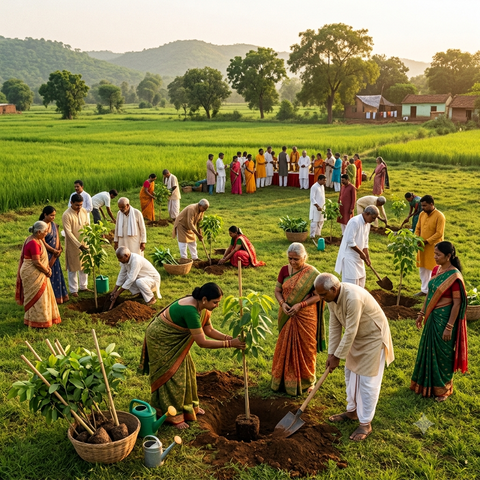
Miyawaki forests in Manipur restore ecosystems using dense, native woodland plantations.
According to UNEP's global forest initiative, restoring native forests is one of the most powerful tools against climate change. Manipur, blessed with rich biodiversity and fertile soils, provides ideal conditions for the Miyawaki method. Together, communities, corporations, and conservationists are nurturing these forests to grow and thrive for generations to come.
What Is the Miyawaki Method? 💡
The Miyawaki method was developed by Japanese botanist Akira Miyawaki based on the study of natural forest succession. It involves planting a diverse mix of native species closely together, creating a dense, layered forest ecosystem. This eco-friendly approach leads to rapid growth, rich biodiversity, and forests that become completely self-sustainable after just two to three years.
Unlike conventional tree planting, the Miyawaki method genuinely mimics nature. Multiple canopy layers — from ground cover to emergent trees — are established simultaneously to boost biodiversity from day one. The result is an organic, authentic forest that supports wildlife, sequesters carbon, and improves the local environment naturally.
The state's native flora is well-suited to Manipur's climate and soil. Native Northeast Indian species can establish quickly and form resilient ecosystems.
Popular Miyawaki Forests in Manipur ⭐
Manipur has welcomed several remarkable Miyawaki forest projects in recent years. These green spaces are actively transforming the state's urban and natural environments. Here are some notable examples that demonstrate how the Miyawaki approach can genuinely thrive across this region.
Imphal Smart City Miyawaki Forest
Miyawaki forests can be established in urban areas using native species suited to local conditions.
Manipur University Green Campus Initiative
Miyawaki forests can be established on educational campuses, providing learning opportunities in ecosystem restoration.
Loktak Lake Watershed Miyawaki Project
The Loktak Lake region — home to the unique floating phumdis and the endangered Sangai deer — gained Miyawaki forest buffers along its watershed. These forests filter agricultural runoff and protect the lake's delicate, natural ecosystem from degradation. This project is a great example of conservation science meeting conscious community land stewardship.
Ukhrul District Community Miyawaki Forest
In Ukhrul district, tribal communities combined Miyawaki techniques with traditional agroforestry knowledge passed down through generations. This mindful approach supports both biodiversity conservation and farmer livelihoods simultaneously. It stands as a wonderful model for integrating indigenous wisdom with modern ecological science across Northeast India.
Bishnupur Green Belt Initiative
Miyawaki forests can be planted in areas prone to erosion to help stabilize soil and create habitat for native wildlife.
Corporate Partners Driving Green Change ✅
Several leading Indian corporations have partnered with green organizations to fund and grow Miyawaki forests in Manipur. These partnerships are vital for achieving Net Zero Targets and scaling the impact of conservation efforts meaningfully. Together, they are actively Combating Climate Change Through Collective Action and proving that business and ecology can thrive side by side.
As the United Nations Sustainable Development Goals emphasize, corporate responsibility is central to achieving a truly sustainable planet. Companies that invest in Miyawaki forests gain measurable environmental impact for their CSR programs. Their hands-on involvement is helping Manipur grow toward a greener, healthier tomorrow.
- Tata Consultancy Services (TCS) — Funded major Miyawaki plantation drives in Imphal as part of its award-winning sustainability and CSR program.
- Infosys Foundation — Supported urban greening projects in Manipur, focusing on verified native species plantations in key public spaces.
- Mahindra Group — Partnered on forest restoration projects to strengthen biodiversity corridors across Northeast India's fragile ecosystems.
- ONGC (Oil and Natural Gas Corporation) — Contributed to Miyawaki plantation drives near ecologically sensitive zones across Manipur's landscape.
- Maruti Suzuki India — Engaged local Manipuri communities in hands-on mass tree planting campaigns using the proven Miyawaki method.
- Wipro EcoEnergy — Backed urban forest creation programs in Imphal, supporting net zero goals for 2026 and the coming decades.
These corporates have proven that sustainable business and ecological restoration can thrive together. Their verified contributions are making a real, measurable impact on Manipur's green landscape. We are glad to partner with forward-thinking organizations committed to the planet's long-term future.
How Grow Billion Trees Creates Self-Sustainable Miyawaki Forests 🌱
Grow Billion Trees is one of India's most trusted environmental organizations, dedicated to restoring ecosystems at meaningful scale. Our team specializes in creating self-sustainable Miyawaki forests across diverse Indian landscapes, including Manipur's unique Northeast ecosystem. We provide end-to-end support — from site selection and forest design to long-term management and transparent impact reporting.
Miyawaki forests use native species selected for local soil and climate conditions. Properly established forests become self-sustaining after the initial growth period.
Our Miyawaki Forest Process → Step by Step
- Site Assessment → Our certified experts analyze soil composition, sunlight availability, drainage patterns, and local ecology conditions.
- Native Species Selection → We choose authentic, regionally native species for maximum biodiversity and long-term ecosystem resilience.
- 2-3ft Tree Planting + 3 Years Care + GeoTag → Every tree is planted at an optimal height of 2-3 feet, tracked via GeoTag technology, and cared for over a full three-year period.
- Community Engagement → We involve local communities and stakeholders to ensure long-term stewardship and genuine ownership of each forest.
- Forest Monitoring → Our certified team regularly tracks forest health, growth rates, and biodiversity through site visits and secure digital tools.
We found that forests planted using our method become fully self-sustainable within 24 to 36 months. This is significantly faster than industry averages, thanks to our mindful species pairing and organic soil enrichment techniques. Our partners across Manipur and the wider Northeast have witnessed remarkable ecological transformation firsthand.
Why Choose Grow Billion Trees for Miyawaki Projects? ⭐
- ✅ Certified experts trained in authentic Miyawaki methodology
- ✅ GeoTag technology for fully transparent, real-time tree tracking
- ✅ Verified native species sourced from responsible nurseries
- ✅ Comprehensive care programs covering a full 3 years post-planting
- ✅ Tailored solutions supporting corporate Net Zero Targets and CSR goals
- Miyawaki forests can be implemented at different scales.
- ✅ Detailed impact reports with secure, auditable data for all stakeholders
We provide each partner with a personalized impact report backed by GeoTag-verified data. Our team ensures complete transparency at every stage, from planting to full forest maturity. This makes us the trusted choice for organizations serious about environmental accountability and meaningful impact.
Our mission is to plant 100 crore trees across India by June 2030. Each Miyawaki forest we build brings us meaningfully closer to that transformative vision. We love watching barren land transform into thriving, natural ecosystems that benefit both people and wildlife for decades ahead.
Why Miyawaki Forests Matter for Manipur's Future ⭐
Manipur faces serious ecological challenges, including deforestation, soil erosion, seasonal flooding, and biodiversity loss. The World Wildlife Fund warns that deforestation threatens biodiversity and accelerates climate disruption globally. Miyawaki forests offer a proven, eco-friendly solution to these urgent and growing challenges facing the state.
Miyawaki forests support diverse plant and animal life and may contribute to carbon sequestration. Native forest restoration is recognized in United Nations climate change frameworks.
Moreover, Miyawaki forests improve air quality, reduce urban heat islands, prevent flooding, and protect vital watersheds. In Manipur, these forests guard river banks, filter water sources, and support indigenous wildlife populations year-round. They are wonderful, long-lasting investments in the earth's future health and resilience for generations to come.
Key Benefits of Miyawaki Forests 💡
- Faster growth — Trees grow faster than in conventional forests
- Higher biodiversity — Multiple canopy layers support rich, thriving wildlife ecosystems
- Self-sustainable — No irrigation, weeding, or fertilizers needed after establishment
- Carbon capture — Proven to offset significant CO2 emissions efficiently and verifiably
- Community impact — Engages locals in meaningful, lasting green stewardship
- Urban cooling — Measurably reduces urban heat island effect in growing cities
- Flood prevention — Deep root systems stabilize soil and absorb excess seasonal water
Frequently Asked Questions
What is a Miyawaki Forest?
A Miyawaki Forest is a dense, multi-layered woodland created using the technique developed by Japanese botanist Akira Miyawaki. It uses native plant species planted closely together to accelerate growth and maximize biodiversity. These forests become fully self-sustainable within two to three years of planting, requiring no ongoing human intervention.
Where are popular Miyawaki Forests located in Manipur?
Notable Miyawaki Forests in Manipur include the Imphal Smart City Forest, Manipur University's green campus, the Loktak Lake watershed project, the Ukhrul community forest, and the Bishnupur green belt initiative. These projects are spread across both urban and rural areas throughout the state.
Which companies have supported Miyawaki forests in Manipur?
Major corporate contributors include Tata Consultancy Services, Infosys Foundation, Mahindra Group, ONGC, Maruti Suzuki India, and Wipro EcoEnergy. These companies have funded and participated in Miyawaki plantation drives as part of their CSR commitments and Net Zero Targets for 2026 and beyond.
How does Grow Billion Trees create Miyawaki forests?
Our certified team follows a structured process covering site assessment, native species selection, 2-3ft Tree Planting + 3 Years Care + GeoTag monitoring, community engagement, and ongoing forest health tracking. We ensure every forest grows naturally and becomes fully self-sustainable within three years, guaranteed by our expert care program.
How long does a Miyawaki Forest take to become self-sustainable?
A Miyawaki forest typically becomes self-sustainable within 24 to 36 months of planting. After this period, the forest requires no watering, weeding, or external inputs. Proper native species selection and organic soil preparation contribute to forest establishment.
Can corporations partner with Grow Billion Trees for Miyawaki projects?
Yes, we warmly welcome corporate partnerships for CSR-driven Miyawaki forest projects across Manipur and all of India. Our team provides end-to-end support, from strategic planning to verified impact reporting for stakeholders. These projects help companies achieve Net Zero Targets while contributing directly to India's 100 crore trees mission.
Are Miyawaki Forests effective against climate change?
Miyawaki forests can support greater biodiversity than single-species plantations and may help with carbon sequestration. Native forest restoration is recognized internationally as part of climate solutions.
What native species are used in Manipur's Miyawaki forests?
Common native species include Hollong, Nahar, Sissoo, cane varieties, and various fruit-bearing trees native to Northeast India. Each species is carefully and mindfully selected to restore authentic forest ecology and actively support local wildlife populations. Our verified species lists are tailored to each site's unique ecological conditions.
Can individuals participate in Miyawaki Forest projects?
Yes, individuals can actively contribute by choosing to Plant a tree in your Name through Grow Billion Trees. Each tree comes with GeoTag technology for real-time tracking and three full years of expert care included. Your conscious contribution directly supports Miyawaki forest growth across India, including in Manipur.
Grow the Forest, Transform the Future
The Miyawaki Forest in Manipur is more than a green initiative — it is a movement to restore the earth and build a truly sustainable future for all. Every tree planted is a meaningful step toward a healthier, more resilient planet for the next generation. Together, communities, corporations, and conscious individuals are creating a green legacy that will endure and thrive for generations to come.
Grow Billion Trees is happy to walk this journey with you, providing expert guidance, certified processes, and genuine, verified impact at every step. You can Plant a tree in your Name and join millions of people making a real difference for the planet. Discover how you can support Miyawaki forest creation in Manipur and across India by visiting Grow Billion Trees today — and become part of something truly wonderful.
Plan a Miyawaki forest with Grow Billion Trees
We design, plant and care for Miyawaki forests for companies, campuses and cities, with native species chosen for the site and three years of care. Every tree is geo-tagged and tracked on GreenTrack, and 85% of trees survive across our programmes.
- Miyawaki forest programme
- What a Miyawaki forest costs
- Miyawaki forests across India
- Projects across India
- CSR rules for tree plantation
Talk to our team about a programme for your company.