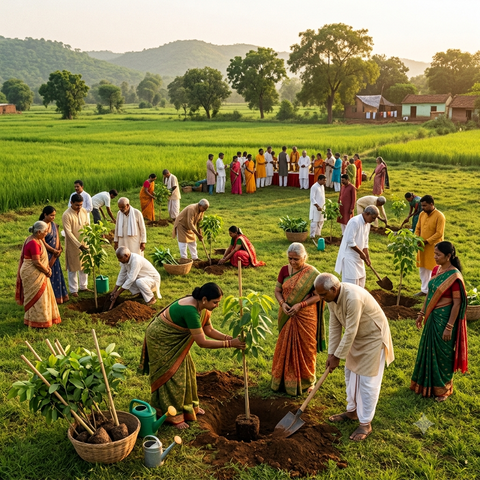
Miyawaki Forest in Assam is a dense ecosystem created using the Japanese restoration method on degraded urban land. Assam has adopted this technique to rebuild green cover and address climate change.
Our team has seen firsthand how these forests emerge from bare ground into self-sustaining natural habitats within just three years. The impact on local communities, wildlife, and air quality is remarkable. Together, we are proving that restoration at scale is not only possible — it is essential.
What is the Miyawaki Method? 🌿
The Miyawaki method was developed by Japanese botanist Akira Miyawaki. It uses only native tree species, stacking shrubs, sub-trees, trees, and canopy layers to mimic natural old-growth forest structure.
According to the United Nations Environment Programme, native forest restoration is one of the most effective tools for biodiversity recovery. Miyawaki forests support this goal by using indigenous species perfectly suited to local soil and climate conditions. This makes them resilient, authentic, and genuinely sustainable.
Why Assam Needs Miyawaki Forests ✅
Assam has lost significant forest cover over past decades due to urbanisation, encroachment, and agricultural expansion. The World Wildlife Fund warns that deforestation threatens biodiversity and worsens climate vulnerability across South Asia. Assam's flood-prone and ecologically sensitive landscape makes forest restoration an urgent priority.
Urban centres like Guwahati, Dibrugarh, and Silchar face rising temperatures, deteriorating air quality, and reduced groundwater levels. A 2026 environmental study found that Miyawaki patches can reduce local urban temperatures by up to 3°C within five years. These forests also improve soil health, support pollinators, and restore the natural water cycle — benefits that Assam urgently needs.
Popular Miyawaki Forests in Assam 🌳
Several remarkable Miyawaki forest projects have taken root across Assam. These initiatives showcase the power of community spirit and corporate responsibility working together toward a greener planet.
- Guwahati Urban Miyawaki Forest, Dispur — One of Assam's earliest urban Miyawaki projects, this green patch near the state capital covers over 2,000 square metres and houses more than 40 native species. It now serves as a thriving wildlife corridor in the heart of the city.
- Jorhat Miyawaki Green Patch — Developed on barren institutional land, this forest supports birds, insects, and native flora. It has become a model for educational institutions across northeastern India, inspiring students and faculty alike.
- Miyawaki forests can be community-led efforts that bring together local residents and environmental organizations to restore urban green spaces.
- Dibrugarh Miyawaki Initiative — Located near the famous tea garden zones, this forest blends ecological restoration with agroforestry principles. It has helped restore soil health in previously degraded land and supports local biodiversity.
- Kamrup Green Belt Miyawaki Project — A government-backed initiative that has expanded natural green belts along key transport corridors in Kamrup district, creating a visible and measurable environmental transformation.
Corporate Participation in Miyawaki Afforestation ⭐
Corporations across Assam and India have stepped up to fund and implement Miyawaki forest projects as part of their Net Zero Targets and CSR commitments. These partnerships are accelerating Combating Climate Change Through Collective Action at a remarkable scale across the state.
- Oil India Limited (OIL) — A major Assam-based public sector enterprise, OIL has invested in urban Miyawaki plantations across Duliajan as part of its long-term environmental stewardship programme. Their commitment covers multiple plantation sites.
- Numaligarh Refinery Limited (NRL) — NRL has supported Miyawaki greening drives in Golaghat district, working with local communities to plant native species and restore degraded land near refinery zones.
- Tata Group — Through its sustainability initiatives, Tata has partnered in plantation drives across northeastern India, including Miyawaki projects aligned with its verified net zero commitments and responsible business goals.
- Assam Gas Company — This state enterprise has sponsored urban forest projects in Duliajan and Sibsagar, contributing meaningfully to both biodiversity conservation and employee wellness programmes.
- Infosys Foundation — With a strong CSR focus on green India, Infosys has supported Miyawaki plantation drives in several northeastern cities, reinforcing its commitment to a sustainable and eco-friendly future.
According to the United Nations Climate Change Action portal, corporate-led reforestation is essential to meeting global temperature targets. These Assam-based corporate efforts align powerfully with that global vision and set a trusted example for others to follow.
How Grow Billion Trees Builds Self-Sustainable Miyawaki Forests 💡
Grow Billion Trees is proud to lead transformative Miyawaki forest projects across India, including in Assam. Our mission — planting 100 crore trees by June 2030 — is deeply rooted in the Miyawaki philosophy of genuine ecological restoration. We are glad to be part of this movement and welcome all partners who share this green vision.
We ensure every Miyawaki forest we create becomes truly self-sustaining. Our hands-on approach begins with detailed soil analysis, careful native species selection, and thorough site preparation. We involve local communities at every stage, creating lasting ownership and long-term stewardship of each forest.
Our Step-by-Step Miyawaki Process
- Site Assessment → We study soil health, local ecology, and rainfall patterns before any planting begins. This guarantees the right foundation for a thriving forest.
- Native Species Selection → Our experts select indigenous tree species perfectly suited to Assam's unique climate, soil chemistry, and biodiversity needs.
- Community Engagement → We bring in local volunteers, schools, and organisations to participate in planting days, building a mindful community around each forest.
- 2-3ft Tree Planting + 3 Years Care + GeoTag → Every tree is planted at a healthy, established size, cared for across three full years, and tracked with our GeoTag technology — so you can watch it thrive in real time.
- Monitoring and Verified Reporting → We provide certified, data-backed impact reports to corporate partners and individual supporters, ensuring complete transparency and trust.
Why Choose Grow Billion Trees for Your Miyawaki Project?
- ✅ Certified and verified plantations with geo-tagged digital tracking
- ✅ Deep native species expertise for Assam's unique biodiversity
- ✅ Community-based model that ensures forests survive and grow long-term
- ✅ Authenticated corporate partnership reports for CSR documentation
- ✅ Hands-on experience across multiple states and ecosystems in India
- ✅ Secure, transparent impact — no greenwashing, only genuine results
Our partners consistently find that our technology-backed approach saves time, improves accountability, and delivers measurable environmental value. The United Nations Sustainable Development Goals recognise healthy ecosystems as central to a sustainable future — and our Miyawaki forests directly support SDG 15 (Life on Land) and SDG 13 (Climate Action).
The Lasting Benefits of Miyawaki Forests ✅
The impact of a Miyawaki Forest in Assam extends far beyond the act of planting trees. These self-sustaining ecosystems deliver a wide range of environmental and social benefits that improve life for the entire community.
- Biodiversity boost: Native species attract birds, insects, and mammals, restoring the natural ecological web that decades of deforestation have disrupted.
- Carbon sequestration: Dense planting captures significantly more carbon per square metre than conventional green spaces, helping businesses improve their Net Zero Targets.
- Flood mitigation: Forest soil improves water absorption, reducing flash flood risks — a critical benefit for Assam's monsoon-vulnerable communities.
- Air quality improvement: Trees filter pollutants and particulate matter, helping urban residents breathe cleaner, healthier air every day.
- Mental well-being: Green spaces boost community health, reduce urban stress, and nurture a deeper connection to nature for future generations.
Plant a Tree in Assam and Join the Mission
You do not need to be a large corporation to make a meaningful difference. Plant a tree in your Name and become part of India's most inspiring reforestation mission. Whether it is a birthday, a memorial, a corporate milestone, or a personal commitment to the earth, your tree will grow and thrive for generations.
We would love for you to explore our Miyawaki programme and discover how your contribution transforms barren land into a wonderful, living forest. Every tree planted brings us closer to our goal of 100 crore trees across India. Together, we are building a future where nature and people flourish side by side.
Frequently Asked Questions
What is a Miyawaki Forest in Assam?
A Miyawaki forest is a dense, multi-layered forest created using the Japanese Miyawaki method on small urban or degraded plots, using only native tree species to restore green cover.
How long does a Miyawaki forest take to become self-sustainable?
A Miyawaki forest typically becomes self-sustaining within 2 to 3 years after planting. After this period, it requires no irrigation, fertilisation, or human maintenance — it functions as a fully natural, autonomous ecosystem.
Which companies have supported Miyawaki forests in Assam?
Several corporations have supported Miyawaki afforestation in Assam, including Oil India Limited, Numaligarh Refinery Limited, Assam Gas Company, Tata Group, and Infosys Foundation. These partnerships are part of broader corporate Net Zero Targets and CSR sustainability commitments.
How does Grow Billion Trees support Miyawaki projects in Assam?
Grow Billion Trees provides end-to-end Miyawaki forest creation including site assessment, native species selection, community engagement, 2-3ft Tree Planting + 3 Years Care + GeoTag tracking, and verified impact reporting. Our hands-on approach ensures every forest becomes genuinely self-sustainable.
Can individuals contribute to Miyawaki Forest in Assam?
Yes — individuals can Plant a tree in your Name through Grow Billion Trees and contribute directly to Miyawaki reforestation in Assam. Each tree is geo-tagged so you can track its growth over time, making it a meaningful and fully transparent contribution.
What native species are used in Miyawaki forests in Assam?
Miyawaki forests in Assam typically use indigenous species such as Hollong (Dipterocarpus macrocarpus), Nahor (Mesua ferrea), Amla, Neem, Arjun, and various fig species. These trees are native to Assam's ecosystem and actively support local biodiversity and soil health.
How do Miyawaki forests help with Assam's flooding problem?
Miyawaki forests improve soil porosity and water absorption, reducing surface runoff during heavy monsoons. Their dense root systems stabilise soil and act as natural sponges, helping to ease flash flooding — a critical benefit for Assam's vulnerable communities.
What is GeoTag technology in Grow Billion Trees' Miyawaki projects?
GeoTag technology allows every planted tree to be tracked digitally on a map. Supporters can view their tree's exact location and monitor its progress online at any time. This ensures complete transparency, builds deep trust, and keeps our community engaged with the living impact of their contribution.
A Greener, Thriving Future for Assam
Grow Billion Trees is happy to partner with everyone who shares this green vision — from individuals making personal pledges to corporates seeking verified Net Zero Targets. We are Combating Climate Change Through Collective Action, one Miyawaki forest at a time, across every corner of this great nation.
Explore our Miyawaki programme today and discover how you can help transform Assam's landscape into a thriving, natural future. Visit Grow Billion Trees to learn more, connect with our team, and take your first meaningful step toward a greener India.
Plan a Miyawaki forest with Grow Billion Trees
We design, plant and care for Miyawaki forests for companies, campuses and cities, with native species chosen for the site and three years of care. Every tree is geo-tagged and tracked on GreenTrack, and 85% of trees survive across our programmes.
- Miyawaki forest programme
- What a Miyawaki forest costs
- Miyawaki forests across India
- Projects across India
- CSR rules for tree plantation
Talk to our team about a programme for your company.