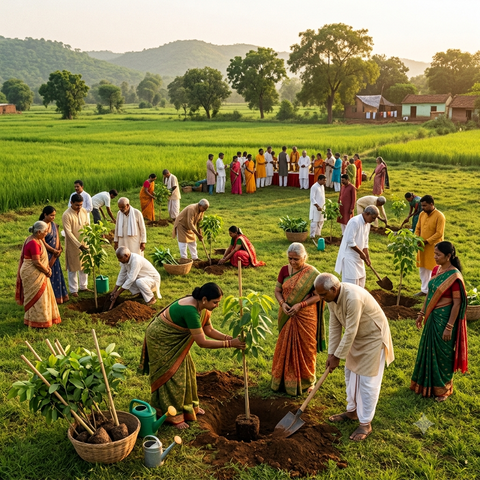
Miyawaki Forest in Andhra Pradesh transforms barren urban plots, industrial zones, and dryland expanses into dense native ecosystems. This Japanese afforestation method, developed by botanist Akira Miyawaki, creates forests through high-density planting and enriched soil. Andhra Pradesh has adopted this technique.
From coastal Visakhapatnam to the arid plains of Anantapur, Miyawaki forests are proving that nature can bounce back with the right support. Corporates, governments, and passionate individuals are joining hands to make this happen. Together, we are creating ecosystems that sustain themselves, support biodiversity, and combat climate change for generations to come.
✅ What is the Miyawaki Method?
The Miyawaki method involves planting multiple native species extremely close together, mimicking the structure of a natural forest. Each square metre hosts 3–5 different species, creating a rich, multi-layered canopy. The dense planting triggers natural competition among trees, accelerating growth and building a self-sustaining ecosystem far faster than traditional methods.
For background, see United Nations Environment Programme on Forests.
The method is also deeply eco-friendly. It uses organic soil amendments, avoids chemical inputs, and relies entirely on native plant intelligence. As a result, Miyawaki forests in Andhra Pradesh are not just green spaces — they are living, breathing restoration projects.
⭐ Popular Miyawaki Forests in Andhra Pradesh
Andhra Pradesh is home to several landmark Miyawaki forests that serve as inspiring models for the entire country. Our team has been glad to witness and support many of these initiatives firsthand. Here are some of the most notable projects:
- Vizag Urban Forest, Visakhapatnam — A Miyawaki forest near the Steel Plant zone with native species including neem, peepal, and tamarind.
- Amaravati Capital Region Green Belt — Part of the new capital city's master plan, featuring multiple Miyawaki patches with 25+ native species spread across key development zones.
- Tirupati Eco Forest, Tirupati — Nestled near the sacred Tirumala foothills, this project beautifully blends ancient grove traditions with modern Miyawaki science.
- Vijayawada Green Lung Project — A 3-acre Miyawaki patch on the banks of the Krishna River, developed in partnership with municipal authorities as a model for urban greening.
- Anantapur Dryland Forest, Anantapur — A pioneering project proving that Miyawaki works even in challenging semi-arid conditions when native species selection and soil preparation are done right.
- Nellore Coastal Restoration Zone — A unique coastal Miyawaki initiative integrating mangrove-adjacent tree species to boost resilience along Andhra Pradesh's eastern shoreline.
Each of these projects showcases the power of conscious, mindful reforestation. They inspire communities, attract eco-tourism, and improve local air and water quality. Moreover, they serve as living proof that Combating Climate Change Through Collective Action is not just a slogan — it is a daily reality in Andhra Pradesh.
💡 Corporates Leading the Green Revolution in Andhra Pradesh
Corporate Andhra Pradesh has enthusiastically embraced Miyawaki forests as part of broader ESG commitments and Net Zero Targets. For background, see World Wildlife Fund's Forest Conservation Initiative.
Some of the great corporate names actively participating in Miyawaki forest creation in Andhra Pradesh include:
- Hindustan Zinc — Supported dense native plantation drives across industrial corridors in AP as part of a long-term sustainability roadmap.
- NTPC (Simhadri Thermal Power Station, Visakhapatnam) — Planted Miyawaki forests around their facility boundary, contributing to local biodiversity and improving air quality for surrounding communities.
- Aurobindo Pharma — Partnered with green organizations to grow urban Miyawaki patches near manufacturing facilities in Andhra Pradesh, as part of their verified carbon neutrality goals.
- Vedanta Resources — Funded multiple Miyawaki restoration patches in eastern Andhra Pradesh, focusing on native species adapted to local soil profiles.
- AP State FiberNet — Collaborated with state forest departments to plant Miyawaki forests along infrastructure corridors, blending green development with digital expansion.
- Dalmia Bharat Group — Invested in Miyawaki forest creation near cement production zones to offset industrial carbon footprints through certified native afforestation.
These companies understand that genuine environmental impact requires more than token gestures. They are investing in sustainable, proven solutions that deliver measurable results. Therefore, Miyawaki forests in Andhra Pradesh continue to grow in scale and ambition each year.
✅ How Grow Billion Trees Builds Self-Sustainable Miyawaki Forests
Grow Billion Trees brings hands-on expertise, scientific rigour, and deep passion to every Miyawaki project in Andhra Pradesh. Our mission is to help communities, corporates, and governments create forests that thrive independently — natural ecosystems that need no external support after the initial care period.
Our process begins with a detailed soil health assessment and native species mapping specific to Andhra Pradesh's diverse agro-climatic zones. We ensure rich soil layering using organic matter, creating the nutrient-dense foundation that Miyawaki forests depend on. Our team has identified over 60 locally native tree species — from the coastal zones of Visakhapatnam to the highland regions near Kurnool — ensuring every forest is genuinely rooted in its local ecology.
Miyawaki forests follow a protocol of high-density planting, multi-species canopy layers, zero chemical inputs, and rigorous early-stage monitoring.
Our signature 2-3ft Tree Planting + 3 Years Care + GeoTag system makes every tree trackable and transparent. Corporate partners and individual supporters can monitor canopy growth, verify tree health, and measure real-world environmental impact through our digital tracking platform. This technology-backed accountability is what makes Grow Billion Trees a trusted partner for companies pursuing verified Net Zero Targets.
We provide comprehensive impact reports including biodiversity assessments, carbon sequestration estimates, and certified plantation documentation. Our Miyawaki forests across Andhra Pradesh have collectively covered significant acreage and supported thousands of native trees. Through the collective goal to Plant 100 crore trees, we are building a greener, more resilient Andhra Pradesh — one dense native forest at a time.
⭐ Key Benefits of Miyawaki Forests for Andhra Pradesh
The environmental and social benefits of Miyawaki Forest in Andhra Pradesh are both immediate and long-lasting. They improve lives, restore nature, and help the planet thrive. Here is why communities and corporates love this approach:
- ✅ Faster growth than conventional plantation methods
- ✅ Denser canopy coverage for ecological impact
- ✅ Carbon sequestration of approximately 5 tonnes of CO2 per acre per year
- ✅ Biodiversity boost — supports insects, birds, reptiles, and small mammals
- ✅ Soil regeneration — improves structure, prevents erosion, and boosts moisture retention
- ✅ Urban cooling — reduces local heat island effect by up to 2°C
- ✅ Groundwater recharge — dense canopies channel rainfall deep into the soil
- ✅ Self-sustaining — no irrigation, weeding, or fertiliser after 2–3 years
According to the United Nations Climate Change Action framework, dense native forests rank among the most cost-effective and impactful tools available for climate mitigation. Andhra Pradesh's growing investment in Miyawaki forests directly supports India's nationally determined contributions to the Paris Agreement.
However, the urgency cannot be overstated. As the World Wildlife Fund on Deforestation and Forest Degradation highlights, the world loses approximately 10 million hectares of forest annually. Miyawaki forests offer a proven, scalable, and organic answer to this crisis — right here in Andhra Pradesh.
Frequently Asked Questions
What is a Miyawaki forest and how does it work?
A Miyawaki forest is a dense, native multi-species forest created using a Japanese afforestation method. Trees are planted closely together with enriched soil, triggering rapid natural growth.
Where are the most notable Miyawaki forests in Andhra Pradesh?
Key Miyawaki forests exist in Visakhapatnam, Vijayawada, Tirupati, Amaravati, Anantapur, and Nellore. Each project was developed through collaborative efforts involving government bodies, corporates, and organisations like Grow Billion Trees.
Which corporates have supported Miyawaki forests in Andhra Pradesh?
Prominent corporates include Hindustan Zinc, NTPC (Simhadri), Aurobindo Pharma, Vedanta, AP State FiberNet, and Dalmia Bharat Group. These companies have partnered with green organisations to fund and scale Miyawaki plantation projects across the state.
How does Grow Billion Trees help create Miyawaki forests?
Grow Billion Trees provides end-to-end Miyawaki forest solutions including soil analysis, native species selection, high-density planting, organic soil preparation, GeoTag tracking, and 3 years of hands-on care. Our team ensures every forest becomes genuinely self-sustainable.
How long does a Miyawaki forest take to become self-sustaining?
Miyawaki forests typically become self-sustaining within 2–3 years of planting. After this period, they require no irrigation, weeding, or external fertilisation. They maintain and regenerate themselves naturally, just like a wild forest.
Can corporates track their Miyawaki forest contribution?
Yes. Grow Billion Trees uses GeoTag technology to provide real-time tree location data, growth monitoring, and verified impact reports. This makes it easy for corporates to report their environmental contributions accurately for ESG disclosures and Net Zero Targets.
Is the Miyawaki method suitable for all of Andhra Pradesh's climates?
Yes. The method adapts well to different climatic zones when native species are carefully chosen. Successful Miyawaki projects exist in both humid coastal zones like Visakhapatnam and semi-arid dryland regions like Anantapur, demonstrating the method's wonderful versatility.
How do Miyawaki forests help companies achieve net zero targets?
Miyawaki forests are fast-growing, carbon-dense ecosystems. Each acre can sequester approximately 5 tonnes of CO2 annually. Combined with verified planting records and GeoTag documentation, these forests provide credible, measurable carbon offsets for corporate net zero commitments.
How can I or my organisation get involved?
You can explore Grow Billion Trees' Miyawaki forest programs for individuals, corporates, and communities. Whether you want to Plant a tree in your Name or commission a full corporate forest, our team provides tailored, certified solutions. Discover how to get started at growbilliontrees.com.
Growing Together Toward a Greener Andhra Pradesh
Miyawaki Forest in Andhra Pradesh is more than an environmental initiative — it is a movement. It brings together individuals, companies, governments, and communities in a shared mission to restore what has been lost and protect what remains. Every dense, native forest planted today is a gift to the next generation.
Grow Billion Trees is happy and proud to be a committed partner in this journey. Our hands-on approach, technology-driven tracking, and deep passion for native ecosystems make us the trusted choice for anyone who wants to create real, lasting environmental impact. We provide certified, transparent, and impactful Miyawaki forest solutions across Andhra Pradesh and beyond.
Together, we are working toward planting 100 crore trees across India by 2030. Explore our Miyawaki forest programs today, and help us build a future where people and nature thrive side by side. Plant a tree in your Name and be part of something truly wonderful — visit Grow Billion Trees to get started.
Plan a Miyawaki forest with Grow Billion Trees
We design, plant and care for Miyawaki forests for companies, campuses and cities, with native species chosen for the site and three years of care. Every tree is geo-tagged and tracked on GreenTrack, and 85% of trees survive across our programmes.
- Miyawaki forest programme
- What a Miyawaki forest costs
- Miyawaki forests across India
- Projects across India
- CSR rules for tree plantation
Talk to our team about a programme for your company.