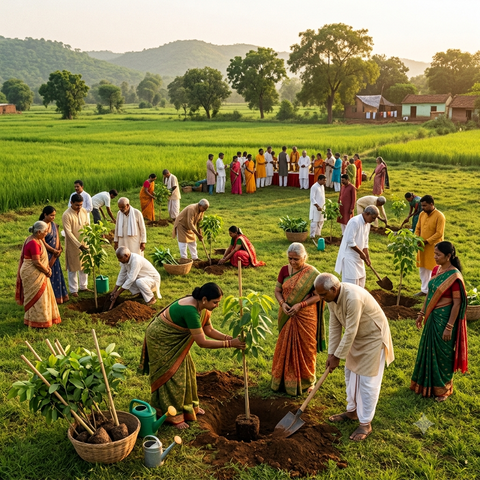
A Miyawaki Forest in Karnataka is a dense, fast-growing native woodland created using the Japanese Miyawaki method. These forests grow much faster than conventional plantations and support richer biodiversity, helping address Karnataka's air pollution and shrinking green cover. Grow Billion Trees works with communities, corporations, and individuals to build Miyawaki forests across the state, as part of the goal to plant 100 crore trees across India by 2030.
What Is the Miyawaki Method?
Developed by Japanese botanist Akira Miyawaki, this technique mimics natural forest ecology by planting diverse native species in dense clusters. Every square metre holds multiple saplings, triggering fierce competition for light and nutrients. As a result, trees grow rapidly and a self-sustaining canopy forms within three to five years.
Unlike monoculture plantations, a Miyawaki forest requires no pesticides, no fertilisers, and minimal human effort once established. According to the United Nations Environment Programme's forest restoration guidance, native multi-species forests like Miyawaki plantings are among the most effective approaches to restoring degraded land and boosting ecosystem resilience. In 2026, this method is widely recognised as a cornerstone of urban greening strategy worldwide.
Why Karnataka Needs Miyawaki Forests
Karnataka has lost forest cover over the past two decades due to rapid urbanisation, industrial expansion, and agricultural encroachment. Bengaluru's green cover has declined. Urban heat islands raise temperatures in cities.
The WWF's analysis of deforestation and forest degradation highlights that urban forest loss accelerates carbon emissions, reduces biodiversity, and worsens flood risk — all challenges Karnataka faces today. However, Miyawaki forests offer a proven, space-efficient solution that fits within city parks, corporate campuses, school grounds, and roadside strips.
Moreover, Karnataka's climate is ideal for Miyawaki planting. The Western Ghats' rich native species bank — including neem, peepal, arjuna, kadamba, and honge — provides a wonderful palette for creating biodiverse mini-forests that thrive with local rainfall patterns. Together, these natural advantages make Karnataka a great laboratory for scalable urban reforestation.
✅ Popular Miyawaki Forests in Karnataka
Karnataka has become a landmark state for Miyawaki forest projects. Several inspiring examples now serve as living proof that urban greening is both achievable and wonderful for communities to enjoy. Here are some of the most celebrated Miyawaki forests across the state.
Cubbon Park Miyawaki Zone, Bengaluru
One of Bengaluru's most loved green lungs, Cubbon Park hosts a dedicated Miyawaki zone developed in partnership with the Bruhat Bengaluru Mahanagara Palike (BBMP) and local environmental groups. The patch now supports over 60 native species. It has become a happy habitat for birds and butterflies previously unseen in the area, drawing nature lovers and school groups alike.
Infosys Campus, Electronic City, Bengaluru
Tech giant Infosys planted a dense Miyawaki forest across several acres of its Electronic City campus as part of its sustainability and Net Zero Targets programme. The initiative features native species including banyan, neem, Indian rosewood, and teak. The Infosys Miyawaki zone has been certified as a carbon sink and serves as a biodiversity education hub for employees throughout the year.
Wipro Eco Park, Sarjapur Road, Bengaluru
Wipro developed an eco-forest at its Sarjapur Road campus using the Miyawaki technique with diverse native species. The project supports Wipro's broader commitment to achieving carbon neutrality.
Bosch India Green Belt, Bengaluru
Bosch India launched a green belt Miyawaki initiative across its Bengaluru manufacturing facility. The forest is designed to reduce industrial heat, improve air quality, and support local pollinators. Bosch's verified environmental reporting confirms measurable improvements in on-site biodiversity since the forest was established, making it a great model for industrial greening.
Mysuru Urban Forest Initiative
The Mysuru City Corporation, in collaboration with local NGOs and corporate donors, has established Miyawaki patches in parks across the city. These forests feature plants native to the Deccan plateau and the Western Ghats transition zone. They have become cherished community spaces where citizens love to walk and children discover native flora firsthand.
Hubli-Dharwad Agroforestry Belt
In northern Karnataka, the twin cities of Hubli-Dharwad have embraced Miyawaki as part of an agroforestry model. Local farmers and municipal bodies partnered to create forest strips along agricultural fields. This approach improves soil health, reduces erosion, and boosts crop yields through natural shade and wind protection — a wonderful example of Combating Climate Change Through Collective Action.
⭐ Corporate Champions Driving Miyawaki Forests in Karnataka
Karnataka's corporate ecosystem has been a major driver of Miyawaki forest adoption. Several leading companies have integrated forest creation into their Environmental, Social, and Governance (ESG) strategies and Net Zero Targets. Notable corporate participants include:
- Infosys — Multiple Miyawaki zones across Bengaluru and Mysuru campuses
- Wipro — Eco-forest at Sarjapur Road and afforestation drives across tech parks
- Bosch India — Industrial Miyawaki green belt in Bengaluru
- Tata Consultancy Services (TCS) — Urban forest plots at Whitefield campus
- Biocon — Campus biodiversity garden using native Miyawaki species
- Mphasis — Tree planting partnerships focused on Bengaluru's urban fringe
According to the United Nations Sustainable Development Goals framework, partnerships between corporations and conservation organisations are essential for scaling nature-based solutions. Karnataka's corporate Miyawaki movement is a great example of this principle in action and inspires us every day.
💡 How Grow Billion Trees Builds Self-Sustainable Miyawaki Forests
At Grow Billion Trees, we provide end-to-end Miyawaki forest creation services designed to ensure every planting becomes a thriving, self-sustaining ecosystem. Our mission is to plant 100 crore trees across India by June 2030, and Karnataka is one of our most active and vibrant states. We ensure every forest we create is rooted in ecological science, community participation, and transparent technology.
Our process begins with a detailed site assessment. We analyse soil composition, existing vegetation, water availability, and microclimatic conditions. This hands-on approach allows us to select the most suitable native species for each location, maximising biodiversity and long-term forest health. Our team works closely with each partner to guarantee outcomes that are authentic, verified, and impactful.
Species Selection and Native Plant Nurseries
We maintain partnerships with local nurseries across Karnataka to source region-specific native saplings. Our team avoids invasive or exotic species entirely, ensuring the forest integrates naturally into the local ecosystem. Species chosen include kadamba, neem, arjuna, peepal, honge, Indian fig, and flowering trees that attract birds and pollinators. This conscious, mindful approach is at the heart of every Grow Billion Trees project.
Soil Preparation and Dense Planting
Healthy, organic soil is the foundation of a thriving Miyawaki forest. We enrich planting sites with natural compost and mycorrhizal inoculants to boost early root development. Saplings are planted at high density — typically three to five plants per square metre — in a layered structure that mirrors natural forest ecology. This method produces a green canopy that grows and thrives without ongoing chemical inputs.
✅ 2-3ft Tree Planting + 3 Years Care + GeoTag
Every sapling planted through Grow Billion Trees comes with our signature package: 2-3ft Tree Planting + 3 Years Care + GeoTag technology. We nurture each tree through its most vulnerable early years with scheduled watering, weeding, pest monitoring, and gap replanting. After three years, the Miyawaki forest becomes genuinely self-sustaining — it requires no further intervention to grow, spread, and flourish across the planet.
GeoTag Technology for Full Transparency
We believe in transparent, verified impact that you can trust. Our GeoTag technology assigns a unique digital identity to each tree or forest plot, allowing corporate partners and individual planters to track their forest's progress in real time. You can view your forest's location, growth updates, and biodiversity improvements through our secure platform, making it easy to report authentic environmental impact to stakeholders and regulators.
Community and Farmer Involvement
Our partners in Karnataka include local farming communities who benefit from Miyawaki agroforestry strips alongside their fields. We provide training, saplings, and ongoing support to help farmers transform degraded land into productive, biodiverse forest edges. This approach improves livelihoods, boosts soil health, and contributes directly to Combating Climate Change Through Collective Action — together, one tree at a time.
The Broader Impact: Karnataka's Green Future
The United Nations Climate Change initiative recognises forest restoration as one of the most cost-effective natural climate solutions available to humanity. Karnataka's Miyawaki movement — driven by corporations, municipalities, NGOs, and organisations like Grow Billion Trees — is contributing meaningfully to India's national climate commitments in 2026 and beyond.
A single hectare of mature Miyawaki forest can sequester up to 50 tonnes of carbon annually, support over 300 species of plants and animals, and reduce ambient temperatures by 2 to 3 degrees Celsius. For a city like Bengaluru, scaling this approach across hundreds of sites could transform urban livability within a single decade. We are happy to share that our Karnataka projects have already delivered remarkable, measurable results.
Improved air quality near planting sites, the return of native bird species, and enthusiastic community engagement from residents who love watching their neighbourhoods grow greener — these outcomes inspire our team every day. Plant a Tree in your Name and become part of this movement. Explore our programs at growbilliontrees.com and discover how you or your organisation can help build a self-sustainable Miyawaki forest in Karnataka today.
Frequently Asked Questions
What is a Miyawaki Forest in Karnataka?
A Miyawaki Forest in Karnataka is a dense, multi-species native woodland created using the Miyawaki afforestation method. These forests grow much faster than conventional plantations and support rich biodiversity.
Which are the most popular Miyawaki forests in Karnataka?
Notable examples include the Cubbon Park Miyawaki zone in Bengaluru, Infosys Electronic City campus forest, Wipro Eco Park in Sarjapur, Bosch India's green belt, the Mysuru Urban Forest Initiative, and agroforestry projects in Hubli-Dharwad. Each demonstrates a different and inspiring application of the Miyawaki method.
Which companies have planted Miyawaki forests in Karnataka?
Leading corporations including Infosys, Wipro, Bosch India, TCS, Biocon, and Mphasis have established Miyawaki forests in Karnataka as part of their ESG reporting and Net Zero Targets. These certified projects combine genuine environmental restoration with measurable business impact.
How does Grow Billion Trees create Miyawaki forests?
Grow Billion Trees conducts detailed site assessments, selects native species, enriches soil with organic matter, and plants at high density. Every forest is maintained for three years through our 2-3ft Tree Planting + 3 Years Care + GeoTag package, after which it becomes a fully self-sustaining natural ecosystem.
What is GeoTag technology in tree planting?
GeoTag technology assigns a unique digital ID to each planted tree or forest plot, enabling real-time tracking of its location, growth, and biodiversity impact. Grow Billion Trees uses this secure, verified system so corporate partners and individuals can report their environmental contribution with complete confidence.
Can corporates partner with Grow Billion Trees for Miyawaki forests?
Yes. Grow Billion Trees offers tailored corporate Miyawaki forest programmes to help businesses meet their Net Zero Targets and ESG requirements. Our team manages everything from site selection to long-term forest maintenance, ensuring a genuine and impactful outcome for every partner.
How long does a Miyawaki forest take to become self-sustaining?
A well-established Miyawaki forest typically becomes self-sustaining within three to five years of planting. After this period, the forest requires no irrigation, fertilisers, or regular human intervention. It grows, thickens, and expands naturally as a resilient native ecosystem.
What native species are used in Karnataka Miyawaki forests?
Common species include neem, peepal, arjuna, kadamba, honge, Indian rosewood, banyan, teak, and various flowering and fruit-bearing trees native to the Western Ghats and Deccan plateau. This diverse, natural mix ensures rich biodiversity and long-term ecological stability.
How does a Miyawaki forest help combat climate change?
Miyawaki forests sequester carbon rapidly, restore biodiversity, reduce urban heat islands, improve air and water quality, and support native wildlife corridors. They are a proven, sustainable nature-based solution for Combating Climate Change Through Collective Action at both local and national scale.
How can I Plant a Tree in my Name through Grow Billion Trees?
You can Plant a Tree in your Name by visiting growbilliontrees.com. Choose a planting programme, receive a personalised tree certificate, and track your tree's growth using GeoTag technology — all as part of our mission to plant 100 crore trees across India and nurture a greener planet for future generations.
Plan a Miyawaki forest with Grow Billion Trees
We design, plant and care for Miyawaki forests for companies, campuses and cities, with native species chosen for the site and three years of care. Every tree is geo-tagged and tracked on GreenTrack, and 85% of trees survive across our programmes.
- Miyawaki forest programme
- What a Miyawaki forest costs
- Miyawaki forests across India
- Projects across India
- CSR rules for tree plantation
Talk to our team about a programme for your company.