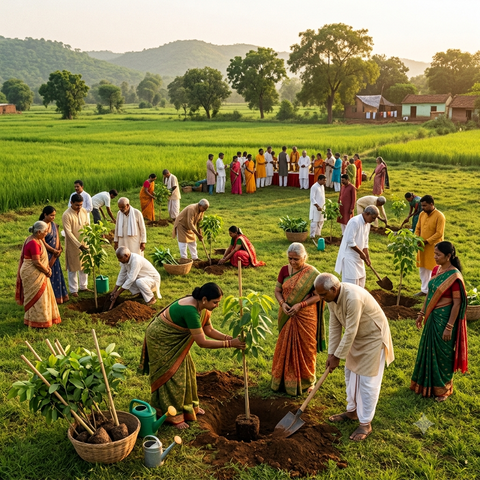
The Miyawaki Forest method in Gulbarga uses dense, native forests for urban reforestation. These forests create green spaces while addressing climate change.
Gulbarga, now officially known as Kalaburagi, welcomes this innovative forest technique that originated in Japan. The city's semi-arid climate makes traditional tree planting challenging, but Miyawaki forests offer a sustainable solution for green urban development.
What Makes Miyawaki Forest in Gulbarga Special
The Miyawaki method creates dense, multi-layered forests using native species. We ensure each forest includes canopy trees, sub-canopy species, shrubs, and ground cover plants. This natural diversity supports local wildlife and improves air quality significantly.
✅ Native Species Focus: Our team selects indigenous trees like Neem, Banyan, Peepal, and Tamarind. These species thrive in Gulbarga's climate and require minimal water once established.
✅ Rapid Growth: Miyawaki forests grow faster and denser than traditional plantations, establishing ecosystems more quickly.
✅ Water Conservation: These forests can improve groundwater recharge. They're valuable in water-scarce environments like Gulbarga.
According to the United Nations Environment Programme, urban forests play a crucial role in climate adaptation and biodiversity conservation in developing cities.
Environmental Benefits for Gulbarga
Miyawaki forests deliver environmental improvements, including better air quality and local environmental benefits.
💡 Air Purification: Miyawaki forests filter harmful pollutants including PM2.5 and nitrogen oxides.
💡 Biodiversity Hub: These forests can attract diverse bird species, butterflies, and beneficial insects.
The United Nations Climate Change initiative recognizes urban forests as essential tools for achieving net zero targets and building climate resilience.
Why Gulbarga Needs Miyawaki Forests
Gulbarga faces significant environmental challenges that Miyawaki forests can address. The city experiences rising temperatures, declining groundwater levels, and poor air quality. Traditional tree planting often fails due to harsh summer conditions and limited maintenance.
⭐ Climate Resilience: Miyawaki forests are drought-resistant after the initial three years. They create microclimates that moderate extreme temperatures.
⭐ Urban Heat Island Reduction: These forests can reduce surface temperatures by up to 9°C. This cooling effect extends beyond the forest boundaries, benefiting entire neighborhoods.
The Miyawaki methodology can transform urban land into green spaces in semi-arid regions like Gulbarga.
Creating Your Miyawaki Forest in Gulbarga
Establishing a Miyawaki Forest in Gulbarga follows a proven scientific process. We begin with comprehensive soil analysis and native species selection. The entire process takes 2-3 years to achieve forest maturity.
→ Site Preparation: Our team analyzes soil composition and pH levels. We improve soil quality with organic matter and mycorrhizal fungi.
→ Species Selection: We choose 15-20 native species based on natural forest surveys. Each species serves a specific ecological function in the forest layers.
→ Dense Planting: Trees are planted at 3-5 plants per square meter. This density mimics natural forest regeneration patterns.
→ Maintenance Phase: Regular watering and weeding for the first two years ensures establishment. After year three, the forest becomes self-sustaining.
Plant a tree in your Name through our 2-3ft Tree Planting + 3 Years Care + GeoTag program. Each tree contributes to our goal of planting 100 crore trees across India by 2030.
Success Stories from Similar Cities
Cities across Karnataka have witnessed remarkable transformations through Miyawaki forests. Bangalore's IT parks now feature multiple Miyawaki forests that improve employee wellness and reduce cooling costs. Mysore's urban forests have become biodiversity hotspots attracting researchers and nature enthusiasts.
Miyawaki forests show 85% tree survival rates. Once established, they become drought-resistant while providing environmental benefits.
The World Wildlife Fund's forest conservation initiatives highlight urban forests as critical for maintaining ecological connectivity in rapidly developing regions.
Community Impact and Social Benefits
Miyawaki forests offer opportunities for community engagement in Gulbarga. Schools can use these spaces for environmental education, and residents benefit from green spaces.
These forests become natural gathering spaces that strengthen community bonds. Children learn about native ecosystems while adults enjoy peaceful walking areas. The psychological benefits of urban forests are well-documented, reducing stress and improving overall well-being.
Local employment opportunities emerge through forest maintenance and eco-tourism. We're happy to report that our Miyawaki projects have created jobs for local youth interested in environmental conservation.
Cost and Implementation
Miyawaki forests in Gulbarga are priced per tree, and quotes depend on the site. The investment includes soil preparation, plants, and three years of maintenance.
Corporate partners often sponsor these forests to achieve their net zero targets while supporting local communities. The return on investment becomes evident within two years through improved air quality and temperature regulation.
Our comprehensive package includes site survey, soil improvement, native plant sourcing, planting, and guaranteed care. We provide GeoTag technology so you can track your forest's progress through satellite imagery.
Getting Started with Your Forest
Ready to transform Gulbarga's landscape? Our team makes the process simple and rewarding. We handle all technical aspects while keeping you informed about your forest's development. Every forest contributes to combating climate change through collective action.
Contact us to explore suitable locations in Gulbarga for your Miyawaki forest. Whether you're an individual, school, or corporation, we'll customize a program that meets your goals and budget.
Discover how easy it is to create lasting environmental impact in your community. Together, we can make Gulbarga a model city for sustainable urban development.
Frequently Asked Questions
How long does a Miyawaki Forest in Gulbarga take to establish?
A Miyawaki forest reaches maturity in 2-3 years, much faster than traditional forests which take 20-30 years. The rapid growth occurs due to dense planting and careful species selection suited to Gulbarga's climate.
What native species work best for Miyawaki forests in Gulbarga?
Native species like Neem, Banyan, Peepal, Tamarind, Indian Rosewood, and Flame of the Forest thrive in Gulbarga's semi-arid climate. We select 15-20 species based on natural forest surveys of the region.
How much water do Miyawaki forests require in Gulbarga's dry climate?
These forests need regular watering only for the first 2-3 years. Once established, they become drought-resistant and improve groundwater recharge.
Can individuals plant Miyawaki forests on small plots?
Yes, Miyawaki forests can be created on plots as small as 100 square meters. Even small forests provide significant environmental benefits and serve as wildlife corridors in urban areas.
What maintenance is required after planting?
The first two years require regular watering, weeding, and monitoring. After year three, the forest becomes self-sustaining with minimal human intervention needed.
How do Miyawaki forests help achieve net zero targets?
Miyawaki forests absorb CO2 and provide carbon sequestration benefits once established.
Are there any government incentives for creating Miyawaki forests in Gulbarga?
Various state and central government schemes support urban forestry initiatives. We help navigate available subsidies and incentives for environmental restoration projects.
What wildlife can we expect in Gulbarga's Miyawaki forests?
These forests attract diverse bird species, butterflies, beneficial insects, and small mammals. Transform Gulbarga's urban landscape with a Miyawaki forest that grows naturally and sustainably. Learn more about our tree planting programs and join the movement to create 100 crore trees across India. Every forest makes a difference in combating climate change.
Plan a Miyawaki forest with Grow Billion Trees
We design, plant and care for Miyawaki forests for companies, campuses and cities, with native species chosen for the site and three years of care. Every tree is geo-tagged and tracked on GreenTrack, and 85% of trees survive across our programmes.
- Miyawaki forest programme
- What a Miyawaki forest costs
- Miyawaki forests across India
- Projects across India
- CSR rules for tree plantation
Talk to our team about a programme for your company.