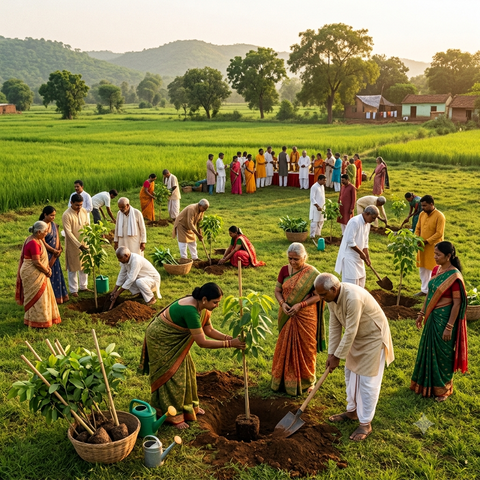
Miyawaki Forest in Chhattisgarh is transforming barren urban lands into dense, thriving ecosystems. This Japanese forestation technique creates forests that grow faster than conventional plantations. Chhattisgarh, already rich in natural forests, is embracing this method to restore and expand green cover in rapidly growing cities.
According to the United Nations Environment Programme on Forests, restoring native forest cover is one of the most powerful tools we have to combat climate change and halt biodiversity loss. We are glad to be part of this movement, helping communities grow lush, self-sustainable Miyawaki forests that endure for generations. Together, we can nurture a greener planet — one forest at a time.
What Is the Miyawaki Method?
The Miyawaki method was pioneered by Japanese botanist Dr. Akira Miyawaki. It involves planting multiple native species densely together, mimicking the natural layers of a wild forest. Trees compete naturally for sunlight, driving rapid growth.
This method uses no chemicals — only natural, organic soil enrichment techniques. It is mindful of local ecology and selects species that are truly native to the region. As a result, the forest becomes self-sustaining within 2 to 3 years, requiring no human intervention after the establishment phase. This makes it a wonderful, proven solution for any urban green restoration challenge.
Why Miyawaki Forests Matter for Chhattisgarh
Chhattisgarh has natural forests, but rapid urbanization in cities like Raipur, Bhilai, Durg, and Bilaspur is shrinking green cover. According to the World Wildlife Fund on deforestation and forest degradation, urban expansion is a leading driver of forest loss globally. Miyawaki forests offer an eco-friendly solution.
A 2026 urban forestry report on Indian cities shows that areas with active Miyawaki programs record up to 3°C lower local temperatures in planted zones. Moreover, these mini-forests absorb carbon, filter air pollutants, and support local biodiversity. Therefore, investing in Miyawaki Forest in Chhattisgarh is a conscious investment in the earth's future. The impact of each planted forest is measurable, real, and lasting.
✅ Popular Miyawaki Forests in Chhattisgarh
Several landmark Miyawaki forests have taken root across Chhattisgarh. These green spaces prove that collective, mindful action can transform even the most degraded urban lands into thriving ecosystems. Here are some wonderful examples that inspire our team every day:
- Naya Raipur (Atal Nagar) Urban Forest: Developed under the Smart City Mission, this Miyawaki forest spans a large green corridor in Chhattisgarh's new capital zone. It features over 25 native species and has become a great model for sustainable urban forestry in central India.
- Bhilai Green Belt Miyawaki Project: Located near the Bhilai Steel Plant township, this initiative transformed industrial buffer zones into dense, eco-friendly forests. SAIL (Steel Authority of India Limited) championed this project as part of its corporate sustainability mandate.
- Durg Municipal Miyawaki Park: The Durg Municipal Corporation launched a community Miyawaki plantation drive, converting vacant land near residential areas into thriving green spaces. Local schools and resident welfare associations participated actively in this natural transformation.
- Bilaspur Eco-Forest Initiative: The Chhattisgarh Forest Department partnered with municipal bodies in Bilaspur to plant Miyawaki forests along road medians and public parks. This initiative improved air quality and boosted biodiversity for thousands of residents.
- Korba Industrial Green Zone: NTPC Limited's Sipat and Korba plants have supported major CSR-led Miyawaki plantation drives across the Korba district, greening the landscape around their power generation facilities and improving the local environment.
Corporate Champions Driving Green Change in Chhattisgarh
Chhattisgarh's strong industrial base has made it a hub for corporate-led environmental action. Several major companies are partnering with forest experts to achieve their Net Zero Targets through Miyawaki plantations. Combating Climate Change Through Collective Action is no longer just a slogan — it is a boardroom priority for India's top firms operating in the state.
- SAIL (Steel Authority of India Limited): The Bhilai Steel Plant has invested in large-scale green belt development using the Miyawaki method, planting thousands of trees annually across its township and surrounding buffer zones.
- NTPC Limited: With operations at Sipat and Korba, NTPC has channelled CSR funding into establishing Miyawaki forests, improving environmental quality in coal-impacted communities across Chhattisgarh.
- Vedanta Limited: Operating across the mineral-rich Bastar and Raigarh regions, Vedanta has supported community-led Miyawaki plantation projects as part of its verified sustainability and environmental commitments.
- SECL (South Eastern Coalfields Limited): SECL's mine rehabilitation programs use the Miyawaki method to restore ecology in post-mining landscapes across Korba and Bilaspur districts, helping degraded land grow and thrive again.
- ACC Cement: ACC's Chhattisgarh plants have embraced Miyawaki plantations in their eco-restoration drives, aligning corporate operations with India's national green mission goals for 2026 and beyond.
According to the United Nations Climate Change portal, corporate net zero commitments backed by nature-based solutions like Miyawaki forests are among the most impactful strategies available to limit global warming. These corporate efforts across Chhattisgarh are a great example of how industry and ecology can thrive together for a sustainable future.
💡 How Grow Billion Trees Builds Self-Sustainable Miyawaki Forests
At Grow Billion Trees, we provide end-to-end Miyawaki forest creation services designed for long-term, self-sustainable outcomes. Our mission is to plant 100 crore trees across India by June 2030, and Miyawaki Forest in Chhattisgarh is central to that goal. We ensure every forest we help create is designed to grow, thrive, and sustain itself without ongoing external support — naturally and organically.
Our approach is hands-on from day one. We begin with a detailed site assessment, soil analysis, and native species selection tailored to Chhattisgarh's unique ecology. Our team then delivers 2-3ft Tree Planting + 3 Years Care + GeoTag technology for every tree planted in your forest. This means you can track your forest's growth in real time, with transparent, verified data on each tree's health and progress — guaranteed.
⭐ Key Features of the Grow Billion Trees Miyawaki Program
- ✅ Native species selection: We use only local, natural species suited to Chhattisgarh's climate and soil — no artificial or invasive varieties, ever.
- ✅ Organic soil preparation: Our team enriches the soil using natural, chemical-free composting methods to support strong, deep root development from the start.
- ✅ Dense, multi-layer planting: We plant shrubs, sub-trees, trees, and canopy species together to create a complete, self-sustaining forest ecosystem from the ground up.
- ✅ GeoTag technology: Every tree is geo-tagged and tracked, giving you certified, transparent data on your forest's growth and measurable carbon impact.
- ✅ 3 years of professional care: Our expert team monitors, waters, and nurtures your forest for three full years until it becomes fully self-sustaining. We guarantee this commitment to every partner.
- ✅ Corporate CSR solutions: We offer certified, verified green programs for corporates seeking to meet their Net Zero Targets through measurable, nature-based action with full ESG reporting support.
- ✅ Customized forest design: Whether it is a company campus, industrial buffer zone, or community park, we design Miyawaki forests to fit the space, purpose, and ecological goals.
The Impact: Numbers That Inspire in 2026
Miyawaki forests support more biodiversity than monoculture plantations and can absorb carbon once fully mature.
These forests become habitats for birds, insects, and small mammals.
The United Nations Sustainable Development Goals highlight ecosystem restoration as a pillar of a sustainable global future. Every Miyawaki Forest in Chhattisgarh we help build contributes directly to SDG 13 (Climate Action), SDG 15 (Life on Land), and SDG 11 (Sustainable Cities). However, the impact goes further — these forests also support local livelihoods and improve quality of life for surrounding communities.
Frequently Asked Questions
What is a Miyawaki forest?
A Miyawaki forest is a dense, multi-layered native forest created using a technique developed by Japanese botanist Dr. Akira Miyawaki. It grows faster than conventional forests.
Why is Miyawaki Forest in Chhattisgarh important?
Chhattisgarh's rapid urbanization is shrinking green cover in cities like Raipur, Bhilai, and Bilaspur. Miyawaki forests restore biodiversity, improve air quality, and reduce urban heat islands. They are a proven, eco-friendly solution that transforms empty urban spaces into thriving, natural ecosystems.
Which companies have supported Miyawaki forests in Chhattisgarh?
Major corporates including SAIL, NTPC, Vedanta, SECL, and ACC Cement have all supported Miyawaki plantation projects in Chhattisgarh. These efforts are part of structured CSR programs aimed at achieving Net Zero Targets and long-term environmental sustainability across the state.
How does Grow Billion Trees help in building Miyawaki forests?
Grow Billion Trees provides complete Miyawaki forest solutions including site assessment, native species selection, organic soil preparation, dense multi-layer planting, and 3 years of professional care. We also use GeoTag technology to track every tree's growth with full transparency and verified data.
How long does it take for a Miyawaki forest to become self-sustainable?
A well-planted Miyawaki forest typically becomes self-sustaining within 2 to 3 years. After that, it requires no watering, fertilization, or external maintenance. Grow Billion Trees provides 3 years of dedicated professional care to ensure your forest reaches this milestone successfully.
Can corporates use Miyawaki forests for CSR and Net Zero goals?
Absolutely. Miyawaki forests are a certified, verified way for corporations to achieve their Net Zero Targets through nature-based solutions. Grow Billion Trees offers corporate green programs with measurable impact, GeoTag tracking, and certified ESG documentation to support transparent reporting.
What species are used in Miyawaki forests in Chhattisgarh?
We select native tree species suited to Chhattisgarh's climate and soil. Common natural choices include Mahua, Amla, Arjun, Jamun, Neem, Bamboo, and Baheda. These organic, indigenous species support local biodiversity and wildlife while strengthening the forest ecosystem over time.
How can I Plant a tree in your Name through Grow Billion Trees?
You can easily Plant a tree in your Name by visiting the Grow Billion Trees website. Every tree comes with GeoTag tracking, a personalized certificate, and 3 years of professional care. It is a great, meaningful way to leave a lasting green legacy — perfect for birthdays, memorials, or any special occasion.
Grow Together for a Greener Chhattisgarh
The Miyawaki Forest in Chhattisgarh movement is growing stronger every year. From corporate campuses in Bhilai to public parks in Raipur, these forests prove that conscious, collective action can restore our earth one patch of land at a time. Together, we can nurture a greener, cooler, and more sustainable Chhattisgarh for all future generations.
At Grow Billion Trees, we are passionate about making Combating Climate Change Through Collective Action a lived reality across India. Whether you are a mindful individual, a purpose-driven corporate, or a community leader, we warmly welcome you to join this wonderful green mission. Explore our Miyawaki forest programs, discover how you can help us plant 100 crore trees, and take action today. Learn more and get started at Grow Billion Trees.
Plan a Miyawaki forest with Grow Billion Trees
We design, plant and care for Miyawaki forests for companies, campuses and cities, with native species chosen for the site and three years of care. Every tree is geo-tagged and tracked on GreenTrack, and 85% of trees survive across our programmes.
- Miyawaki forest programme
- What a Miyawaki forest costs
- Miyawaki forests across India
- Projects across India
- CSR rules for tree plantation
Talk to our team about a programme for your company.