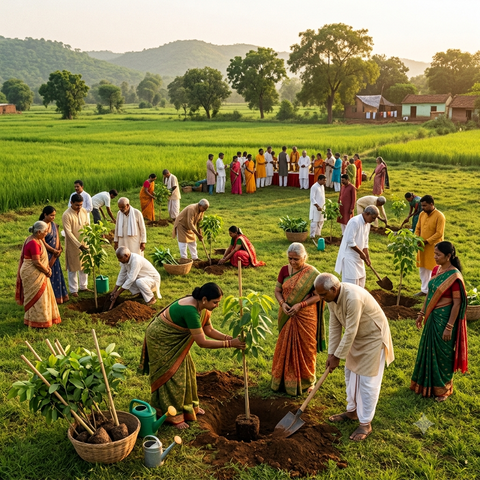
A Miyawaki Forest in Mangalore is a dense, multi-layered native forest created using the Japanese Miyawaki afforestation method. The technique produces mature forest conditions faster than conventional plantations. Mangalore's coastal ecology and proximity to the Western Ghats support diverse native species.
According to the United Nations Environment Programme's forests initiative, restoring urban tree cover is among the most impactful steps a city can take to address climate breakdown. Our team has seen firsthand how Miyawaki forests transform barren urban plots into thriving ecosystems within just a few years.
What Is the Miyawaki Method? 💡
Japanese botanist Akira Miyawaki developed this technique after decades of studying natural forest ecosystems. The method involves planting 30 to 50 native species closely together within a small plot. Trees compete for light and nutrients, triggering rapid upward growth and dense canopy formation.
The result is a self-sustaining, multi-layered forest. After just three years, a Miyawaki forest requires no irrigation, fertiliser, or maintenance. It supports far greater biodiversity than conventional green spaces and sequesters carbon at a measurably higher rate.
- ✅ Grows faster than conventional plantations
- ✅ Supports higher biodiversity than monocultures
- ✅ Uses native species adapted to local climate conditions
- ✅ Self-sustaining after three years of professional care
- ✅ Suitable for plots as small as 100 square metres
The WWF's global forest conservation initiative recognises that restoring native forest cover is the most reliable path to long-term ecological recovery. Miyawaki forests deliver exactly this at an urban and community scale.
Why Mangalore Urgently Needs Miyawaki Forests ⭐
Mangalore sits at the confluence of two rivers and faces the Arabian Sea. Rapid urbanisation has significantly reduced the city's natural green cover over the past two decades. Coastal vegetation, riparian forests, and native wildlife corridors are all under sustained pressure.
The Western Ghats — a UNESCO World Heritage biodiversity hotspot — begin just inland from Mangalore. Restoring native forests within the city creates ecological bridges that support species movement and survival. Moreover, Mangalore's monsoon-fed terrain makes it naturally suited to fast-growing, dense native vegetation.
Urban heat islands, flooding risk, declining air quality, and the loss of coastal buffer zones all point to the same solution. Therefore, a Miyawaki Forest in Mangalore is not just an environmental statement — it is a practical investment in the city's long-term resilience and public health.
Popular Miyawaki Plantation Projects Across India
India has embraced the Miyawaki method with wonderful energy. These real-world projects demonstrate what is possible when communities, corporates, and conservation teams work together with intention and purpose.
Navi Mumbai Urban Forest, Maharashtra
A Miyawaki forest can become a thriving pocket forest supporting diverse wildlife. It serves as both a community green space and an educational resource.
Bengaluru Tech Campus Forests
Multiple Miyawaki plots have been established across IT campuses and residential layouts in Bengaluru. Corporate partners and resident groups collaborated to green urban spaces that had previously been barren or paved. Our team has studied these sites closely and observed impressive canopy density within three growing seasons.
Hyderabad Smart Forest Project
Hyderabad's civic authorities partnered with private firms to create 50 micro-forests across the city. This initiative has improved air quality indices in target neighbourhoods and generated measurable reductions in localised urban heat. It is a great model for Mangalore to follow.
IIT Bombay Campus Plantation
This landmark academic-led project proved the Miyawaki method's scalability in institutional settings. More than 20 native species were planted across the campus, creating a model forest that now supports research and serves as a biodiversity demonstration site.
Chennai Coastal Forest Belt
Drawing on Miyawaki principles adapted for coastal ecosystems, this project combined mangrove restoration with native tree planting along the shoreline. It provides a wonderful example of how the method can be tailored to Mangalore's similar coastal geography and soil conditions.
Corporates Leading the Miyawaki Green Charge ✅
India's corporate sector has made Miyawaki forestry a centrepiece of sustainability strategies. Achieving Net Zero Targets demands measurable, verified environmental action — and Miyawaki forests deliver precisely that. Our partners include leading organisations committed to lasting ecological impact.
- Infosys — Planted thousands of native trees across campuses, including sites in coastal Karnataka, as part of their verified carbon neutrality programme.
- Wipro — Established Miyawaki plots on campuses across India, generating measurable biodiversity improvements backed by ecological audits.
- Tata Group — Supported urban greening initiatives in coastal Karnataka under its long-standing environmental stewardship commitments.
- Mahindra Group — Partnered in afforestation drives across biodiversity-priority zones in South India with a focus on native species restoration.
- HDFC Bank — Funded tree plantation initiatives in Mangalore and surrounding areas through its Parivartan CSR programme.
- Bosch India — Contributed to urban Miyawaki forest creation near South India operations as part of its global sustainability roadmap.
These organisations understand that Combating Climate Change Through Collective Action is both a moral responsibility and a business imperative. We provide each corporate partner with certified impact reports aligned to ESG and sustainability disclosure frameworks.
How Grow Billion Trees Helps Create Miyawaki Forests in Mangalore 💡
Grow Billion Trees is on a mission to plant 100 crore trees across India by June 2030. We are glad to offer one of India's most comprehensive Miyawaki plantation programmes, with a hands-on approach designed for Mangalore's unique coastal ecosystem.
Our programme is built on complete transparency and long-term impact. Every plantation includes 2-3ft Tree Planting + 3 Years Care + GeoTag technology, giving you real-time access to your forest's growth data. We ensure every tree planted is tracked, verified, and nurtured by our experienced ground teams across Karnataka.
The United Nations Climate Change platform emphasises that nature-based solutions are essential tools for achieving the Paris Agreement goals. Our Miyawaki forests directly contribute to this global mission, rooted in local soil and local knowledge.
What Our Miyawaki Programme Includes ✅
- ✅ Site assessment and native species selection for Mangalore's coastal ecosystem
- ✅ Soil enrichment and biomass preparation for fast-track growth
- ✅ Dense planting of 30–50 native species per plot
- ✅ Three full years of professional care and monitoring
- ✅ GeoTag technology for real-time, verified tree tracking
- ✅ Personalised tree certificates for individuals, families, and corporates
- ✅ ESG-aligned impact reports for corporate sustainability disclosures
Whether you want to Plant a tree in your Name, honour a loved one, or fulfil a corporate sustainability pledge, we provide a seamless, authentic pathway to lasting environmental impact. Our certified process gives every contributor complete confidence in their green contribution.
Native Species for a Mangalore Miyawaki Forest
Choosing the right species is the heart of any successful Miyawaki project. For a Miyawaki Forest in Mangalore, native coastal and Western Ghats species deliver the strongest ecological outcomes and the highest long-term survival rates.
Species such as Neem, Indian Gooseberry (Amla), Banyan, Peepal, Wild Jack, Kokum, Jamun, and coastal mangroves form a healthy multi-layered forest adapted to Mangalore's high humidity, monsoon rainfall, and laterite soil.
In addition, native species naturally support local pollinators, resident birds, and small mammals — boosting the entire ecosystem. According to WWF's research on deforestation and forest degradation, native species restoration is far more effective than monoculture planting for long-term biodiversity recovery and sustainable carbon sequestration.
Climate Action: The Urgency Behind Urban Forests
The United Nations Sustainable Development Goals include specific, measurable targets for life on land and climate action — goals that Miyawaki forests are uniquely positioned to advance. Every forest we help establish in Mangalore contributes to these verified global targets.
Miyawaki forests can deliver mature forest conditions within three to five years, improving air quality, flood mitigation, and biodiversity.
The work of Combating Climate Change Through Collective Action requires everyone to play a conscious, mindful part. A Miyawaki forest in your neighbourhood is a great and proven place to start making a real difference for the planet.
Start Your Miyawaki Journey in Mangalore Today ⭐
Whether you are an individual who loves Mangalore's natural heritage, a family looking to create a living legacy, or a corporation seeking verified green credentials, Grow Billion Trees offers the right programme for you. We are happy to guide you through every step, from site selection to tree certification.
Explore our Miyawaki plantation programme at growbilliontrees.com and discover how your contribution can transform an urban corner of Mangalore into a thriving native forest. Together, we can build greener, more resilient cities and a sustainable future for generations to come.
Frequently Asked Questions
What is a Miyawaki Forest in Mangalore?
A Miyawaki Forest in Mangalore is a dense, native-species urban forest created using the Japanese Miyawaki method. Multiple native species are planted closely together to create a self-sustaining, multi-layered forest.
Why is Mangalore an ideal location for Miyawaki forests?
Mangalore's coastal setting, proximity to the Western Ghats, high annual rainfall, and biodiversity significance make it perfect for Miyawaki planting. The city's urban heat issues and reduced green cover make ecological restoration both urgent and highly impactful.
How long does a Miyawaki forest take to establish?
A Miyawaki forest typically becomes self-sustaining within three years and reaches a mature canopy within five to eight years. This is dramatically faster than traditional forests, which may take 20 to 30 years to fully mature.
Can corporates participate in Miyawaki plantation in Mangalore?
Yes. Grow Billion Trees offers dedicated corporate Miyawaki programmes, including ESG-aligned impact reports, GeoTag-verified plantation records, and tailored drives designed to support Net Zero Targets and sustainability disclosures for CSR compliance.
Which native species are planted in a Mangalore Miyawaki forest?
Coastal and Western Ghats natives such as Neem, Amla, Banyan, Peepal, Wild Jack, Kokum, Jamun, and mangroves are planted. These species are adapted to Mangalore's climate and actively support local pollinators, birds, and wildlife.
What does GeoTag technology provide for tree contributors?
Each tree is assigned GPS coordinates and monitored through the Grow Billion Trees platform. Contributors access real-time growth data with full transparency, providing authenticated, verified proof of their environmental impact.
How does the Miyawaki method compare to conventional tree planting?
Miyawaki forests become self-sustaining within three years using many native species. Conventional monoculture plantings use fewer species, require ongoing maintenance, and support less wildlife.
How do I join the Miyawaki programme with Grow Billion Trees?
Visit growbilliontrees.com to explore available Miyawaki programmes. You can Plant a tree in your Name, gift a tree for a birthday or memorial, or enrol your organisation in a large-scale plantation drive tailored to your sustainability goals.
Plan a Miyawaki forest with Grow Billion Trees
We design, plant and care for Miyawaki forests for companies, campuses and cities, with native species chosen for the site and three years of care. Every tree is geo-tagged and tracked on GreenTrack, and 85% of trees survive across our programmes.
- Miyawaki forest programme
- What a Miyawaki forest costs
- Miyawaki forests across India
- Projects across India
- CSR rules for tree plantation
Talk to our team about a programme for your company.