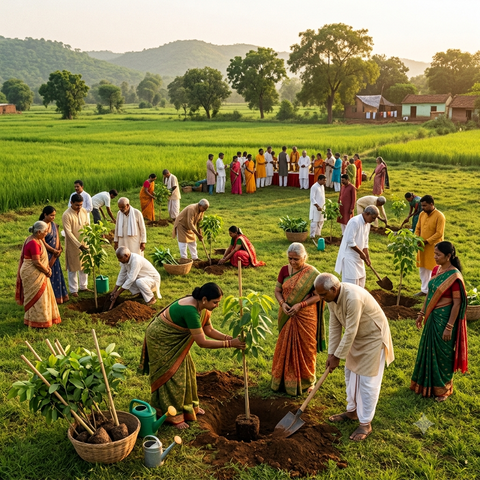
The Miyawaki technique plants native species close together, creating dense forests. This approach can help with air pollution and restore greenery in urban areas like Ghaziabad.
According to the United Nations Environment Programme's forest restoration guidelines, urban forests are critical for improving air quality in densely populated areas. Ghaziabad's rapidly growing population and industrial activity make Miyawaki forests not just welcome — they are essential. Our team at Grow Billion Trees has witnessed first-hand how these mini-forests transform neighbourhoods within just a few years.
What Is the Miyawaki Method? 💡
The Miyawaki method was developed by Japanese botanist Akira Miyawaki. It plants multiple native species close together to mimic the structure of natural forests. Trees grow dense, tall, and self-sustaining in a remarkably short time — reaching maturity in 20–30 years versus 200 years for conventional forests.
Miyawaki forests are very dense and support high biodiversity. They work in small urban plots, making them suitable for cities where large open land is scarce.
Why Ghaziabad Urgently Needs Miyawaki Forests ⚠️
Ghaziabad consistently ranks among India's top 10 most polluted cities. The WWF's global report on deforestation and forest degradation highlights how rapid urbanisation strips cities of natural green cover, worsening air and water quality. Ghaziabad's industrial growth and vehicular pollution have created a pressing need for sustainable green corridors.
In 2026, data from the Central Pollution Control Board shows Ghaziabad's AQI frequently exceeds 300 — a hazardous level for residents. Miyawaki forests can reduce local temperatures by up to 2°C and lower particulate matter significantly. They also improve groundwater recharge and restore native biodiversity lost to decades of urban expansion.
- ✅ Reduces urban air pollution and particulate matter levels
- ✅ Lowers local temperature and the urban heat island effect
- ✅ Restores native plant and animal biodiversity naturally
- ✅ Improves groundwater recharge in water-stressed areas
- ✅ Requires minimal land — works on small urban plots
Popular Miyawaki Plantation Projects in Ghaziabad ⭐
Several wonderful Miyawaki projects have already taken root in and around Ghaziabad. These initiatives prove that communities, corporates, and government bodies can work together for a greener, healthier planet. Each project is a living example of what collective, mindful action can achieve.
1. Hindon Riverbank Miyawaki Forest
Miyawaki forests can restore degraded riparian land with native vegetation. This approach supports wildlife recovery in urban areas.
2. Indirapuram Urban Miyawaki Initiative
The Indirapuram township in Ghaziabad has embraced Miyawaki forests as part of its sustainable urban planning. Resident welfare associations and corporate partners funded dense native plantations in parks and green corridors. This project is a great model for community-led environmental transformation in Indian cities.
3. Vasundhara Eco-Forest Drive
Community-led Miyawaki projects can involve schools, housing societies, and local businesses. Ongoing care and monitoring help these forests establish successfully.
4. Sector 62 Green Corridor (Noida–Ghaziabad Belt)
Spanning the Noida–Ghaziabad border, this green corridor project has created a continuous Miyawaki belt alongside busy roads. The initiative was designed to act as a natural air filter for commuters and nearby residents. Our team ensures regular maintenance and conscious replanting to keep the corridor growing strong year after year.
How Grow Billion Trees Powers Miyawaki in Ghaziabad ✅
Grow Billion Trees is on a mission to plant 100 crore trees across India by June 2030, and Ghaziabad is a key focus city. We offer end-to-end Miyawaki forest creation services — from site assessment and species selection to planting, monitoring, and long-term care. Our 2-3ft Tree Planting + 3 Years Care + GeoTag model ensures every tree planted is tracked, nurtured, and verified.
We provide hands-on support to corporates, residential societies, schools, and government bodies looking to create Miyawaki forests. Our GeoTag technology allows every stakeholder to track their trees in real time, verifying growth and survival with full transparency. This certified, tech-enabled approach builds genuine trust and ensures authentic environmental impact — not just numbers on paper.
As part of our commitment to Combating Climate Change Through Collective Action, we work with partners across India to make Miyawaki forest creation accessible and impactful. We ensure every project follows authentic scientific principles, using only natural, locally sourced native species suited to the region's soil and climate.
Corporate Partners Driving Miyawaki Change 🌱
We are glad to report that India's corporate sector is actively joining the Miyawaki movement. Leading organisations have partnered with Grow Billion Trees to meet their Net Zero Targets and ESG commitments through verified, impactful green initiatives in and around Ghaziabad.
- ✅ Infosys — partnered for campus and off-campus Miyawaki greening across the NCR region
- ✅ Tata Consultancy Services (TCS) — funded native tree corridors in urban industrial zones near Ghaziabad
- ✅ Mahindra & Mahindra — supported Miyawaki and agroforestry drives for farmer communities
- ✅ ITC Limited — contributed to urban forest restoration as part of their sustainability roadmap
- ✅ Hindustan Unilever — engaged employees in hands-on Miyawaki planting events near Ghaziabad
Corporate participation has been truly transformative for Ghaziabad's urban greenery. According to the United Nations Climate Change Action framework, private sector involvement is essential for achieving global climate targets. These partnerships help Grow Billion Trees scale impact while helping companies meet verified, recognised sustainability goals.
The Environmental Impact of Miyawaki Forests 💡
Miyawaki forests support biodiversity and contribute to carbon sequestration in urban areas.
For background, see WWF's work on forests. In Ghaziabad, we have seen native bird species, insects, and small mammals return to areas that were barren just a few years ago. This ecological recovery is measurable, conscious, and deeply inspiring for all involved.
Plant a Tree in Your Name — Join the Mission ✅
You don't need to own land or manage a large project to make a difference. With Grow Billion Trees, you can Plant a tree in your Name and contribute directly to active Miyawaki forest projects in Ghaziabad. Each tree includes 2-3ft Tree Planting + 3 Years Care + GeoTag tracking — so you can watch your tree grow and thrive from anywhere in the world.
Whether you are an individual, a family, or a corporate team, we welcome you to join India's largest tree-planting mission. Our personalised tree certificates make wonderful gifts for birthdays, memorials, Women's Day, and corporate events. Together, we are building a greener, healthier India — one Miyawaki forest at a time.
Explore our eco-friendly programmes and discover how to get started today. Every tree you plant is a mindful step toward a better future for the next generation. Help us grow 100 crore trees and save the planet — one native sapling at a time.
Frequently Asked Questions
What is a Miyawaki Forest in Ghaziabad?
A Miyawaki Forest in Ghaziabad is a dense, native urban forest created using the Japanese Miyawaki method. Multiple native species are planted close together on small land patches, enabling rapid, natural, self-sustaining forest growth ideal for polluted urban environments.
How fast does a Miyawaki forest grow?
Miyawaki forests grow much faster than naturally developing forests. Visible growth appears within the first year of planting.
How does Grow Billion Trees help with Miyawaki projects in Ghaziabad?
Grow Billion Trees provides end-to-end Miyawaki forest creation — site assessment, native species selection, planting, three years of care, and GeoTag tracking. We work with individuals, corporates, and communities to create verified, impactful green spaces that genuinely improve the local environment.
Which corporates have participated in Miyawaki projects near Ghaziabad?
Corporates including Infosys, TCS, Mahindra & Mahindra, ITC Limited, and Hindustan Unilever have participated in Miyawaki and urban forest initiatives in the Ghaziabad–NCR region through partnerships with Grow Billion Trees.
Can I plant a tree in my name as part of a Miyawaki forest?
Yes. With Grow Billion Trees you can Plant a tree in your Name and contribute to active Miyawaki projects in Ghaziabad. Each tree comes with a personalised certificate and GeoTag tracking so you can monitor your tree's growth in real time.
What native species are used in Ghaziabad Miyawaki forests?
Ghaziabad's Miyawaki forests use species native to the Indo-Gangetic plain, including Neem, Peepal, Arjun, Jamun, Mahua, and Bahera. Using natural, native species ensures higher survival rates, greater biodiversity, and stronger ecological benefits for the local environment.
How much land is needed to create a Miyawaki forest?
A Miyawaki forest can be created on as little as 50 square metres of land. This makes it perfect for urban rooftops, parks, vacant plots, and corporate campuses. Even small patches of earth can become thriving biodiversity hotspots with this proven method.
How do Miyawaki forests help reduce air pollution in Ghaziabad?
Miyawaki forests trap particulate matter and absorb carbon dioxide. They can help reduce air pollution in urban areas.
Can schools and housing societies in Ghaziabad create Miyawaki forests?
Absolutely. Grow Billion Trees actively partners with schools, residential welfare associations, and housing societies to create Miyawaki forests. Our team handles everything from sustainable design to planting, making it easy for any organisation to participate in this great green movement.
How does GeoTag technology work for Miyawaki tree tracking?
Our GeoTag technology assigns a unique geolocation marker to each planted tree. You can track your tree's growth, health, and survival through our platform in real time. This ensures full transparency, verified impact, and a secure, authentic record of every single planting.
Plan a Miyawaki forest with Grow Billion Trees
We design, plant and care for Miyawaki forests for companies, campuses and cities, with native species chosen for the site and three years of care. Every tree is geo-tagged and tracked on GreenTrack, and 85% of trees survive across our programmes.
- Miyawaki forest programme
- What a Miyawaki forest costs
- Miyawaki forests across India
- Projects across India
- CSR rules for tree plantation
Talk to our team about a programme for your company.