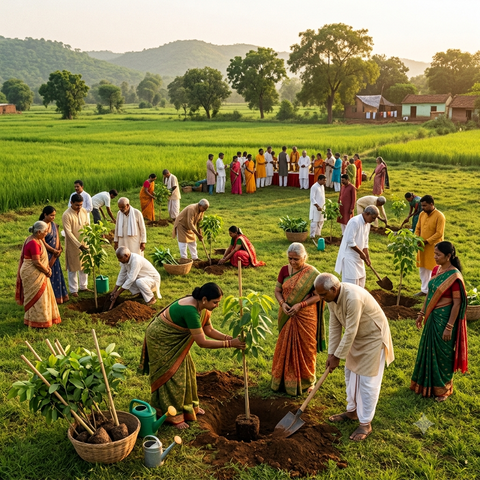
By the Grow Billion Trees Team
A Miyawaki Forest in Kanpur restores the city's green cover. Using the Japanese Miyawaki method, dense native forests grow faster than conventional plantations and become self-sustaining ecosystems. Miyawaki projects are helping restore green space in Kanpur.
What Is the Miyawaki Method? 💡
The Miyawaki method was developed by Japanese botanist Dr. Akira Miyawaki to recreate natural forest ecosystems on degraded land. It plants multiple native species at high density, along with organic mulch and soil conditioning, to mimic natural forest succession. The result is a layered, biodiverse canopy that matures far faster than traditional green drives.
According to the United Nations Environment Programme's forests programme, native forest restoration is among the most proven strategies for reversing biodiversity loss and sequestering carbon at scale. Miyawaki forests embody this approach in a compact, urban-friendly format. Moreover, these forests support birds, insects, and pollinators far beyond what monoculture plantations can achieve.
Why Kanpur Urgently Needs Miyawaki Forests ✅
Kanpur is one of Uttar Pradesh's largest industrial cities and faces some of the most serious air quality challenges in northern India. Urban green cover has declined sharply over two decades as industrial and residential expansion consumed natural land. As a result, the city experiences elevated temperatures, worsening pollution, and shrinking biodiversity.
The World Wildlife Fund's analysis of deforestation and forest degradation highlights how rapidly urbanising areas suffer cascading environmental and public health impacts when tree cover is lost. Miyawaki forests offer a space-efficient, eco-friendly solution that works even on small plots — making them ideal for a dense city like Kanpur. However, their success depends on expert execution, native species selection, and sustained aftercare.
Popular Miyawaki Plantation Projects in Kanpur ⭐
Several landmark Miyawaki forest projects in Kanpur have already delivered remarkable results. These initiatives span academic institutions, municipal authorities, and industrial green corridors — each proving that urban reforestation is both practical and impactful.
IIT Kanpur Miyawaki Forest
IIT Kanpur has developed Miyawaki forests on its campus. Educational institutions can participate in urban reforestation using the Miyawaki method.
Kanpur Nagar Nigam Green Parks Initiative
The Kanpur Municipal Corporation identified over 15 sites across city parks and roadside green belts for Miyawaki-style dense plantation as part of its 2026 urban forest targets. These sites include busy traffic corridors and neighbourhood parks previously dominated by sparse ornamental plantings. The initiative has begun to improve local air quality indices and provide cooler microclimates for residents. Community members are happy to report measurable changes in neighbourhood greenery within just two growing seasons.
Panki Industrial Belt Green Corridor
Industries within Kanpur's Panki and Dada Nagar industrial zones have adopted Miyawaki plantations as natural buffers between factories and residential areas. These green corridors absorb particulate matter, reduce noise pollution, and improve soil health simultaneously. In addition, they contribute meaningfully to Uttar Pradesh's state-level reforestation commitments. For example, the Panki corridor now hosts over 40 native tree and shrub species where bare concrete once stood.
Bithoor Riverfront Miyawaki Restoration
Along the banks of the Ganga near Bithoor, a sacred town adjoining Kanpur, a Miyawaki restoration project is working to revive the natural riparian forest that once lined the river. Native species including Arjun, Jamun, and Mahua have been planted to stabilise soil and filter runoff. This project connects ecological restoration with cultural heritage, making it one of the most meaningful Miyawaki efforts in the region. Our team is glad to be associated with similar riparian restoration work across India.
Corporate Participation in Kanpur's Miyawaki Movement ✅
Leading Indian corporations have embraced Miyawaki forest creation as a powerful tool for achieving Net Zero Targets and fulfilling Corporate Social Responsibility commitments. These partnerships bring essential funding, scale, and visibility to urban forest projects in Kanpur and across India.
- Tata Consultancy Services (TCS) — TCS has backed urban Miyawaki and dense plantation programmes in multiple Indian cities as part of its sustainability roadmap, supporting native forest creation in Uttar Pradesh.
- Mahindra Group — Mahindra's sustainability initiatives have funded dense native forest creation across industrial zones, directly aligned with its net-zero commitment for 2040.
- HDFC Bank — Through its CSR programmes, HDFC Bank has funded tree plantation initiatives including Miyawaki-style forests in Tier-2 cities, helping green India's urban heartland.
- ITC Limited — ITC's well-documented agroforestry and reforestation work extends to urban forest creation, with Miyawaki pilots in industrial hubs across northern India.
- Hero MotoCorp — Hero MotoCorp has contributed to urban greening programmes in northern India, supporting dense plantation drives aligned with the Miyawaki model.
- NTPC Limited — NTPC has invested in green buffer plantations near its power stations, with Miyawaki-style forests forming a core part of its environmental compliance strategy.
These partnerships reflect the growing understanding that Combating Climate Change Through Collective Action requires bold business leadership. The United Nations Climate Change framework affirms that corporate environmental commitments are indispensable to keeping global warming within safe limits.
How Grow Billion Trees Helps Create Miyawaki Forests in Kanpur 💡
Grow Billion Trees brings hands-on expertise in Miyawaki forest creation to Kanpur and every corner of India. Our team has real-world experience executing dense native forest projects from site assessment through three full years of dedicated aftercare. We ensure every sapling we plant receives the expert nurturing needed to thrive in local conditions.
Our mission is to plant 100 crore trees across India by June 2030, and Miyawaki forests are a vital part of this collective vision. We welcome corporates, communities, and individuals to join us in making this goal a reality. Our end-to-end Miyawaki services include:
- ✅ Site assessment and organic soil preparation — Our specialists evaluate land and condition soil using natural mulching techniques suited to Kanpur's climate.
- ✅ Native species selection — We choose trees and shrubs naturally adapted to the Indo-Gangetic plain, ensuring long-term forest health.
- ✅ 2-3ft Tree Planting + 3 Years Care + GeoTag — Every tree we plant is tracked with GeoTag technology, so you can monitor its growth and impact in real time.
- ✅ Corporate Miyawaki programmes — We partner with companies to design, execute, and document Miyawaki forests that directly support verified Net Zero Targets.
- ✅ Community and school engagement — We involve local schools, resident associations, and volunteers to build lasting environmental awareness and ownership.
Miyawaki forests benefit from community involvement and specialist care.
The Environmental Impact of Miyawaki Forests in Kanpur ✅
A well-executed Miyawaki Forest in Kanpur provides neighbourhood benefits including temperature moderation, air quality improvement, and increased biodiversity.
Miyawaki forests also sequester carbon at rates that conventional plantations cannot match, making them one of the most effective nature-based climate tools available today. The United Nations Sustainable Development Goals specifically highlight urban forest restoration as critical to achieving SDG 11 (Sustainable Cities) and SDG 13 (Climate Action). Therefore, every Miyawaki forest planted in Kanpur contributes directly to India's global climate commitments.
Key Environmental Benefits at a Glance
- • Reduces urban heat island effect through natural canopy shading
- • Supports 100+ native bird and insect species within three years
- • Self-sustaining with minimal maintenance after Year 3
- • Improves groundwater recharge, soil structure, and local hydrology
- • Filters airborne particulates and absorbs industrial pollutants
Plant a Tree in Your Name — Join Kanpur's Green Revolution
You do not need to be a corporation to make a meaningful difference. With Grow Billion Trees, every individual can Plant a Tree in your Name and become part of a conscious, planet-positive movement. Each tree planted adds to our collective goal of 100 crore trees across India — a mission that belongs to all of us.
Whether you want to celebrate a birthday, honour a loved one's memory, or simply give back to the earth, we provide personalised tree certificates and GeoTag tracking links that connect your story to a living, growing tree. We love helping people discover that even a single tree can carry deep meaning and lasting impact. Explore our individual and corporate planting programmes today at Grow Billion Trees and discover how easy it is to make a difference.
Frequently Asked Questions
What is a Miyawaki Forest in Kanpur?
A Miyawaki Forest in Kanpur is a dense, multi-species native forest created using the Japanese Miyawaki method on urban land. These forests become self-sustaining ecosystems and are being developed across Kanpur.
Which popular Miyawaki projects exist in Kanpur?
Notable Miyawaki projects in Kanpur include the IIT Kanpur campus plantation, the Kanpur Nagar Nigam urban parks programme, the Panki Industrial Belt green corridor, and the Bithoor riverfront Miyawaki restoration project. Each initiative focuses on native species and long-term ecological health.
How does Grow Billion Trees support Miyawaki forest creation in Kanpur?
Grow Billion Trees provides complete Miyawaki services including site assessment, organic soil preparation, native species selection, 2-3ft Tree Planting + 3 Years Care, and GeoTag tracking. Our team handles every stage from planting to three-year aftercare, ensuring forests thrive in Kanpur's specific climatic and soil conditions.
Which corporates have participated in Miyawaki forest initiatives?
Leading corporates including Tata Consultancy Services, Mahindra Group, HDFC Bank, ITC Limited, Hero MotoCorp, and NTPC have participated in Miyawaki and dense urban plantation drives in India. These companies use Miyawaki forests to advance their Net Zero Targets and CSR commitments.
How long does a Miyawaki Forest take to mature?
A Miyawaki Forest typically becomes self-sustaining within two to three years of planting. By five to ten years, it develops into a fully mature, multi-layered ecosystem. This is dramatically faster than the 20-30 years required by conventional plantation methods, making it ideal for time-sensitive urban greening targets.
What native species are used in Kanpur's Miyawaki forests?
Miyawaki forests in Kanpur use native species suited to the Indo-Gangetic plain. Common choices include Neem, Peepal, Arjun, Jamun, Mahua, Amla, Bel, and various native shrubs. These species are selected to recreate Kanpur's natural pre-settlement forest ecology and require minimal external inputs once established.
Can individuals contribute to Miyawaki plantation in Kanpur?
Yes. Individuals can contribute by planting a tree through Grow Billion Trees, joining community plantation drives, or gifting a tree to a loved one. Our platform allows you to Plant a Tree in your Name, receive a personalised certificate, and track your tree's growth through GeoTag technology.
Why are Miyawaki forests more effective than regular plantations?
Miyawaki forests are planted at three to five times higher density than regular plantations, using multiple native species rather than a single variety. This creates complex, resilient ecosystems that support greater biodiversity, sequester more carbon, and recover faster from climate shocks. They are a proven, science-backed approach endorsed by global environmental bodies.
Together, Let's Grow a Greener Kanpur 🌱
The Miyawaki Forest movement in Kanpur is a wonderful opportunity for every citizen, business, and community to take meaningful climate action. Our team at Grow Billion Trees is passionate about helping Kanpur reclaim its natural green heritage through expert, technology-driven, and community-powered Miyawaki programmes.
We believe that Combating Climate Change Through Collective Action begins with one tree, one forest, one city at a time. Together, we can transform Kanpur's urban landscape into a thriving network of living green lungs — boosting air quality, improving biodiversity, and building a sustainable future for generations to come. Explore our Miyawaki programmes and discover how you can be part of India's green revolution at Grow Billion Trees.
Plan a Miyawaki forest with Grow Billion Trees
We design, plant and care for Miyawaki forests for companies, campuses and cities, with native species chosen for the site and three years of care. Every tree is geo-tagged and tracked on GreenTrack, and 85% of trees survive across our programmes.
- Miyawaki forest programme
- What a Miyawaki forest costs
- Miyawaki forests across India
- Projects across India
- CSR rules for tree plantation
Talk to our team about a programme for your company.