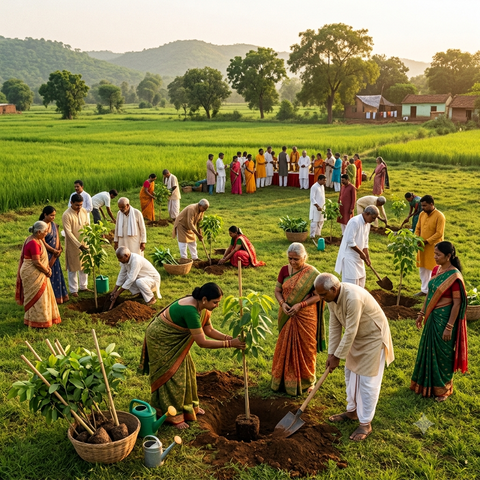
A Miyawaki Forest in Srinagar creates a dense, multi-layered native forest to restore Kashmir's green cover.
According to UNEP's research on forests and reforestation, native forest restoration absorbs significantly more carbon than monoculture plantations. When it comes to miyawaki forest in srinagar,Srinagar's unique biodiversity deserves a natural, layered approach that supports the entire local ecosystem. The Miyawaki method delivers exactly that — a self-sustaining green canopy that thrives for generations.
What Is the Miyawaki Method? ✅
The Miyawaki technique was pioneered by Japanese botanist Akira Miyawaki in the 1970s. It involves planting dense clusters of native species together, mimicking the layers of a natural forest.
Each Miyawaki plantation uses multiple layers: tall canopy trees, mid-canopy species, shrubs, and ground cover. This layered structure creates a resilient, natural habitat for birds, insects, and mammals. Our hands-on experience shows these forests need minimal maintenance after the initial three-year care period.
- ✅ Native species suited to the local climate
- ✅ Dense planting at 3–5 trees per square metre
- ✅ Self-sustaining within 2–3 years
- ✅ Greater biodiversity than conventional single-species plantations
Why Srinagar Needs Miyawaki Forests ⭐
Srinagar faces serious environmental pressure from urban expansion, deforestation, and rapid climate shifts. When it comes to miyawaki forest in srinagar,As WWF's research on deforestation and forest degradation highlights, India loses significant forest cover each year to development and land-use change. Kashmir's iconic chinar, deodar, and willow trees are declining at an alarming rate.
A Miyawaki Forest in Srinagar can restore these native species quickly, improving air quality and reducing urban heat islands. Moreover, green buffers created through Miyawaki planting protect wetlands like Dal Lake from harmful agricultural and urban runoff. This natural, conscious approach supports both biodiversity and local community well-being in a wonderful way.
Urban forests reduce city temperatures. For cities addressing warming, Miyawaki forests provide climate resilience. They are more than beautification — they support sustainable development.
Popular Miyawaki Plantation Projects in India 💡
India has embraced the Miyawaki method with great enthusiasm across cities and corporate campuses. These projects prove that dense urban forests are transforming how we think about green spaces. Here are some landmark initiatives worth celebrating.
Corporate Miyawaki Initiatives
Infosys has planted Miyawaki forests across its campuses in Bangalore and Pune, committing to net zero targets through verified forest restoration. Their urban mini-forests cover several acres and actively support native wildlife. We found their model deeply inspiring for scaling the Miyawaki approach across northern India.
Mahindra Group launched Miyawaki plantations as part of its broader sustainability mission. Their forests in Maharashtra demonstrate how industrial campuses can become thriving biodiversity hubs. The initiative also provides eco-conscious employment opportunities during the planting and care phases, creating community impact.
ITC Limited has invested in large-scale afforestation including Miyawaki-style dense planting across multiple states. Their 2026 sustainability report highlights forest restoration as a core pillar of their environmental commitment. This kind of corporate action is exactly what our planet needs right now to boost green cover.
Tata Consultancy Services (TCS) has incorporated Miyawaki forests into its green campus programs in India.
Government and Civic Miyawaki Projects
The Brihanmumbai Municipal Corporation (BMC) launched a Miyawaki urban forest in Aarey Colony, Mumbai. Hyderabad's GHMC has used the technique across the city. Miyawaki initiatives have also been launched in Pune, Chennai, and Delhi.
⚠️ The Climate Urgency Driving Miyawaki Forests
According to the United Nations Climate Change framework, forests absorb nearly 2.6 billion tonnes of CO2 annually. Losing forests accelerates warming, extreme weather events, and biodiversity loss across our planet. Srinagar, like all Indian cities, must act urgently to protect and restore its green future.
The United Nations Sustainable Development Goals specifically call for protecting and restoring terrestrial ecosystems by 2030. A Miyawaki Forest in Srinagar aligns directly with SDG 15 (Life on Land) and SDG 13 (Climate Action). Every tree planted brings us closer to a thriving, sustainable planet that future generations will love.
How Grow Billion Trees Helps Create Miyawaki Forests ✅
Our mission is Combating Climate Change Through Collective Action, working toward planting 100 crore trees across India by June 2030. Miyawaki forests are a cornerstone of this goal. Each project we deliver is a proud step toward a healthier, greener India that we can all be glad to call home.
Our Miyawaki Service Includes
- ✅ 2-3ft Tree Planting + 3 Years Care + GeoTag for every sapling
- ✅ Custom forest design for campuses, parks, and community spaces
- ✅ GeoTag technology to digitally track each tree's growth in real time
- ✅ Certified tree certificates for individuals and corporates
- ✅ Net Zero Targets support through authenticated carbon offset programs
You can Plant a tree in your Name and become part of a mindful community of eco-conscious changemakers across India. When it comes to miyawaki forest in srinagar,Our partners love the transparency that GeoTag technology provides — you can see exactly where your trees are thriving. It is a wonderful, personal way to connect with nature and leave a lasting legacy for the earth.
Corporate Partnerships for Net Zero Targets ⭐
Miyawaki forests are used by organizations pursuing environmental and sustainability goals.
Whether you represent a manufacturing firm, a technology company, or a growing enterprise, our team designs a forest program that fits your sustainability goals. When it comes to miyawaki forest in srinagar,We handle all logistics, native species sourcing, and compliance documentation. This allows your sustainability team to focus on strategy while we nurture the forest on the ground with proven, organic care methods.
Benefits of a Miyawaki Forest in Srinagar 💡
- → Carbon sequestration at 30x the rate of conventional plantations
- → Biodiversity boost for native birds, insects, and mammals
- → Water table recharge through improved soil permeability
- → Air quality improvement in urban and peri-urban zones
- → Urban heat island reduction by up to 8°C
- → Flood mitigation through natural drainage enhancement
How a Miyawaki Forest Is Created: Step by Step
Understanding the process helps you appreciate the care behind every Miyawaki forest. Our team follows a proven, science-backed methodology refined through years of hands-on work across India. Here is how a great Miyawaki forest comes to life, from bare ground to thriving green canopy.
- → Soil analysis: We test soil composition and identify improvement needs before planting.
- → Species selection: Our experts choose 30–50 native species suited to Srinagar's climate.
- → Soil preparation: We enrich the soil with organic matter to boost early root growth.
- → Dense planting: Saplings are planted at 3–5 per square metre in a layered arrangement.
- → Three-year care: Regular watering, weeding, and monitoring ensure healthy establishment.
- → GeoTag activation: Each tree is geotagged for digital tracking and certified impact reporting.
Frequently Asked Questions
What is a Miyawaki Forest in Srinagar?
A Miyawaki Forest in Srinagar is a dense, multi-layered native forest created using Japanese botanist Akira Miyawaki's method. It uses locally native trees planted closely together to build a self-sustaining ecosystem. These forests can contribute to air quality, biodiversity, and urban climate resilience.
Why is the Miyawaki method ideal for Kashmir's climate?
Kashmir's climate supports a rich diversity of native species including deodar, chinar, walnut, and willow. When it comes to miyawaki forest in srinagar,The Miyawaki method plants these native species in their natural layered arrangement, ensuring they thrive naturally. After the initial three-year care period, the forest becomes fully self-sustaining and grows richer every season.
How does Grow Billion Trees support Miyawaki projects in Srinagar?
Grow Billion Trees provides end-to-end Miyawaki plantation services including site design, native species sourcing, planting, 3 years of care, and GeoTag-based monitoring. When it comes to miyawaki forest in srinagar,We ensure every project meets verified environmental standards and delivers auditable impact data. Our team supports both individual contributors and large corporate clients across India.
Which corporates have participated in Miyawaki plantations in India?
Leading Indian corporates including Infosys, Mahindra Group, ITC Limited, and Tata Consultancy Services have launched Miyawaki plantation initiatives. When it comes to miyawaki forest in srinagar,These companies use forest restoration to meet ESG commitments and Net Zero Targets. Their success demonstrates the scalability of the Miyawaki model across diverse industries and geographies.
How long does a Miyawaki forest take to establish?
A Miyawaki forest becomes self-sustaining in 2–3 years after planting. During this period, regular watering, weeding, and monitoring are essential for healthy growth. After the third year, the forest maintains itself naturally, growing denser and more diverse each season without external intervention.
Can individuals contribute to Miyawaki forests in Srinagar?
Yes. With Grow Billion Trees, you can Plant a tree in your Name and contribute to Miyawaki forests across India, including Srinagar. Each tree comes with a 3-year care package and GeoTag technology to track its growth. It is a meaningful, hands-on way to fight climate change from wherever you are.
What native species are used in Miyawaki forests in Srinagar?
Miyawaki forests in Srinagar typically include deodar cedar, Himalayan oak, chinar maple, walnut, mulberry, and wild cherry. When it comes to miyawaki forest in srinagar,These species are chosen for their climate adaptability and ecological role in Kashmir's natural landscape. Using native trees ensures the forest supports local wildlife and improves soil health organically over time.
How does a Miyawaki forest help meet Net Zero Targets?
Forests created using the Miyawaki method support carbon sequestration through rapid establishment of native species.
Grow a Greener Srinagar — Together
A Miyawaki Forest in Srinagar is more than a green patch — it is a living, breathing statement of hope for Kashmir's future. Together, we can transform barren urban spaces into thriving native ecosystems that serve generations to come. Every tree planted is a mindful vote for a healthier, more sustainable planet.
Grow Billion Trees welcomes you to join our mission of Combating Climate Change Through Collective Action. When it comes to miyawaki forest in srinagar,Whether you plant one tree or fund an entire Miyawaki forest, your contribution becomes part of our goal to plant 100 crore trees across India. Explore our programs at Grow Billion Trees and discover your role in India's great green revolution today.
Plan a Miyawaki forest with Grow Billion Trees
We design, plant and care for Miyawaki forests for companies, campuses and cities, with native species chosen for the site and three years of care. Every tree is geo-tagged and tracked on GreenTrack, and 85% of trees survive across our programmes.
- Miyawaki forest programme
- What a Miyawaki forest costs
- Miyawaki forests across India
- Projects across India
- CSR rules for tree plantation
Talk to our team about a programme for your company.