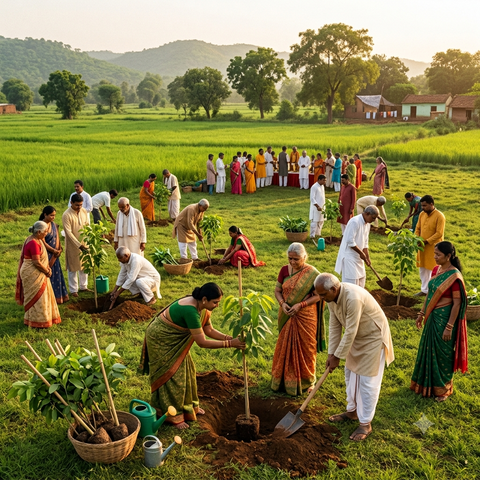
The best native trees to grow near Bhatpara include Banyan, Neem, Peepal, Jamun, Arjun, Mahua, Jackfruit, and Amla — all proven performers in West Bengal's tropical monsoon climate. Planting the right species here can boost local biodiversity and reduce urban heat.
At Grow Billion Trees, our team works hands-on with communities across West Bengal. We have found that native species consistently outperform exotic ones in long-term survival, biodiversity support, and carbon sequestration. Our mission to plant 100 crore trees across India starts with the right tree in the right place — and Bhatpara is a wonderful place to start.
✅ Why Native Trees Are the Right Choice Near Bhatpara
Native trees evolved over thousands of years in the Bengal ecosystem. They are naturally adapted to local rainfall patterns, soil chemistry, and seasonal temperature swings. As a result, they establish faster, survive longer, and require far less maintenance than introduced species.
According to the United Nations Environment Programme's forest conservation initiative, planting native species is among the most effective strategies for restoring degraded land and reversing biodiversity loss. Native forests also sequester carbon more efficiently over their lifespan. This makes them a powerful force in Combating Climate Change Through Collective Action.
Communities near Bhatpara can play a direct role in increasing green cover. West Bengal faces tree loss to urbanisation — making local planting efforts important.
⭐ Top 8 Native Trees to Grow Near Bhatpara
1. Banyan Tree (Ficus benghalensis)
The Banyan is India's national tree and one of the best native trees to grow near Bhatpara. It thrives in alluvial plains, sending aerial roots deep into moist soil. A single mature Banyan shades over 200 square metres and supports more than 80 species of birds, insects, and small mammals. It is a natural cooling station in dense urban neighbourhoods like Bhatpara.
Banyan trees can live for hundreds of years, making them a legacy gift for future generations. However, they need open space to spread their canopy and roots, and require regular watering to establish.
2. Peepal Tree (Ficus religiosa)
The Peepal is one of the few trees scientifically shown to release oxygen round the clock, including at night. It grows fast in the warm, humid conditions of Bhatpara and tolerates compacted urban soils well. Therefore, it is ideal for roadside planting and community green spaces. Our team has documented Peepal trees reaching 15 feet within three years in North 24 Parganas.
3. Neem (Azadirachta indica)
Neem is an air purifier. Its leaves and bark have medicinal properties used in Ayurvedic and modern medicine.
Neem also acts as a natural pest repellent, protecting neighbouring crops without chemical inputs. This makes it especially valuable in the semi-urban agricultural areas surrounding Bhatpara, where small farmers and homesteaders share land with growing neighbourhoods.
4. Jamun (Syzygium cumini)
Jamun, or Indian blackberry, is a beloved fruit tree native to the Bengal plains. It grows in moist lowland soils and along riverbanks — terrain abundant near Bhatpara. The dark, sweet fruit supports local bird species and provides food security for families. Jamun root systems help retain soil moisture, reducing erosion in monsoon-heavy areas.
5. Arjun Tree (Terminalia arjuna)
Arjun trees naturally flourish along riverbanks and suit Bhatpara's riverine landscape. Their deep roots anchor soil along the Hooghly, helping prevent agricultural erosion during heavy rains. The bark is used in traditional medicine.
6. Mahua (Madhuca longifolia)
Mahua is a multi-purpose tree supporting both ecology and rural livelihoods. Its flowers are edible and its seeds yield oil used in cooking and natural cosmetics. Mahua thrives in Bhatpara's tropical conditions and provides nectar for honeybees that help local agricultural pollination.
7. Jackfruit (Artocarpus heterophyllus)
Jackfruit is West Bengal's official state fruit and one of the most sustainable food-producing trees you can grow. A single mature tree yields up to 100 fruits annually, providing both nutrition and income for local families. It grows vigorously in the deep alluvial soils of North 24 Parganas. As a result, it is a happy and practical choice for our agroforestry programs that combine food security with reforestation impact.
8. Amla (Phyllanthus emblica)
Amla, or Indian gooseberry, is one of the most organic and medicinally potent trees native to Bengal. It is proven to improve soil health through leaf litter decomposition and nitrogen cycling. Our team has found Amla particularly effective in mixed-species plantations, where it fills the mid-canopy layer and provides year-round habitat. Its Vitamin C-rich fruit also delivers tangible nutritional benefits to local communities.
💡 How to Plant Native Trees Near Bhatpara: Step-by-Step
Planting native trees is straightforward when you follow the right process. Here is what our experts recommend for the Bhatpara region:
- → Select the right species for your specific site — riverbank zones suit Arjun and Jamun; open areas welcome Banyan and Peepal.
- → Plant during the monsoon (June–August) when rainfall supports fast root establishment without irrigation.
- → Prepare the pit at least 2 feet deep, mixing organic compost to enrich alluvial soil before planting.
- → Water consistently through the first post-monsoon dry season to reduce transplant shock.
- → Use bamboo guards to protect saplings from grazing cattle and foot traffic during the first year.
- → Monitor growth using our GeoTag platform to track your tree's health and location in real time.
When you plant with Grow Billion Trees, we handle everything for you. Our 2-3ft Tree Planting + 3 Years Care + GeoTag package delivers a fully managed planting experience for just ₹299. You can Plant a tree in your Name and watch it grow through our transparent GeoTag technology — a great gift for yourself or someone you love.
✅ The Environmental Impact of Planting Native Trees
The ecological case for native tree planting near Bhatpara is compelling. According to the United Nations Climate Change initiative, a single mature tree absorbs an average of 22 kg of CO₂ per year. Native species amplify this effect because they live longer, grow denser root networks, and support greater biodiversity than exotic alternatives. Every tree planted near Bhatpara contributes directly to India's Net Zero Targets.
The World Wildlife Fund reports that deforestation destroys approximately 10 million hectares of forest globally every year. Planting native trees near Bhatpara is an act of environmental restoration.
Our goal at Grow Billion Trees is to plant 100 crore trees across India by June 2030. Every native tree planted near Bhatpara brings that vision closer to reality. Together, we are Combating Climate Change Through Collective Action — one root, one leaf, one community at a time.
⭐ Why Plant With Grow Billion Trees?
We are a verified, mission-driven environmental organisation with certified planting programs across India. Thousands of customers trust us for transparency, real impact, and reliable care. Here is what makes our service genuinely different:
- ✅ Plant a tree in your Name for just ₹299 — one of India's most affordable green acts
- ✅ 2-3ft Tree Planting + 3 Years Care + GeoTag included in every order
- ✅ Personalised tree certificates for birthdays, memorials, Women's Day, and special gifts
- ✅ Corporate programs to achieve Net Zero Targets with measurable reporting
- ✅ Specialised Miyawaki, Mangrove, and Agroforestry programs across India
- ✅ Trusted by customers across Mumbai, Bangalore, Delhi, Chennai, and Hyderabad
We are glad to work with individuals, families, farmers, and corporates who love this planet and want real, lasting impact. Our partners across West Bengal deliver authentic, guaranteed planting with full accountability from sapling to maturity.
Frequently Asked Questions
What are the best native trees to grow near Bhatpara?
The best native trees to grow near Bhatpara include Banyan, Peepal, Neem, Jamun, Arjun, Mahua, Jackfruit, and Amla. These species thrive in West Bengal's tropical monsoon climate and the alluvial soils of North 24 Parganas near the Hooghly River.
Why are native trees better than exotic species for Bhatpara?
Native trees are adapted to local soil, rainfall, and seasonal conditions, requiring less water and no chemical inputs. They support native wildlife, improve biodiversity, and resist local diseases more effectively. Exotic species can disrupt the local ecosystem and demand more resources to survive.
When is the best time to plant trees near Bhatpara?
The ideal planting window is the monsoon season from June to August. Heavy rainfall helps young saplings establish roots quickly without supplemental irrigation. With proper watering, planting is possible through October before the dry winter sets in.
How does GeoTag technology work for tree planting?
GeoTag assigns each planted tree a unique geographic coordinate tracked via a digital dashboard. When you plant with Grow Billion Trees, you receive real-time access to your tree's location, growth records, and care updates. This guarantees full transparency and verified environmental impact.
Can I plant a tree near Bhatpara as a gift?
Yes, absolutely. Grow Billion Trees offers personalised tree certificates for birthdays, anniversaries, memorials, and special occasions including Women's Day. You can Plant a tree in your Name or dedicate one to a loved one — a meaningful, eco-friendly gift that grows for decades.
What does the ₹299 tree planting package include?
The ₹299 package includes 2-3ft tree planting by trained professionals, three years of ongoing care and monitoring, and GeoTag technology for real-time tracking. A personalised certificate is also provided. This makes it one of the most complete and affordable tree planting programs in India.
How do native trees help India meet its Net Zero Targets?
Native trees absorb CO₂, release oxygen, and cool surface temperatures. A single mature tree sequesters up to 22 kg of CO₂ annually according to the United Nations. Planting dense native forests near urban centres like Bhatpara directly supports India's national climate commitments and Net Zero Targets for 2070.
Are there corporate planting programs available near Bhatpara?
Yes. Grow Billion Trees offers structured corporate environmental programs to help organisations achieve measurable Net Zero Targets. These include large-scale Miyawaki forests, agroforestry initiatives, and urban forestry projects across West Bengal and other Indian states.
What is the Miyawaki method and does it work near Bhatpara?
The Miyawaki method is a Japanese forest restoration technique that plants multiple native species densely together to create a self-sustaining mini-forest within 2–3 years. It works excellently in Bengal's warm, humid climate and can transform as little as 100 square metres into a thriving native ecosystem.
How can I start planting native trees near Bhatpara today?
Visit Grow Billion Trees to explore planting programs, select your native species, and plant your first tree. You can choose from individual, gift, or corporate planting options and receive a verified GeoTag certificate. Every order directly funds reforestation across India.
Grow a Greener Bhatpara — Start Today
Bhatpara's fertile soil, warm climate, and proximity to the Hooghly make it one of West Bengal's most rewarding places to grow native trees. From the majestic Banyan to the healing Neem, each species you plant here will thrive, nurture local wildlife, and help secure a healthier future for your community. We are glad to guide you every step of the way.
Explore the full range of planting programs at Grow Billion Trees and Plant a tree in your Name today for just ₹299. Together, we can transform the landscape around Bhatpara — and bring India's mission of 100 crore trees one root closer to reality.