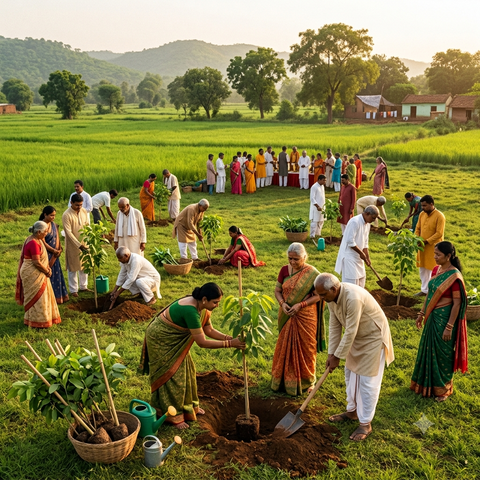
Short answer: India now has a regulated carbon market, the Carbon Credit Trading Scheme (CCTS). Carbon Credit Certificates (CCCs) are issued by the Bureau of Energy Efficiency, held in a registry run by Grid Controller of India, and traded on India's power exchanges under rules set by the Central Electricity Regulatory Commission. Companies can also buy and sell credits in the voluntary market through international standards such as Verra and Gold Standard. Tree planting can earn credits under two approved forestry methods.
Last reviewed: October 2026. Rules are still being rolled out, so check the official sources linked at the end before you act.
Two carbon markets operate in India
India's market has two parts that are easy to mix up:
- The compliance market (CCTS). Large industrial plants in nine sectors have legally binding emission-intensity targets. Plants that beat their target earn CCCs. Plants that miss it must buy and surrender CCCs.
- The offset mechanism. Companies and project developers that have no target can register projects that cut or remove emissions, earn CCCs, and sell them.
Separately, the voluntary carbon market keeps running. Here, projects are certified by international standards such as Verra (VCS) and Gold Standard, and credits are sold directly to companies that want to offset their emissions.
Who runs the Indian carbon market
| Role | Organisation |
|---|---|
| Administrator: sets targets, approves methods, issues CCCs | Bureau of Energy Efficiency (BEE), Ministry of Power |
| Registry: holds accounts and records every CCC | Grid Controller of India (Grid-India) |
| Regulator of trading | Central Electricity Regulatory Commission (CERC) |
| Where CCCs are traded | India's power exchanges (no over-the-counter trading at the start) |
| Environment policy partner | Ministry of Environment, Forest and Climate Change |
Which companies must take part
Emission-intensity targets have been notified for nine sectors: aluminium, cement, chlor-alkali, pulp and paper, iron and steel, fertiliser, petroleum refining, petrochemicals and textiles. The first compliance years are 2025–26 and 2026–27, measured against a 2023–24 baseline. About 740 plants are covered, accounting for over 700 million tonnes of CO₂-equivalent a year.
If your company is not in these sectors, you are not obliged to take part. You can still use the offset mechanism or the voluntary market.
Where carbon credits are traded in India
- CCCs (compliance and offset): on India's power exchanges. CERC finalised the trading regulations in early 2026; reports name Indian Energy Exchange (IEX), Power Exchange India (PXIL) and Hindustan Power Exchange (HPX). Trading runs in scheduled sessions with price discovery by bidding, and accounts are held in the Grid-India registry.
- Voluntary credits (VCS, Gold Standard): sold directly between project developers and buyers, or through brokers and international marketplaces. They are recorded in each standard's own registry.
For current price levels, see our carbon credit price guide.
How to sell carbon credits in India
If you develop a project that reduces or removes emissions, the usual path is:
- Pick an approved method. For the Indian offset mechanism, the project must follow a BEE-approved methodology (see the list below). For the voluntary market, it must follow a Verra or Gold Standard methodology.
- Prepare the project design document. It sets out the baseline, how emissions will be reduced or removed, and how results will be monitored.
- Get it validated. An accredited verification body checks the design.
- Register the project. With BEE through the Indian Carbon Market portal, or with the international standard.
- Monitor and verify. Collect data for each period; the verifier checks the results.
- Receive credits. CCCs are issued into your Grid-India registry account, or voluntary credits into the standard's registry.
- Sell. CCCs on the power exchanges; voluntary credits directly to buyers or through brokers.
How companies buy carbon credits
- Plants with CCTS targets buy CCCs on the power exchanges to cover any shortfall.
- Other companies usually buy voluntary credits to offset emissions they report, for example in BRSR disclosures. Check the latest BEE and CERC rules on whether and how non-obligated buyers can purchase CCCs.
- Before buying, check the credit's standard, the project type, the year the reduction happened (vintage) and the registry record.
Approved offset methods, including tree planting
BEE has approved these methodologies for the Indian offset mechanism:
| Sector | Methodologies |
|---|---|
| Energy | Grid-connected renewable electricity; hydrogen from electrolysis of water; electricity and heat from biomass |
| Industry | Energy efficiency and fuel switching; hydrogen from biogas methane |
| Waste | Landfill methane recovery; flaring or use of landfill gas; compressed biogas |
| Agriculture | Methane recovery from livestock manure; improved rice cultivation |
| Forestry |
BM FR05.001: afforestation and reforestation of degraded mangrove habitats BM FR05.002: afforestation and reforestation of lands except wetlands |
The two forestry methods mean tree-planting projects, including mangroves, can earn CCCs if they meet the method's rules on land, baseline, monitoring and verification.
Where tree planting fits
Trees remove carbon slowly. A plantation earns credits only as the trees grow and survive, and every claim has to be measured and verified. So the projects that work are the ones with:
- suitable, legally clear land and a baseline that can be proved
- species chosen for the site, and care through the early years so trees survive
- tree-level records: location, photos and survival checks over time
Grow Billion Trees runs plantation programmes for companies across 14 states, with 85% of trees surviving across our programmes. Every tree is tracked on our GreenTrack platform. For companies exploring carbon projects, our team can advise on whether a site and programme could suit an approved method. See carbon credits and mangrove restoration.
Frequently asked questions
Is carbon credit trading legal in India?
Yes. The Carbon Credit Trading Scheme was notified under the Energy Conservation Act, and trading of Carbon Credit Certificates is regulated by CERC on India's power exchanges.
What is a Carbon Credit Certificate (CCC)?
A CCC is the unit issued under India's scheme. It represents one tonne of CO₂-equivalent reduced or removed and is recorded in the Grid-India registry.
Can an individual trade carbon credits in India?
The Indian scheme is designed for registered entities: obligated plants and registered project developers. Individuals usually take part only through the voluntary market, for example by offsetting their own footprint.
Can tree plantation projects earn carbon credits in India?
Yes, if they follow an approved method. BEE has approved two forestry methodologies: one for mangrove habitats and one for afforestation and reforestation of other lands except wetlands.
Which exchanges trade carbon credits in India?
CCCs are traded on India's power exchanges under CERC rules. Voluntary credits are traded directly or through international marketplaces and brokers.
Official sources
- Bureau of Energy Efficiency: Indian Carbon Market and approved methodologies
- Central Electricity Regulatory Commission: trading regulations
- ICAP: India notifies emission-intensity targets for nine sectors
Planning a carbon or plantation programme? Talk to our team about sites, methods and tracking.