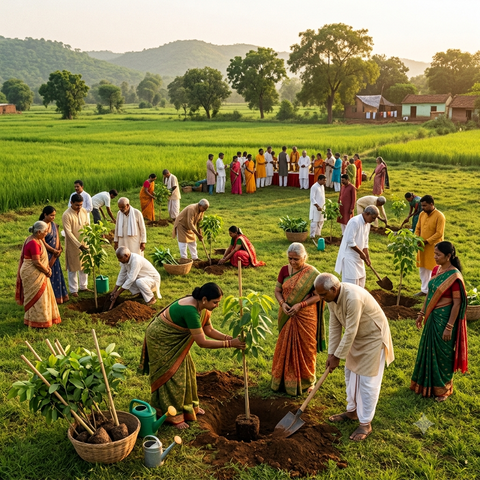
Bamboo Plantation in Assam sustains the state's forests while supporting rural farmers. Assam holds significant bamboo resources. This sustainable crop is important for India's reforestation and rural development.
We have found, through hands-on work with agroforestry and reforestation partners across India, that bamboo is one of the most impactful and eco-friendly choices any farmer or conservationist can make. It matures in just 3–5 years, sequesters carbon at a remarkable rate, and supplies dozens of thriving industries. Assam's fertile alluvial soil and high rainfall make it the natural heart of India's bamboo movement.
✅ Why Assam is India's Bamboo Capital
Assam has diverse bamboo species and contributes to India's bamboo output. According to the United Nations Environment Programme's forests initiative, bamboo forests are critical for biodiversity, watershed protection, and carbon sequestration. Assam's bamboo stands provide significant ecological benefits.
Industries including paper, textiles, construction, furniture, and handloom all draw from Assam's bamboo wealth. Bamboo grows without synthetic pesticides, making it a genuinely organic and natural resource. The plant also regenerates from its roots after harvest, meaning the land never needs to be reploughed or replanted from scratch.
Ecologically, bamboo serves as a natural shield for Assam's communities. It stabilises riverbanks, controls flooding, and supports biodiversity by providing habitat for wildlife. In a state where Brahmaputra floods affect millions annually, bamboo is both a green solution and a lifesaving one.
💡 Economic Impact: How Bamboo Plantation in Assam Uplifts Farmers
For Assam's small and marginal farmers, bamboo can provide income. It is a low-input, high-return crop that improves livelihoods without degrading the land.
Bamboo cultivation is low-cost and low-maintenance. Farmers intercrop bamboo with vegetables, pulses, and spices during early years, earning steadily while the bamboo matures.
The National Bamboo Mission supports bamboo cultivation, with Assam as a priority state. This supports bamboo-based enterprises and creates jobs for artisans, weavers, and bamboo processors. Bamboo handicrafts from Assam — including furniture, baskets, and traditional Japi hats — are exported internationally, adding value to local craft traditions.
⭐ Environmental Benefits: Bamboo and Climate Action
Bamboo is one of the fastest-growing plants on Earth, capable of growing up to 91 cm in a single day. This rapid growth makes bamboo plantations highly effective at Combating Climate Change Through Collective Action. As highlighted by the United Nations Climate Change initiative, nature-based solutions including fast-growing plantations are among the most powerful tools for limiting global warming.
Bamboo helps restore degraded land through rapid growth and carbon sequestration. It is an effective natural solution for land regeneration and environmental benefit at scale.
However, the challenge is immense. WWF's research on deforestation and forest degradation warns that South Asia loses thousands of hectares of forest cover each year to agricultural expansion and development. Bamboo plantation offers a practical and rapid counter-measure, helping communities restore what has been lost while earning a stable income.
Bamboo also improves water retention in the soil, reducing runoff during Assam's intense monsoon rains. This helps recharge groundwater, supports local agriculture, and reduces the severity of flash floods — a triple environmental win for rural communities.
✅ Bamboo and Agroforestry: A Partnership That Thrives
Agroforestry — integrating trees with crops on the same land — is a proven strategy for building sustainable farm systems. Bamboo fits into agroforestry models with ease. Our team has seen how bamboo serves as a windbreak, a shade provider, and a soil enricher for neighbouring food crops in Assam's diverse farming landscapes.
Farmers in Assam's Goalpara, Jorhat, and Sibsagar districts are planting bamboo alongside rice, mustard, ginger, and turmeric. This integrated approach helps them improve soil health while diversifying income streams. Bamboo roots prevent nutrient runoff, keeping farmland fertile for decades without artificial inputs.
Our partners in Assam report that bamboo-integrated farms show greater resilience to climate shocks — including both floods and drought. This resilience is vital in a region facing increasingly unpredictable monsoons due to climate change. In addition, bamboo's fast canopy growth shades out invasive weeds, reducing the labour burden on farming households.
💡 Grow Billion Trees: Supporting Bamboo Plantation in Assam
At Grow Billion Trees, we are proud to support reforestation and agroforestry efforts across India, including bamboo plantation drives in Assam. Our mission to plant 100 crore trees in India by June 2030 includes a strong focus on ecologically valuable native species like bamboo. We love how bamboo delivers both environmental and economic value — it is a plant built for purpose.
We provide 2-3ft Tree Planting + 3 Years Care + GeoTag for every tree planted through our platform. This means you can Plant a tree in your Name and track its real-world growth using verified geolocation technology. Starting at just ₹299, it is an easy, eco-friendly, and impactful way to join India's green movement.
Our certified planting programs are verified, transparent, and secure. We ensure each sapling receives consistent care during its most vulnerable early years. Whether you are an individual marking a birthday, a family honouring a loved one, or a corporate partner working towards Net Zero Targets, we are glad to welcome you into this mission. Every tree planted is a step towards a greener, cooler planet.
⭐ Corporate Opportunities: Reaching Net Zero Through Bamboo
In 2026, over 500 Indian companies have publicly committed to Net Zero goals. Many are now turning to bamboo plantation in Assam for credible, measurable, and certified carbon offsets. Bamboo's rapid carbon absorption and long productive lifespan make it an ideal asset in corporate sustainability portfolios.
Our corporate partners commission large-scale bamboo plantations, receive GeoTag-verified growth data, and generate detailed impact reports for ESG disclosures. This transparent, authentic approach is trusted by leading businesses seeking genuine sustainability credentials. We provide end-to-end support from planting to reporting.
According to the United Nations Sustainable Development Goals, responsible production and climate action are among the most urgent global priorities. Bamboo plantation in Assam directly supports SDG 13 (Climate Action), SDG 15 (Life on Land), and SDG 8 (Decent Work and Economic Growth) — making it one of the most multi-dimensional sustainability investments available today.
✅ How to Get Started with Bamboo Plantation
- Choose your program → Select individual planting, agroforestry, or a corporate package at Grow Billion Trees
- Fund your saplings → Starting at ₹299 per tree with 3 years of dedicated care included
- Track your impact → Receive your personalised GeoTag certificate and monitor growth in real time
- Share your story → Inspire others to join the movement to plant 100 crore trees across India
It is that simple. Every bamboo tree you fund helps save soil, support a farmer's family, and sequester carbon for decades. Together, we can transform India's landscape one bamboo grove at a time. Therefore, there has never been a better moment to act.
Frequently Asked Questions
What is the significance of Bamboo Plantation in Assam?
Bamboo Plantation in Assam is significant because Assam holds substantial bamboo resources. It supports local farmer livelihoods, prevents soil erosion, sequesters carbon, and supplies raw material for paper, textiles, construction, and handicrafts industries.
How much income can a farmer earn from bamboo plantation in Assam?
A farmer with one hectare of bamboo can earn substantial income after the crop matures. Intercropping vegetables and spices during early years provides income while the bamboo grows.
How does bamboo plantation help combat climate change?
Bamboo grows rapidly and is an effective natural carbon capture tool. Bamboo plantation helps restore degraded land.
How can I plant a bamboo tree through Grow Billion Trees?
You can Plant a tree in your Name starting at just ₹299 through the Grow Billion Trees platform. Each tree includes 2-3ft Tree Planting + 3 Years Care + GeoTag technology. You receive a personalised certificate and can track your tree's growth with real-time geolocation data.
What bamboo species are commonly grown in Assam?
Assam hosts over 58 bamboo species. The most common include Bambusa tulda (Jati Bans), used in paper and construction; Dendrocalamus strictus (Male Bamboo), prized for furniture; and Melocanna baccifera (Muli Bamboo), widely used in handicrafts and traditional Assamese goods.
Is bamboo plantation beneficial for soil health?
Yes. Bamboo roots form dense, fibrous networks that prevent soil erosion and improve soil structure over time. Bamboo leaf litter decomposes into rich organic matter, naturally fertilising the land. In Assam, bamboo is especially valuable for stabilising flood-prone riverbanks along the Brahmaputra.
How does bamboo plantation in Assam support corporate Net Zero Targets?
Bamboo plantations offer verified, measurable, and long-term carbon offsets. Companies partnering with Grow Billion Trees receive GeoTag-verified impact data and auditable sustainability reports. This makes bamboo in Assam a credible, authentic choice for businesses committed to achieving Net Zero Targets by 2030 or 2050.
What government schemes support bamboo plantation in Assam?
The National Bamboo Mission is the primary national scheme supporting bamboo cultivation. Assam is a priority state under this mission. It funds plantation drives, processing units, skill development for artisans, and market linkage programmes for bamboo products.
Can bamboo plantation be combined with other crops in Assam?
Yes. Bamboo fits naturally into agroforestry models. Farmers in Assam grow bamboo alongside rice, mustard, ginger, turmeric, and vegetables. This intercropping approach boosts income during the bamboo growth phase, improves soil health, and makes farms more resilient to climate shocks like floods and dry spells.
How does bamboo plantation address deforestation in Assam?
Bamboo grows rapidly on degraded or marginal land without displacing existing forests. It restores soil structure, increases ground cover, and supports biodiversity in areas previously stripped of vegetation. As a result, bamboo plantation is one of the most practical and scalable responses to ongoing deforestation across South Asia.
Conclusion: Grow With Bamboo, Grow With Purpose
Bamboo Plantation in Assam is more than a farming choice — it is a conscious movement for a greener, fairer India. It uplifts farmers, restores ecosystems, and positions Assam as a leader in India's climate action story. In 2026, as urgency around environmental action grows, bamboo offers a proven, scalable, and deeply human path forward.
We are happy to support every individual, family, and organisation ready to be part of this wonderful green revolution. Explore our tree planting programs at Grow Billion Trees and Plant a tree in your Name today — because every bamboo grove planted is a future grown with purpose, care, and hope.
Bamboo plantation with Grow Billion Trees
Companies fund bamboo through CSR as part of agroforestry and restoration programmes, and farmers grow it on their own land and keep the income from the harvest. Every plantation is geo-tagged and tracked on GreenTrack.
- Bamboo plantation for CSR and carbon credits
- Agroforestry programme
- Agroforestry for farmers: register free
- CSR rules for tree plantation
Talk to our team about a programme for your company.