
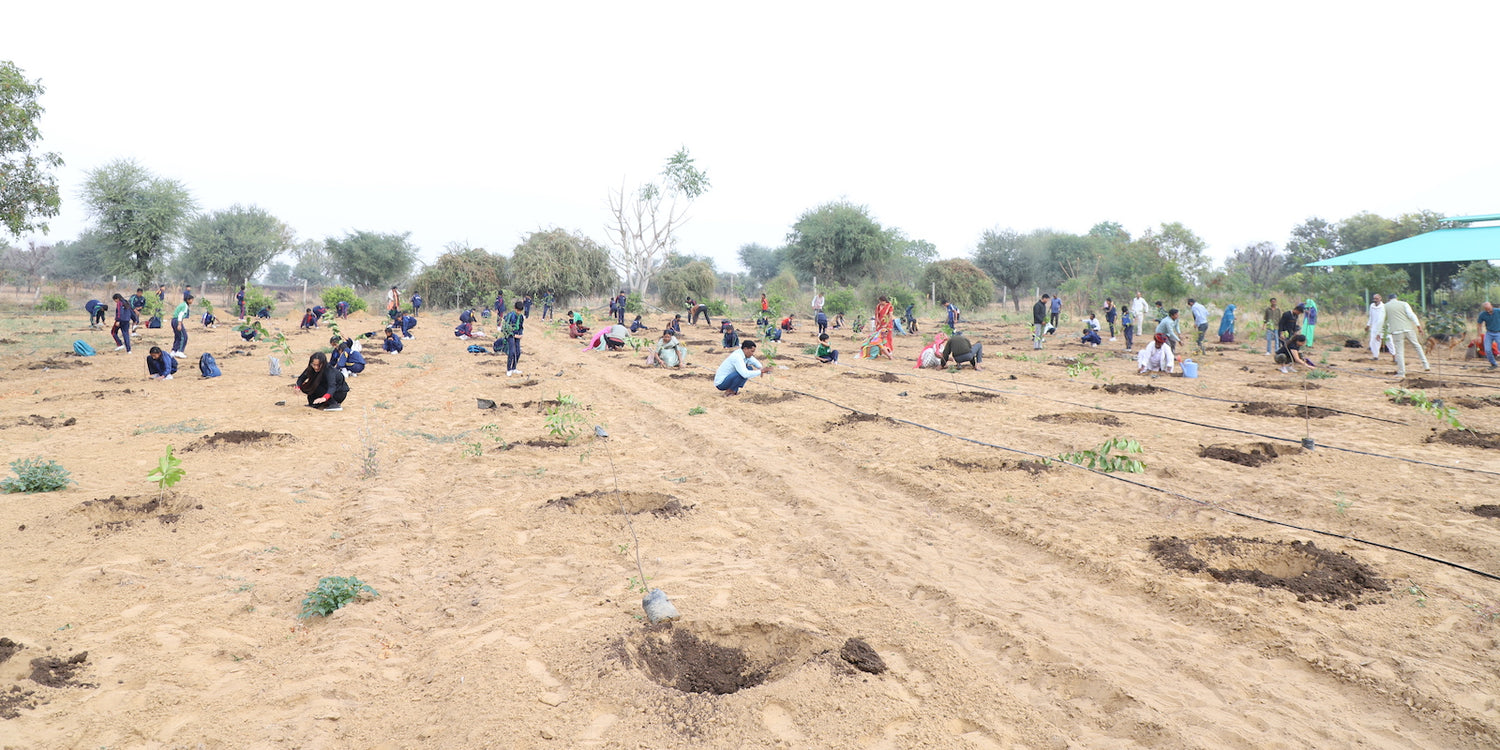
Indian farmers can earn income by participating in carbon credit programs, which compensate landowners for trees planted and maintained on their properties. These projects monetize the carbon dioxide that trees absorb, with payments typically distri Read more
Green Gold: How Indian Farmers Can Earn from Carbon Projects
Indian farmers can earn income by participating in carbon credit programs, which compensate landowners for trees planted and maintained on their properties. These projects monetize the carbon dioxide that trees absorb, with payments typically distributed annually based on verified forestry practices and conservation outcomes.
Carbon Credits for Farmers
Green Gold:
How Indian Farmers
Can Earn from Carbon Projects
A comprehensive guide to agroforestry, carbon credits, and how planting trees on your land can generate income for the next 30 years — per acre, every year.
₹30–35K
Farming income today
per acre/year
per acre/year
₹1–1.5L
With agroforestry
per acre/year
per acre/year
+₹4–5K
Carbon credits bonus
per acre/year
per acre/year
30 yrs
Recurring annual
payments
payments
Imagine planting trees on your land today — and receiving a payment for them every single year for the next 30 years. Not just from the fruit they bear or the timber they hold, but from the very air those trees clean. This is the promise of carbon credits, and for Indian farmers, it has never been more accessible or more real than right now.
India's 140 million farmers are at the centre of one of the world's most exciting new income opportunities. As the country rolls out its Indian Carbon Market (ICM), endorses international certification standards, and allocates ₹20,000 crore to carbon capture in Budget 2026-27, the path from field to carbon credit has become clearer than ever before.
This guide explains everything a farmer or landowner needs to know — in plain language — about how carbon credits work, how much money is really on the table, which trees to plant, and exactly how to get started.
Understanding Carbon Credits
What Is a Carbon Credit — and Why Does It Have Value?
A carbon credit is a certificate that represents the removal of one metric tonne of carbon dioxide (CO₂) from the atmosphere. When your trees absorb CO₂ through photosynthesis and store it in their wood, roots, and soil, that absorbed carbon can be measured, verified by an independent auditor, and converted into a carbon credit that has real financial value.
The reason these credits are worth money is simple: the world's factories, airlines, cement plants, and power stations emit billions of tonnes of CO₂ every year. Governments and corporations around the world have committed to "net zero" emissions — meaning they need to offset what they cannot yet eliminate. They do this by purchasing carbon credits from projects like yours — tree planting, agroforestry, and forest conservation.
The Simple Formula
Your trees absorb CO₂ → That CO₂ is measured and verified → A carbon credit is issued → Industries buy that credit → You receive the payment.
Two Types of Carbon Markets Available to Indian Farmers
Voluntary Carbon Market (VCM): Businesses and individuals buy credits voluntarily to meet self-imposed climate goals. International standards like Verra (Verified Carbon Standard) and Gold Standard govern credit quality and credibility. Prices on the international voluntary market currently range from ₹1,200 to ₹2,500 per tonne, with premium "co-benefit" projects fetching even more.
Indian Carbon Market (ICM): India's official domestic carbon market, which went live on 1 January 2025, operating under the Carbon Credit Trading Scheme (CCTS). Domestic credit prices currently average ₹195–₹500 per tonne but are growing rapidly as market demand increases. Farmers can trade on government-regulated electronic exchanges overseen by the Central Electricity Regulatory Commission (CERC).
The Income Opportunity
How Much Can a Farmer Actually Earn — Per Acre, Per Year?
This is the question every farmer asks first — and rightly so. Here is an honest, grounded breakdown of what the three income streams look like on a per-acre, per-year basis.
Current Income
₹30,000–₹35,000
Conventional Farming
Two crops per year (Rabi & Kharif). Typical paddy, wheat, or soybean cycle. Gross margin ~45–50%.
2–3× Income Uplift
₹1 Lakh–₹1.5 Lakh
Agroforestry Income
Fruit trees (Mango, Jamun, Chickoo, Leechi) + Timber trees (Teak, Mahogany, Acacia). Gross margin ~50–60%.
Bonus — Every Year
₹4,000–₹5,000
Carbon Credit Income
Paid annually for 20–30 years. Your trees do the work automatically. No extra effort once planted.
Total with Agroforestry + Carbon Credits
₹1.04 Lakh – ₹1.55 Lakh per acre per year
To put this in context: the average Indian farmer earns roughly ₹30,000–35,000 per acre per year from conventional two-crop farming. Agroforestry — planting fruit and timber trees alongside or instead of annual crops — can raise this to ₹1 lakh to ₹1.5 lakh. Carbon credits add a further ₹4,000–₹5,000 on top of that, every single year, for the entire crediting period.
"The trees you plant today are not just a crop — they are an asset that pays you every harvest season and also sends you a carbon cheque every year for 30 years."
Detailed Income Comparison: Conventional vs. Agroforestry
| Conventional Farming — Per Acre | |
|---|---|
| Metric | Value |
| Number of Crops | 2 per year |
| Avg. Revenue | ₹60,000–70,000 |
| Gross Margin | ~45–50% |
| Net Profit | ₹30,000–35,000 |
| Agroforestry — Per Acre | |
|---|---|
| Metric | Value |
| Number of Trees | 200–300 |
| Avg. Revenue | ₹2–3 Lakh |
| Gross Margin | ~50–60% |
| Net Profit | ₹1 L–₹1.5 L |
Which Trees to Plant
Best Trees to Plant for Carbon Projects
Not all trees are equal from a carbon perspective. The best approach for Indian agroforestry is to combine fruit-bearing trees (which give you immediate and seasonal income from produce) with timber trees (which build long-term asset value and sequester the most carbon). Here is the updated recommended species list:
🍎 Fruit Trees — Seasonal Income
-
Mango★★★★Fruit income for 40–60 years. India's most planted agroforestry tree. High market demand.
-
Jamun★★★Medicinal fruit, fast-growing, drought-tolerant. Rising health market demand.
-
Chickoo (Sapodilla)★★★★Long-lived, consistent annual fruiting, low maintenance after establishment.
-
Leechi★★★Premium seasonal fruit. Excellent prices in domestic and export markets.
-
Jackfruit★★★★Dual use — food and timber. Very high biomass = high carbon stock.
🌲 Timber Trees — Long-Term Asset + High Carbon
-
Teak★★★★★Premium hardwood, highest carbon density, very long-lived. Best ROI of all timber species.
-
Mahogany★★★★★High-value tropical hardwood. Excellent carbon sequestration rate. Strong export demand.
-
Acacia (Earleaf)★★★★★Extremely fast-growing, nitrogen-fixing. Ideal for degraded and barren land.
-
Neem★★★★Medicinal and pest-repellent. Hardy, drought-resistant. Grows in most Indian soils.
-
Pongamia★★★★★Biofuel + nitrogen-fixing. Thrives on barren, poor soil. Excellent for degraded land projects.
Pro Tip
A proven one-acre model used in Jharkhand's Birsa Harit Gram Yojana scheme plants 112 fruit trees and 80 timber trees per acre — giving you seasonal produce income, long-term timber value, and maximum carbon sequestration from the same land.
India's Policy Framework
India's Government Is Backing You — The Policy Timeline
The policy landscape supporting farmer participation in carbon markets has transformed dramatically over the past four years. Here is the key legislation and framework that makes this opportunity real and reliable:
2022
Energy Conservation (Amendment) Act, 2022
Parliament passed the legal foundation for India's carbon market, empowering the central government to issue Carbon Credit Certificates and establish a national carbon trading framework.
2023
Carbon Credit Trading Scheme (CCTS)
Notified on 28 June 2023. Creates two mechanisms: a mandatory compliance scheme for large industries, and a voluntary offset mechanism open to farmers, NGOs, and individuals. Agriculture and forestry are explicitly included.
2023
Green Credit Programme (GCP)
Notified on 12 October 2023. Provides Green Credits for voluntary tree planting on degraded land, managed by the Indian Council of Forestry Research and Education (ICFRE). Open to individuals, companies, NGOs, and government bodies.
2024
VCM Framework for Agriculture
The Ministry of Agriculture and Farmers' Welfare launches India's voluntary carbon market framework for the agriculture sector in January 2024. Critically endorses Verra's VM0047 (Afforestation/Reforestation) and VM0042 methodologies — giving Indian farmer credits full international recognition and access to premium global prices.
2025
Indian Carbon Market Goes Live
The ICM is officially operational from 1 January 2025. Farmers can now register projects, earn Carbon Credit Certificates (CCCs), and trade them on government-regulated electronic exchanges. The registry is operated by Grid Controller of India Limited (GCIL).
2026
₹20,000 Crore CCUS Budget Allocation
Union Budget 2026-27 allocates ₹20,000 crore for Carbon Capture, Utilisation and Storage. NABARD and Tata Trusts now offer advance financing to carbon farming cooperatives, providing upfront payments against future credit earnings — directly solving the farmer liquidity problem.
Step-by-Step Process
How to Join a Carbon Project: A Step-by-Step Guide
The process is structured but very accessible — especially when you work through an aggregator or FPO. Here is the complete journey from farmer to carbon credit earner:
1
Join Through an FPO, Cooperative, or Aggregator
Individual farmers almost never enter carbon markets alone. The technical complexity and costs of registration, verification, and trading make it impractical for a single person. Instead, join a project run by a Farmer Producer Organisation (FPO), cooperative, NGO, or private aggregator (such as Varaha, Boomitra, or Grow Indigo). These intermediaries pool land from hundreds or thousands of farmers, making the project economically viable and sharing all costs. Even farmers with as little as 1 acre can participate through aggregated projects.
2
Document Your Baseline
Before any credits can be claimed, the current state of your land must be formally recorded. For tree-planting projects, this means: recording current land-use status (fallow, barren, cropland?), creating plantation plans and maps, and documenting what vegetation currently exists. This "before" snapshot is essential — carbon sequestered can only be measured against this baseline. Your FPO or aggregator will handle this documentation.
3
Project Registration on ICM Portal or Verra
The FPO or aggregator prepares a Project Design Document (PDD) — a detailed proposal describing the methodology, expected carbon reductions, monitoring plan, and social co-benefits. This is submitted for registration on the Indian Carbon Market (ICM) portal (managed by BEE) or on an international registry like Verra, depending on which market you target.
4
Validation by an Accredited Carbon Verification Agency (ACVA)
An independent third-party auditor — an Accredited Carbon Verification Agency (ACVA) — reviews the PDD to confirm that the proposed emission reductions are scientifically sound, measurable, and "additional" (i.e., would not have happened without the carbon finance incentive). This validation step ensures global credibility and is a prerequisite for credit issuance.
5
Plant Trees and Monitor Growth
Farmers plant the agreed species on their land according to the approved plan. Monitoring of tree growth, survival rates, and carbon stock is then conducted periodically — typically every 6–12 months — using a combination of field surveys, satellite remote sensing (NDVI analysis), and AI-powered digital MRV (Measurement, Reporting, and Verification) platforms. Companies like Boomitra and Mitti Labs use satellites to verify practices at the individual plot level. You focus on farming — the technology does the measurement.
6
Verification and Credit Issuance
After each monitoring period (typically 1 year), the ACVA conducts a formal audit to verify that the carbon removals are real and match the projections. Once verified, Carbon Credit Certificates (CCCs) — or Verified Carbon Units (VCUs) on international registries — are issued and recorded in the ICM registry or Verra registry.
7
Trading and Payment — Every Year
Credits can be sold on electronic trading platforms regulated by CERC (for domestic ICM credits) or on global exchanges for Verra/Gold Standard credits. Farmers receive payment either directly or through their aggregator. Unlike a one-time crop sale, carbon credits from tree-planting projects generate recurring income for the entire crediting period — often 20 to 30 years — giving you a new annual payment alongside your produce income, every single year.
Land Eligibility
Does Your Land Qualify?
Not all land automatically qualifies for a carbon project. Here are the key requirements:
✔ Land That Qualifies
Fallow / idle land with no trees currently
Degraded or barren agricultural land
Farmland where trees can be added alongside crops (agroforestry)
Land not covered by forest in recent years
Private land with clear ownership documents (Khasra / Patta)
Even 1 acre — when joining through an FPO or aggregator
✖ Land That Does Not Qualify
Land already covered by dense forest or trees
Land where tree planting is already legally mandated
Land without clear ownership or title documents
Projects where crop yield drops by more than 5%
Documents You Will Need
Khasra / Khatoni / Patta (land records) | Aadhaar Card | Bank Account Details | Current photographs of your land | FPO / cooperative membership
Organisations & Contacts
Who to Contact — Your Starting Points
🏛 Government Schemes
Indian Carbon Market (ICM / BEE)
Register offset projects · beeindia.gov.in
Green Credit Programme (GCP)
Tree planting credits · ICFRE / MoEFCC portal
Birsa Harit Gram Yojana — Jharkhand
Carbon finance for tribal farmers · TRIF
UP Agroforestry Scheme
₹10,000 upfront + 30-year credit purchase commitment
NABARD Green Finance
Advance financing for cooperatives · nabard.org
🤝 Private Aggregators
Varaha
80,000+ farmers · 700,000 acres · Pan-India
Boomitra
Verra-registered · Plots from 1 acre · AI-powered MRV
Grow Indigo (Mahyco + Indigo Ag)
'Carbon Kaksha' farmer training · Multiple states
Sow&Reap Agro
Gold Standard certified · 35,000 farmers · Telangana
ITC AgriTech
Carbon-labelled produce · Agroforestry pilots · UP
Challenges & Solutions
Common Challenges — and How to Overcome Them
⚠ Process feels complex
The technical and legal steps — registration, verification, trading — can feel overwhelming for an individual farmer.
The technical and legal steps — registration, verification, trading — can feel overwhelming for an individual farmer.
→
✔ Join an FPO or aggregator
They handle ALL technical, legal, and trading steps on your behalf. You just plant and maintain trees.
They handle ALL technical, legal, and trading steps on your behalf. You just plant and maintain trees.
⚠ First payment is delayed
Carbon credits are only issued after a monitoring period — meaning income can be 1–3 years after planting.
Carbon credits are only issued after a monitoring period — meaning income can be 1–3 years after planting.
→
✔ Seek advance payments
Many state schemes (BHGY, UP) and aggregators now offer upfront advance payments against future credit earnings. NABARD also provides financing.
Many state schemes (BHGY, UP) and aggregators now offer upfront advance payments against future credit earnings. NABARD also provides financing.
⚠ Verification costs money
Third-party ACVA audits and MRV activities have fixed costs that can be prohibitive for a single farmer.
Third-party ACVA audits and MRV activities have fixed costs that can be prohibitive for a single farmer.
→
✔ Pool with 500+ farmers
When hundreds of farmers pool their land in a group project, fixed verification costs are shared across everyone — dramatically reducing the per-farmer burden.
When hundreds of farmers pool their land in a group project, fixed verification costs are shared across everyone — dramatically reducing the per-farmer burden.
⚠ Low domestic credit prices
Domestic ICM prices average ₹195–₹500 per tonne, which is lower than international rates.
Domestic ICM prices average ₹195–₹500 per tonne, which is lower than international rates.
→
✔ Get internationally certified
Verra (VM0047) or Gold Standard certification gives access to international prices of ₹1,200–₹2,500 per tonne — 5–10× the domestic rate.
Verra (VM0047) or Gold Standard certification gives access to international prices of ₹1,200–₹2,500 per tonne — 5–10× the domestic rate.
⚠ Small farmers left out
Some carbon projects have historically favoured larger landholders, excluding small and marginal farmers.
Some carbon projects have historically favoured larger landholders, excluding small and marginal farmers.
→
✔ Choose inclusive programmes
Specifically seek out Boomitra (1 acre minimum), Sow&Reap, Birsa Harit Gram Yojana, and other programmes explicitly designed for small and marginal farmers.
Specifically seek out Boomitra (1 acre minimum), Sow&Reap, Birsa Harit Gram Yojana, and other programmes explicitly designed for small and marginal farmers.
Your Action Plan
Your 8-Step Action Checklist — Start Today
-
1Assess your land. Is it fallow, barren, or currently without trees? If yes, it very likely qualifies for an agroforestry carbon project.
-
2Gather your documents. Collect your land records (Khasra/Patta/Khatoni), Aadhaar card, and bank account details before making contact with any programme.
-
3Find your local FPO. Contact your nearest Farmer Producer Organisation, Krishi Vigyan Kendra (KVK), or District Agriculture Office to ask about active carbon credit programmes in your area.
-
4Research active state schemes. Jharkhand's BHGY, UP's Agroforestry Scheme, Maharashtra, Andhra Pradesh, and Telangana all have active programmes. Eight states now have operational carbon finance markets for farmers.
-
5Contact private aggregators. Reach out to organisations like Varaha, Boomitra, or Grow Indigo who operate in your region. Many have field teams and can visit your land.
-
6Plan your tree species. Work with your aggregator to select a mix of fruit trees (Mango, Jamun, Chickoo, Leechi) and timber trees (Teak, Mahogany, Acacia) appropriate for your region's climate and soil.
-
7Understand the commitment. Carbon projects require you to maintain your trees for 20–30 years. You cannot clear the land or cut down the trees without serious consequences for your credit income.
-
8Review your revenue sharing agreement. Before signing anything, ensure you understand clearly what percentage of carbon credit revenue will come to you versus the aggregator. Reputable programmes provide fully transparent agreements.
Ready to Start Your Carbon Journey?
Grow Billion Trees works directly with farmers across India to plant trees, earn carbon credits, and build lasting income. Our team will guide you through every step.
Talk to Our Team →
Farmers Ask
Frequently Asked Questions
Honest answers to the questions farmers ask most about carbon credits
🌱 Basics: Understanding Carbon Credits
What is a carbon credit in simple language?
A carbon credit is like a receipt that says "this tree absorbed 1 tonne of CO₂ from the air." Factories and companies that pollute the air have to buy these receipts to compensate for their emissions. When your trees absorb CO₂, you get these receipts — and you sell them. The money comes to you. Think of it as a payment for the clean air your trees create.
Who actually pays for the carbon credits?
Large companies and industries — steel plants, cement factories, airlines, oil companies — that emit CO₂ are required or choose to offset their emissions. They buy carbon credits from verified projects like yours. International companies buying Verra-certified credits often pay ₹1,200–₹2,500 per tonne. Domestic industries buying ICM credits pay ₹200–₹500 per tonne currently, with prices rising as the market grows.
Is this scheme from the government? Is it safe and genuine?
Yes — it is backed by the Indian government. The Carbon Credit Trading Scheme (CCTS) was officially notified by the Ministry of Power in June 2023. The Indian Carbon Market (ICM) is managed by the Bureau of Energy Efficiency (BEE) under the Ministry of Power. Trading happens on government-regulated exchanges under oversight of the Central Electricity Regulatory Commission (CERC). The Ministry of Agriculture also launched a dedicated VCM framework for farmers in January 2024. It is genuine, regulated, and growing rapidly.
What is Verra and the Green Credit Programme? Are they different?
They are two separate but compatible systems:
- Verra (VCS / VM0047): The world's most widely used international carbon credit standard. Credits verified under Verra can be sold to companies globally at higher international prices (₹1,200–₹2,500+/tonne). Endorsed by India's Ministry of Agriculture in 2024.
- Green Credit Programme (GCP): India's own domestic voluntary programme for tree planting, managed by ICFRE under MoEFCC. Open to individuals and bodies who plant on degraded forest land. Credits trade on a domestic platform at lower prices but with simpler registration.
💰 Income & Payments
How much money will I actually receive per acre per year?
Here is the honest breakdown per acre per year:
- Conventional farming alone: ₹30,000–₹35,000
- Agroforestry (fruit + timber trees): ₹1 Lakh–₹1.5 Lakh
- Carbon credit bonus on top: ₹4,000–₹5,000 additional per year
- Total combined income: ₹1.04 Lakh–₹1.55 Lakh per acre per year
When will I receive my first payment?
The first carbon credit payment typically comes 1–2 years after planting, once the first monitoring period is completed and credits are verified and sold. However, many state government schemes and private aggregators now provide upfront advance payments or plantation subsidies (such as the UP scheme's ₹10,000 upfront) to bridge this gap. NABARD also offers advance financing to farmer cooperatives against future credit earnings. Once the first payment comes, you receive a new payment every year for the rest of the crediting period.
Do I also keep earning from fruits and timber?
Absolutely — and this is one of the most powerful aspects of agroforestry carbon projects. Carbon credits are a bonus income on top of everything else. You still sell your fruit each season (mango, leechi, jamun, chickoo) at market rates. Your timber trees (teak, mahogany) grow in value every year and can be harvested at the end of the project period for significant lump-sum income. Carbon credits add a reliable annual payment on top of both of these income streams. You never have to choose between carbon income and produce income — you earn all three simultaneously.
Who holds my carbon credit money — and how does it reach me?
Credits are sold on exchanges, and proceeds flow through your FPO, cooperative, or aggregator, who then distributes your share directly to your bank account. The revenue-sharing percentage between you and the aggregator is agreed upon in your contract before you join. Reputable organisations like Varaha, Boomitra, and Sow&Reap provide fully transparent revenue-sharing agreements. Always ask for this in writing and have someone you trust review it before signing.
🌳 Trees & Land
Which trees give the most carbon credits?
Trees that grow large, live long, and produce dense wood sequester the most carbon. The best performers for Indian conditions:
- Teak: Highest carbon density of any Indian timber tree. Long-lived, premium wood value.
- Mahogany: Dense hardwood, very high carbon stock, excellent export value.
- Acacia (Earleaf): Fastest growing of the recommended species. Also nitrogen-fixing — improves your soil.
- Pongamia: High biomass, nitrogen-fixing, and grows on marginal land where other trees struggle.
- Jackfruit: Among fruit trees, produces the largest biomass and therefore highest carbon per acre.
Can I plant trees on my existing agricultural land, or do I need separate land?
You can plant trees directly on your agricultural land using an agroforestry model — which means trees and crops grow on the same land at the same time. Fruit trees like mango, jamun, and chickoo can be planted along the borders or at specific spacings within your field, while you continue growing your annual crops between them. This is actually the recommended approach as it maximises your income per acre without reducing your crop area significantly. The key requirement is that the land must not already have significant tree cover.
I only have 1–2 acres of land. Is it worth it for me?
Yes — absolutely. While a single 1-acre plot cannot support a standalone carbon project (the economics don't work at that scale), you can participate by joining an FPO-aggregated project where land is pooled across hundreds of farmers. Boomitra explicitly enables participation from plots as small as 1 acre, as does the Birsa Harit Gram Yojana scheme in Jharkhand. When pooled together, the fixed costs of verification and registration are shared across all farmers, making participation economically worthwhile even for very small landholders.
Can I cut my trees after a few years to sell the timber early?
No — this is one of the most important things to understand before joining. Carbon credits are issued based on the assumption that your trees will continue sequestering carbon for the full crediting period (typically 20–30 years). If you cut down the trees before that period ends, you may be required to return the credits already issued and paid out, and you lose all future payments. The commitment is long-term. However, you can generally trim, prune, and harvest fruit without affecting your credit status. Speak clearly with your aggregator about what is and isn't permitted before signing any agreement.
📋 Registration & Process
Do I need to register myself on the government website?
Not directly, in most cases. When you join through an FPO or private aggregator, they handle all registration on the ICM portal or Verra registry on your behalf. The aggregator is the "project developer" in the eyes of the market. Your role is to provide your land documents, sign the participation agreement, plant the trees, and maintain them. If you want to register independently, you can do so on the Bureau of Energy Efficiency website (beeindia.gov.in) under the offset mechanism, but this is complex and not recommended without expert support.
How is the carbon absorbed by my trees measured?
Modern carbon projects use a combination of technology and field surveys. Satellites take regular images of your land and measure vegetation density using an index called NDVI (Normalized Difference Vegetation Index). AI systems then calculate how much carbon is being stored based on the tree species, size, and density observed from space. These estimates are periodically validated by on-the-ground surveys by field teams. Companies like Boomitra and Mitti Labs specialise in this satellite + AI verification, which dramatically reduces the cost compared to manual measurement of every tree.
What documents do I need to start?
The basic documents required to participate in any carbon project are:
- Land records: Khasra / Khatoni / Patta — proof that you own or have the right to use the land
- Identity proof: Aadhaar card
- Bank account details: For receiving payments directly to your account
- Current photographs: Of the land in its present state (your aggregator will often help with this)
- FPO membership: Or a signed participation agreement with your aggregator
How do I know a carbon project company is genuine and not a fraud?
This is a very important question. Here is how to verify legitimacy:
- Check registry registration: Ask if the project is registered on the ICM portal (beeindia.gov.in) or on Verra's public registry (verra.org/programs/verified-carbon-standard/). All genuine projects are publicly listed.
- Ask for a written agreement: Reputable aggregators provide a clear written contract specifying your revenue share, rights, and obligations.
- Verify the aggregator: Organisations like Varaha, Boomitra, Grow Indigo, and Sow&Reap have a public track record, published data, and media coverage that you can verify.
- Consult your KVK: Your local Krishi Vigyan Kendra can help verify whether a project is legitimate.
- Never pay upfront fees: Legitimate carbon projects do not ask farmers to pay registration or membership fees. The aggregator bears these costs and recovers them from the credit sale proceeds.
⚠️ Risks & Realities
What are the real risks I should know about?
It is important to be honest about risks:
- Long commitment: You are committing your land for 20–30 years. Make sure you are comfortable with this before signing.
- Market price fluctuation: Carbon credit prices go up and down. The ₹4,000–₹5,000 estimate is based on current domestic prices; actual prices may vary.
- Yield impact: Some agroforestry plantings may affect your crop yields if trees are too dense or poorly spaced. Projects must ensure yield penalty stays below 5% per Verra standards. Work with your aggregator on spacing.
- Natural disaster risk: If trees are destroyed by floods, fire, or disease, you may lose carbon credits for that period. Reputable projects have a "buffer pool" of credits to cover such events.
- Aggregator risk: If a private aggregator company closes or defaults, the project could be disrupted. Choosing well-established, publicly verifiable aggregators reduces this risk significantly.
Will my crop income reduce when I plant trees?
It depends on the planting model. In a well-designed agroforestry system, trees are spaced so that enough light and water reaches your annual crops. Verra's standards require that crop yields must not fall by more than 5% — any project that causes more than 5% yield reduction is not eligible for carbon credits. The UP state scheme, BHGY in Jharkhand, and most reputable aggregators use proven spacing and species combinations that maintain or even improve crop yields through improved soil health. Always ask your aggregator for specific details on the planting density and expected crop impact for your soil type.
What happens to the project after 20–30 years?
After the crediting period ends, you retain full ownership of the land and the trees. The trees themselves represent a significant asset — mature teak and mahogany trees after 25–30 years can be worth lakhs per acre in timber value alone. You may be able to renew the carbon project for another crediting period, continuing to earn carbon credits if the market conditions support it. In any case, the trees and the income from fruit throughout the period, plus the timber at the end, represent a substantial multi-generational wealth-building opportunity.
Does carbon credit income affect my other government farming subsidies?
As of the current policy framework, carbon credit income is treated as agricultural income for tax purposes in India, and it does not automatically affect your eligibility for PM-KISAN, crop insurance, or other standard farming subsidies. However, tax and subsidy rules can change, and you should consult your local bank, FPO, or a tax advisor for the most current guidance specific to your state and circumstances. Grow Billion Trees recommends confirming with your local agriculture department before joining a project.
Frequently Asked Questions
How can Indian farmers earn money from carbon credit projects?
Farmers can earn income by participating in carbon credit programs that compensate landowners for trees planted and maintained on their properties. These programs monetize the carbon dioxide that trees absorb from the atmosphere.
How often do farmers receive payments from carbon credit programs?
Payments from carbon credit projects are typically distributed annually to participating farmers. The annual payment amount is based on verified forestry practices and conservation outcomes achieved on the property.
What do I need to do to join a carbon credit program?
You need to plant and maintain trees on your property according to the program's requirements. Payments depend on verified forestry practices and proper conservation outcomes, so consistent land management is essential.
Who can participate in carbon credit projects?
Landowners with properties suitable for tree planting can participate in carbon credit programs. The programs compensate those who plant and maintain trees that absorb carbon dioxide.
How are carbon credit payments decided?
Payments are calculated based on verified forestry practices and the conservation outcomes your trees achieve. Annual payments reflect the carbon dioxide absorbed by trees on your land over the period.
Connect with us
-
👥 Corporates
If you are looking for:
- 🌲 Tree Plantation Events
- 📊 CSR Projects
📧 corporate@growbilliontrees.com
📞 +91 9699723523
💬 +91 9325931304 WhatsApp (Only)
🕒 Mon - Sat | 10am - 7pm IST
-
🧩 Tree Plantation NGOs
If you are looking for:
- 💰 Financial Assistance
- 🤝 Operational Support
📧 support@growbilliontrees.com
📞 +91 9699723523
💬 +91 9325931304 WhatsApp (Only)
🕒 Mon - Sat | 10am - 7pm IST
-
🌼 Individuals
If you are looking for:
- 👥 Group Tree Plantation Drive
- 🌳 Bulk Tree Plantation
📞 +91 9699723523
💬 +91 9325931304 WhatsApp (Only)
🕒 Mon - Sat | 10am - 7pm IST
