
The IPL Is Planting 500 Trees for Every Dot Ball. Is It Enough?

The IPL Is Planting 500 Trees for Every Dot Ball. Is It Enough?
500 trees per dot ball. 500,000+ trees planted since 2023. The numbers sound impressive — until you hold them against the IPL's true carbon footprint. We ran the full calculation so you don't have to.
dot ball (IPL 2025–26)
campaign began in 2023
a typical IPL season
footprint offset annually
Every time a bowler beats the bat in the IPL, a green tree icon flashes on screens across India. It is a small, beautiful moment — a moment where sport and the planet seem to be pulling in the same direction. Since 2023, the BCCI and Tata Group have committed to planting 500 trees for every dot ball bowled, turning one of cricket's most tactical plays into a live act of environmental commitment. By the start of IPL 2026, over half a million trees had been planted under this programme. Fans are excited. Media have celebrated it. BCCI President Roger Binny personally presided over the planting of the 400,000th tree at the BCCI Centre of Excellence in Bengaluru.
But here at Grow Billion Trees, we do one thing above all else: we count trees honestly. So we asked the question that most coverage has carefully avoided: does the Green Dot Ball campaign actually move the needle on the IPL's carbon footprint? The answer involves some sobering arithmetic — and some genuinely hopeful conclusions, if you know where to look.
"The initiative is part of the BCCI's sustainability drive, transforming one of cricket's most tactical plays into a symbol of regenerative action — ensuring every dot ball contributes to greener landscapes across India."
— BCCI & Tata Group, Green Dot Ball Campaign Statement, 2026How the Green Dot Ball campaign works
The Green Dot Ball initiative was first piloted during the IPL 2023 playoffs. 84 dot balls in a single Qualifier match — between CSK and GT — resulted in 42,000 saplings committed to planting. Its immediate visual impact on broadcasts was striking: the familiar dot on the scorecard was replaced by an animated green tree, a real-time signal to 500+ million viewers that something different was happening.
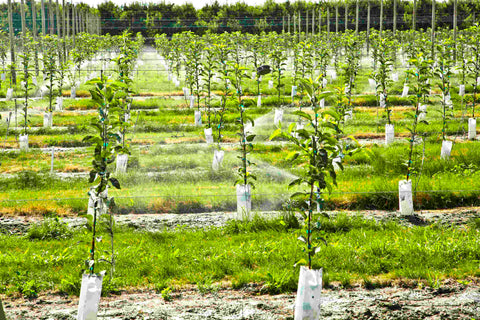
The programme expanded to the full league phase in IPL 2025, dramatically increasing the volume of trees committed. The 2026 edition continued at the same rate — 500 saplings per dot ball — and extended the same initiative to the Women's Premier League (WPL). Plantation sites include urban forests, coastal erosion zones, and a dedicated cricket forest at the BCCI Centre of Excellence in Bengaluru. Ground-level execution involves NGOs and state forest departments, with geo-tagged verification.
The maths: how many trees per season?
Before we can assess the carbon impact, we need to know how many trees the campaign actually produces per season. That means counting dot balls.
In a T20 match, a team faces 120 deliveries. Studies of IPL scoring patterns show that roughly 42–46% of all legitimate deliveries are dot balls — deliveries from which no run is scored. A typical IPL innings of 120 balls produces around 50–55 dot balls. With two innings per match and 74 matches in a season, that gives us a total dot ball count for the entire tournament.
| Parameter | Basis | Figure |
|---|---|---|
| Deliveries per innings | Standard T20 (excl. wides/no-balls) | ~120 |
| Dot ball rate in IPL | Historical IPL scoring data, CricTracker 2025 | ~43–46% |
| Dot balls per innings | 120 × 44% | ~53 |
| Dot balls per match (2 innings) | 53 × 2 | ~106 |
| Total matches per season (IPL 2025) | League stage + playoffs | 74 + 4 = 78 |
| Total dot balls per season | 106 × 78 | ~8,268 |
| Trees pledged per dot ball | BCCI–Tata Green Dot Ball commitment | 500 |
| Total trees pledged per full season | ~4.1 million | |
How much carbon do those trees actually sequester?
Trees are not instant carbon sinks. A freshly planted sapling absorbs almost nothing in its first year. A mature tropical broadleaf tree — Neem, Teak, Pongamia — in Indian conditions absorbs approximately 20 kg of CO₂ per year once it reaches maturity, typically at 7–10 years of age. The IPCC Tier 1 default for tropical broadleaf species gives a range of 15–25 kg/tree/year at maturity.
Here is the carbon sequestration timeline for 4.1 million trees planted in a single IPL season:
| Time horizon | Assumed avg absorption | Annual sequestration | Cumulative CO₂e captured |
|---|---|---|---|
| Year 1–3 (saplings) | ~2 kg/tree/yr | ~8,200 t/yr | ~24,600 t |
| Year 4–7 (growing) | ~10 kg/tree/yr | ~41,000 t/yr | ~164,000 t |
| Year 8–10 (maturing) | ~17 kg/tree/yr | ~69,700 t/yr | ~209,100 t |
| Year 10+ (mature forest) | ~20 kg/tree/yr | ~82,000 t/yr | Ongoing |
| Total carbon captured in first 10 years (one season's trees) | ~397,700 t CO₂e | ||
So: ~400,000 tonnes of CO₂e captured over 10 years if all 4.1 million trees from one IPL season survive and reach maturity. At full maturity, the annual sequestration rate reaches approximately 82,000 tonnes per year — and continues indefinitely if the trees are maintained.
That is genuinely impressive. Those are real forests, real carbon removal, real ecological benefit. But the critical question is how this compares to what the IPL actually emits.
The IPL's actual carbon footprint: the full picture
Here is where the numbers get uncomfortable. The IPL's environmental impact has been measured and modelled across multiple studies. A single IPL match generates approximately 10,000–14,000 tonnes of CO₂e when all sources are included. Across a 74-match season, the total climbs to 750,000–900,000 tonnes CO₂e — a figure that has increased dramatically since the league's first carbon audit in 2010 (which found just 42,264 tonnes), driven primarily by the explosion in digital viewership.
| Emission source | Share of total | Est. tonnes CO₂e/season |
|---|---|---|
| Digital streaming & data centres | >75% | ~600,000–675,000 t |
| Spectator travel (to stadiums) | ~10–12% | ~75,000–108,000 t |
| Stadium operations (electricity, generators) | ~5% | ~37,500–45,000 t |
| Team & franchise travel | ~2–3% | ~15,000–27,000 t |
| Hotels, food, logistics | ~5–8% | ~37,500–72,000 t |
| Total per season (central estimate) | ~825,000 t CO₂e | |
The dominant source is one that most people don't think about: the energy consumed by the devices and data centres through which over 500 million people watch each match. In 2025, JioHotstar reported 1.37 billion total viewership sessions for the season opener alone. Each stream, each device, each data centre ping adds a micro-emission — and at IPL scale, micro becomes massive.
"The emissions generated by sports venues only account for about 5% of the total, whereas digital viewership contributes to more than three-quarters of the total emissions footprint."
— StepChange Earth, IPL Sustainability Analysis, 2023The gap: a direct comparison
Now we can put the two numbers side by side. This is the central question of the blog — and the answer is stark.
The offset gap at a glance
The headline number is this: at full maturity, the trees from one IPL season's Green Dot Ball campaign will sequester roughly 10% of that season's emissions per year. To offset one full season's footprint within a decade, you would need approximately 41 million trees — ten times the current pledge rate.
But there is a crucial caveat that changes the framing entirely: the campaign is cumulative. Every season adds another 4+ million trees. By 2030, if the campaign continues at its current rate, the total planted will approach 20–25 million trees from IPL and WPL combined. As those forests mature through the 2030s, their collective annual sequestration will grow year on year — potentially reaching 400,000–500,000 tonnes per year by 2035. That is beginning to be meaningful.
The survival question: how many trees actually make it?
Every carbon offset calculation for trees carries one uncomfortable asterisk: survival rates. Saplings planted across diverse Indian geographies — coastal erosion zones, degraded urban land, semi-arid regions — do not all survive to maturity. Industry survival rates for large-scale reforestation programmes in India range from 40% to 85%, depending on species selection, soil quality, maintenance commitment, and rainfall patterns.
If we apply a conservative 60% survival rate to the 4.1 million trees pledged per season, the effective tree count falls to approximately 2.5 million mature trees — reducing the annual sequestration at maturity to around 50,000 tonnes. That shifts the offset coverage from 10% to roughly 6% of the seasonal footprint.
This is why at Grow Billion Trees we insist on the three-year care commitment for every tree we plant. Planting is the beginning — maintenance is what creates a forest. A 2-3 ft tree planted today with three years of watering, weeding, and protection has a fundamentally different survival trajectory than a sapling dropped in the ground and forgotten. The BCCI's partnerships with NGOs and state forest departments include post-planting care protocols, but public verification data on survival rates remains limited.
What the campaign is really good at — and what it isn't
The honest answer is that the Green Dot Ball initiative is an outstanding awareness and behaviour-change mechanism, but a limited carbon offset tool — at least at current scale. Here's why both things can be true simultaneously.
Where the campaign wins
The genius of the Green Dot Ball is its emotional architecture. By converting a tactical cricket event — the dot ball — into a visible, real-time environmental act, the BCCI has achieved something that sustainability campaigns typically struggle with: it made climate action feel exciting. When Khaleel Ahmed bowled 119 dot balls in IPL 2025, fans weren't just counting economy rate — they were counting trees. That shift in fan consciousness, multiplied across 500 million viewers, is genuinely priceless.
The campaign has also created institutional accountability at BCCI level. Before 2023, the IPL had no binding environmental commitment tied to live match metrics. The Green Dot Ball changed that. It gives journalists, advocates, and fans a measurable number to hold the BCCI to — and milestones like the 400,000th and 500,000th tree create publicly verifiable proof of delivery. That is not nothing.
Additionally, the plantation geography has been thoughtfully chosen: urban forests in heat-stressed cities, coastal plantations fighting erosion, the dedicated cricket forest at the BCCI Centre of Excellence. These are ecologically strategic, not just symbolically useful.
Where the numbers fall short
The problem is one of scale. The IPL's carbon footprint is overwhelmingly driven by digital streaming and data centres — a source that trees cannot meaningfully address in any realistic timeframe. Even if the BCCI planted 10 times more trees, the structural problem would remain: 75% of the IPL's emissions come from the electricity powering 500 million screens and the servers delivering content to them. The solution to that problem is renewable energy in data centres and telecom infrastructure — not trees.
Trees are deeply valuable for the ecosystems they support, the biodiversity they restore, and the long-term carbon they lock away. But they are slow-acting, subject to survival risk, and fundamentally unable to offset emissions that are happening right now at a rate 10 times faster than even an optimistic sequestration curve. Using trees as the primary climate response for a digital-era sporting event is like trying to bail out a flooding stadium with a cricket water bottle.
What would it actually take to offset the IPL?
To put a number to full carbon neutrality, here is what would be needed across different strategies:
| Strategy | Potential CO₂ reduction | Feasibility |
|---|---|---|
| Switch data centres to 100% renewable energy | Up to 400,000–500,000 t/season | High — JioStar & telecom sector moving this way |
| Transition 50% of TV screens to LED (existing viewers) | ~150,000–200,000 t/season | Medium — viewer behaviour change needed |
| Incentivise public transport to stadiums (85% shift) | ~64,000–92,000 t/season | High — metro cities already have capacity |
| Switch all stadium power to solar | ~30,000–40,000 t/season | High — several stadiums already partial-solar |
| Green Dot Ball trees (at full maturity, cumulative) | ~82,000 t/yr per season's trees | Medium — dependent on survival rates |
The arithmetic is clear: renewable energy for streaming infrastructure alone could eliminate more carbon than any number of trees. The Chinnaswamy stadium in Bengaluru already runs partially on solar. The MCA Stadium in Pune became India's first to run entirely on renewable energy on match days. These are proof points that the transition is possible — and cost-effective at scale.
The bigger opportunity: what the IPL could be
The Green Dot Ball demonstrates that the IPL's leadership understands climate action has a role in cricket. The question is whether they are willing to scale that ambition from symbolic to structural. Three moves would transform the IPL's climate legacy:
1. Mandate clean energy contracts for streaming. JioStar, which holds broadcast rights through 2027, should be required to run IPL streaming on certified renewable energy. This single move would eliminate the dominant source of the IPL's footprint.
2. Set a public carbon budget. No IPL franchise currently publishes its carbon footprint. The BCCI should require all 10 teams to measure, disclose, and reduce their Scope 1, 2, and 3 emissions — the same standard applied to listed companies under India's BRSR framework.
3. Scale the Green Dot Ball to match the ambition. At current rates, the campaign plants trees equivalent to approximately 0.5% of the IPL's total footprint each year. Doubling the tree pledge rate, improving survival verification, and extending the programme to IPL-adjacent events (auctions, training camps, practice matches) would materially improve the numbers.
Cricket — India's most-watched sport — has a unique platform to normalise climate action for 500 million people. That is an opportunity that goes far beyond any carbon accounting spreadsheet. The Green Dot Ball is one of the most creative pieces of climate communication in Indian sports history. It deserves to be backed by the structural ambition that matches its creative brilliance.
Be part of the green innings
Every tree we plant is geo-tagged, cared for 3 years, and tracked. Plant yours today.
Plant a Tree @ ₹299 Corporate Bulk PlantingFrequently asked questions
How many trees does the IPL plant per dot ball? +
How many trees have been planted under the Green Dot Ball campaign? +
How many dot balls are bowled in a full IPL season? +
How much carbon do the Green Dot Ball trees sequester? +
Is the Green Dot Ball campaign enough to offset the IPL's carbon footprint? +
What is the biggest source of the IPL's carbon emissions? +
How does tree survival rate affect the carbon calculation? +
What else should the IPL do to reduce its carbon footprint? +
How many trees would fully offset the IPL's carbon footprint? +
How can fans contribute to the IPL's green mission? +
Further reading: The Hidden Carbon Cost of IPL — What One Franchise Leaves Behind


Leave a comment